Table of Contents
Context
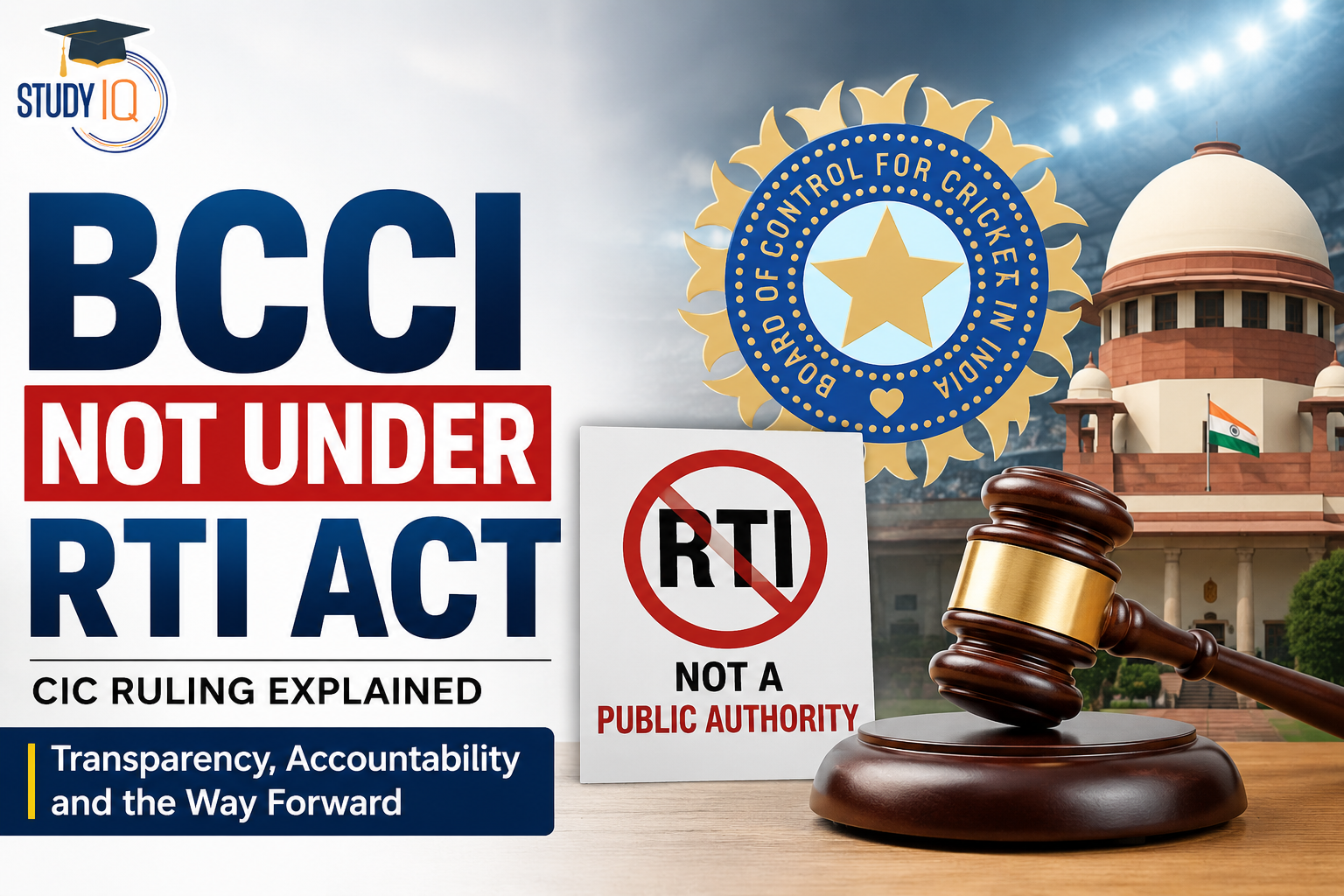
The Central Information Commission (CIC) recently ruled that the Board of Control for Cricket in India (BCCI) does not qualify as a “public authority” under the RTI Act, 2005. As a result, the BCCI cannot be legally compelled to disclose information through RTI applications.
Read Also: UPSC Daily Current Affairs 2026
Legal framework
- Section 2(h) of the RTI Act, 2005: It defines a “public authority” as any institution or body established by:
- The Constitution
- Parliamentary law
- State law
- Government notification/order.
- The definition also extends to bodies that are Government-owned, Government-controlled, substantially financed by the government, or NGOs receiving substantial public funding.
- Article 12 of the Constitution: Defines the term “State” for the enforcement of Fundamental Rights. It includes governments and authorities functioning under government control.
- Although courts have acknowledged that the BCCI performs functions of public importance, it has not been recognised as “State” under Article 12.
- National Sports Governance Act, 2025: The National Sports Governance Act, 2025 states that sports bodies receiving government grants may fall under RTI obligations, but only regarding the use of such funds.
Important Supreme Court judgments
- Zee Telefilms Ltd. v. Union of India (2005): The Supreme Court ruled that the BCCI is not a “State” under Article 12 because it is neither financially nor administratively dominated by the government.
- This judgment formed the constitutional basis of the CIC’s reasoning.
- Thalappalam Service Cooperative Bank Ltd. v. State of Kerala (2013): The Court clarified that “control” under Section 2(h) means substantial and pervasive control, not ordinary regulation or supervision.
- The CIC relied on this principle to conclude that the BCCI is outside RTI coverage
- BCCI v. Cricket Association of Bihar (2016): In this case, the Supreme Court introduced governance reforms through the Lodha Committee recommendations.
Lodha Committee and Law Commission recommendations
- Lodha committee: Suggested major governance reforms for the BCCI, including:
- Tenure restrictions,
- One-state-one-vote policy,
- Conflict-of-interest regulations,
- Structural reforms.
- The Law Commission’s 275th Report (2018): Recommended bringing the BCCI under the RTI Act due to its role resembling that of a National Sports Federation.
Key concerns
- Accountability Deficit: The BCCI controls Indian cricket and selects national players, yet citizens cannot seek information from it through RTI.
- Transparency Issues: Matters related to player selection, governance, finances, and conflict-of-interest policies may remain beyond public scrutiny.
- Public Importance of Cricket: Cricket holds enormous national significance in India and involves widespread public participation and emotional investment.
- Gaps in Existing RTI Law: The case exposes limitations in the RTI framework when dealing with influential private bodies performing public functions.
- Need for Clear Legislation: There is growing demand for a legal framework determining whether private organisations exercising national-level public responsibilities should follow transparency norms.
Way forward
- The BCCI could voluntarily disclose information such as audited accounts, governance decisions, and selection procedures.
- Parliament may design a balanced transparency mechanism specifically for sports bodies performing public functions.
- Governance reforms should preserve institutional autonomy while ensuring accountability.
- The government should encourage minimum disclosure standards without excessive interference.
- India may consider a separate sports transparency framework for major sporting institutions instead of treating them as government bodies.
|
Read More Notes |
|
| Environment Notes | Art and Culture Notes |
| Science and Tech | History Notes |
| Geography Notes | Indian Polity Notes |
| General Knowledge | International Relation |
|
Explore StudyIQ Courses |
|
 Circular Economy in India: Benefits, Cha...
 EPFO Wage Ceiling Hike 2026: Social Secu...
 Daily Mains Articles 2026 – Updated Da...













 WhatsApp