
Table of Contents
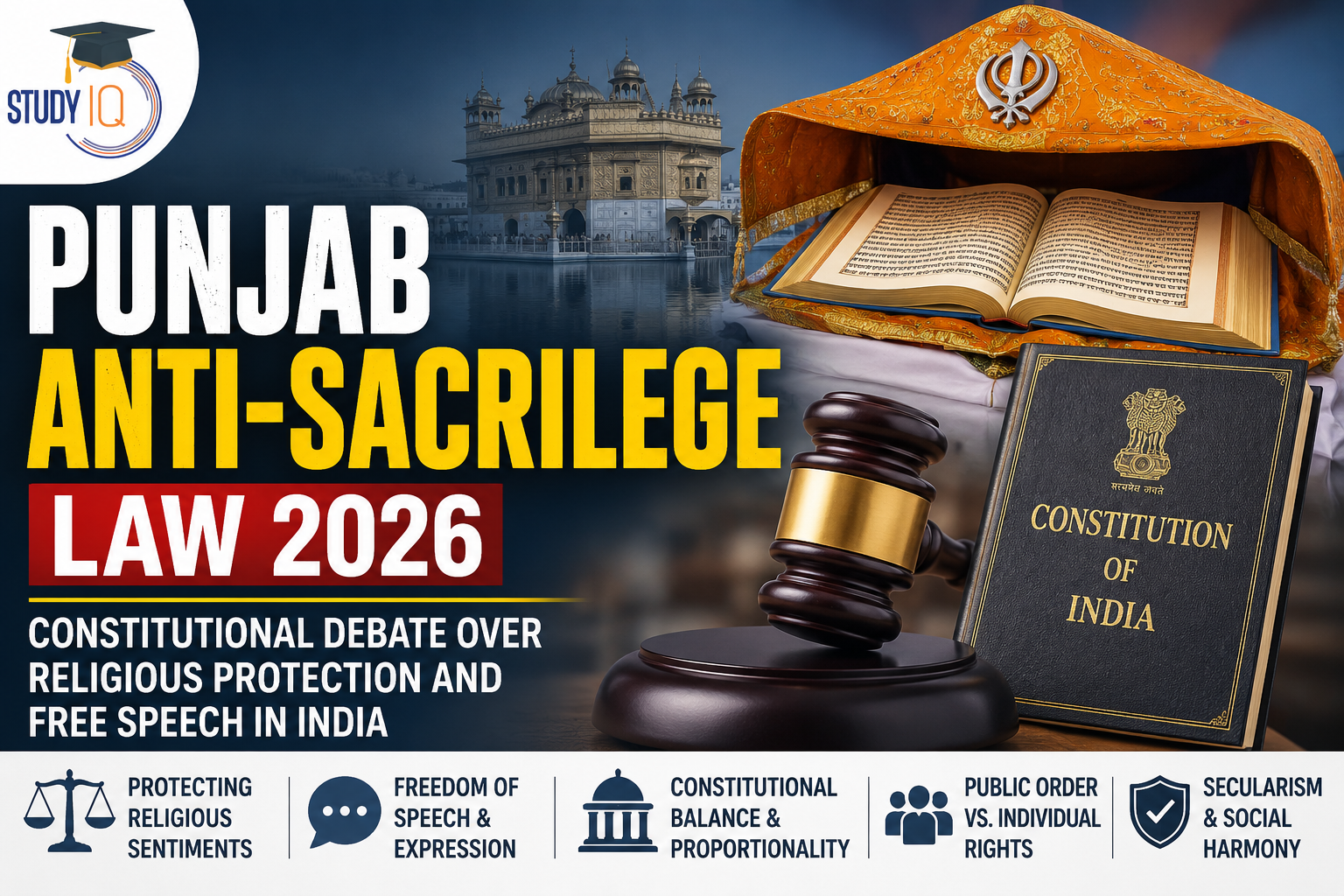
The Punjab government’s enactment of the Jaagat Jot Sri Guru Granth Sahib Satkar (Amendment) Act, 2026, marks one of the most significant legislative interventions in recent years concerning the protection of religious sentiments in India. The law, which prescribes stringent punishments including life imprisonment for acts of sacrilege against the Guru Granth Sahib, has generated widespread public support in Punjab while simultaneously inviting serious constitutional debate.
The legislation emerges from a deeply sensitive social and political context. For the Sikh community, the Guru Granth Sahib is not merely a religious scripture but is revered as the eternal Guru. Consequently, incidents of desecration have historically provoked intense public outrage and have often been viewed not simply as criminal acts, but as attacks upon collective religious identity and social harmony. The enactment of the Amendment Act reflects the State’s attempt to address long-standing public demands for stronger penal measures following repeated incidents of beadbi, particularly after the 2015 Bargari sacrilege controversy that profoundly affected Punjab’s political and social landscape.
Read Also: Judiciary Current Affairs
Legislative Background and Evolution of the Law
The parent legislation, namely the Jaagat Jot Sri Guru Granth Sahib Satkar Act, 2008, was originally enacted to ensure respect and proper custody of the Guru Granth Sahib. However, over the years, the penal framework under the Act was increasingly perceived as inadequate in dealing with incidents of sacrilege.
Responding to sustained public pressure and religious demands, the Punjab Cabinet approved the Amendment Bill in April 2026, following which a special session of the Punjab Vidhan Sabha unanimously passed the legislation. The Governor subsequently granted assent, and the law was brought into force immediately through official notification.
The enactment also carried political and social significance. The issue of sacrilege had remained emotionally charged in Punjab for over a decade, and the law was projected by the State government as a decisive response to public sentiment demanding stricter punishment for offenders.
Salient Features of the Punjab Anti-Sacrilege Law
The Amendment Act substantially expands both the scope and severity of the earlier law. It introduces a broad definition of sacrilege, covering any wilful and deliberate act intended to desecrate the Guru Granth Sahib. Such acts include damaging, burning, tearing, defacing, theft, or destruction of any Saroop or part thereof.
Importantly, the law extends beyond physical acts and incorporates speech, writings, visible representations, signs, and electronic communication where such acts are capable of hurting the religious feelings of persons professing the Sikh faith.
The legislation prescribes severe punishments:
- Basic sacrilege offences attract imprisonment ranging from seven to twenty years, along with substantial fines.
- Cases involving conspiracy aimed at disturbing communal harmony may result in life imprisonment.
- Attempts to commit sacrilege are independently punishable.
- The law additionally provides for confiscation of the convict’s property upon conviction.
Apart from criminal sanctions, the Act establishes a regulatory framework assigning the Shiromani Gurdwara Parbandhak Committee (SGPC) responsibility for maintaining a Central Register concerning the printing, storage, and distribution of Saroops.
Constitutional Framework and State Interest
The State possesses a legitimate constitutional interest in preserving public order and preventing communal disharmony. Under the constitutional scheme, maintenance of law and order remains one of the primary responsibilities of the State government.
India’s conception of secularism does not imply indifference towards religion. Rather, constitutional secularism seeks to maintain principled neutrality while ensuring peaceful coexistence among religious communities. In a society where religion continues to play a central social role, deliberate acts of desecration may trigger serious disturbances affecting public tranquility and communal harmony.
The Punjab government has defended the legislation on this basis, arguing that the law seeks not merely to protect a religious scripture, but also to preserve social stability and prevent communal unrest.
Freedom of Speech and Expression: Constitutional Concerns
Despite its stated objectives, the legislation raises serious constitutional concerns, particularly in relation to Article 19(1)(a) of the Constitution, which guarantees freedom of speech and expression.
The expansive definition of sacrilege under the Act includes spoken words, written communication, signs, and electronic representations capable of hurting religious sentiments. Such broad language may potentially criminalize legitimate criticism, academic discourse, satire, theological disagreement, or historical analysis relating to religion.
The Supreme Court has repeatedly emphasized that constitutional protection extends not only to popular speech but also to speech that may offend sections of society. In Shreya Singhal v. Union of India, the Court invalidated vague statutory language that created a chilling effect on free expression. Similarly, in S. Rangarajan v. P. Jagjivan Ram, the Court observed that freedom of expression cannot be suppressed merely because certain groups perceive an idea as offensive.
The phrase “hurt religious feelings” has historically generated interpretive difficulties in Indian criminal law. Unless narrowly interpreted by courts, such terminology risks subjective application and misuse.
Article 25 and the Question of Religious Freedom
The law also intersects with Article 25 of the Constitution, which guarantees freedom of conscience and the free profession, practice, and propagation of religion.
While Article 25 protects religious practices, constitutional courts have consistently held that the State cannot privilege one religion in a manner inconsistent with constitutional equality and secularism. Since the legislation specifically protects the Guru Granth Sahib with extraordinary penal consequences, questions may arise regarding equal treatment and constitutional neutrality.
However, defenders of the law argue that Punjab’s unique historical and demographic circumstances justify specialised legislation intended to address a particular social concern affecting the State.
Proportionality of Punishment and Criminal Jurisprudence
Another major issue concerns the proportionality of punishment prescribed under the legislation. The doctrine of proportionality has emerged as a central principle of constitutional adjudication under Articles 14 and 21.
The prescription of life imprisonment for sacrilege-related offences may invite judicial scrutiny regarding whether the punishment bears a rational relationship to the gravity of the offence. Critics argue that while acts of sacrilege undoubtedly affect religious sentiments and public order, equating such offences with crimes warranting life imprisonment may appear excessive within the framework of criminal jurisprudence.
Indian constitutional courts have increasingly recognized that punishments must not be arbitrary or manifestly disproportionate. The judiciary may therefore examine whether the severity of punishment under the Act satisfies constitutional standards of fairness and reasonableness.
Legislative Competence and Federal Concerns
The constitutional challenge before the Punjab and Haryana High Court also raises questions regarding legislative competence.
Criminal law falls within the Concurrent List under the Seventh Schedule of the Constitution, permitting both Parliament and State Legislatures to enact laws on the subject. However, where a State law creates inconsistency with existing central legislation, constitutional complications may arise under Article 254.
The Punjab government has maintained that the Amendment merely modifies an existing State enactment and therefore remains within the legislative competence of the State. Nevertheless, the issue of repugnancy and the necessity of Presidential assent may become important questions during judicial review.
Judicial Review and the Future of the Law
The constitutional validity of the Punjab Anti-Sacrilege Law is now likely to be tested through judicial scrutiny before the Punjab and Haryana High Court. The Court will be required to balance competing constitutional interests:
- protection of religious sentiments,
- preservation of public order,
- freedom of speech and expression,
- religious liberty,
- and constitutional proportionality.
The judiciary’s approach may ultimately determine the permissible constitutional limits of faith-based penal legislation in India. Courts may uphold the law entirely, read down certain provisions through restrictive interpretation, or invalidate portions found inconsistent with fundamental rights.
The controversy surrounding the legislation illustrates the continuing constitutional tension between collective religious sensitivities and individual freedoms in a plural democracy.
Conclusion
The Punjab Anti-Sacrilege Law represents a significant assertion by the State on an issue deeply connected with religious identity, social harmony, and public sentiment. The legislation attempts to address longstanding demands for stronger protection against acts perceived as attacks upon the Sikh faith. At the same time, it raises substantial constitutional concerns regarding free speech, proportionality, secularism, and legislative competence.
The ultimate constitutional fate of the law will depend upon judicial interpretation and the manner in which courts reconcile the competing values of religious protection and individual liberty. Regardless of the outcome, the litigation surrounding the Act is likely to become an important chapter in the evolution of Indian constitutional jurisprudence concerning the relationship between faith, criminal law, and fundamental rights.
 Supreme Court Dowry Enforcement Order 20...
 Supreme Court Modifies 3-Year Practice R...
 Doctrine of Per Incuriam Explained: Supr...







 WhatsApp





