
Table of Contents
Context: The War Powers Act limits Trump’s unilateral ability to continue the war without Congressional approval.
About War Powers Act
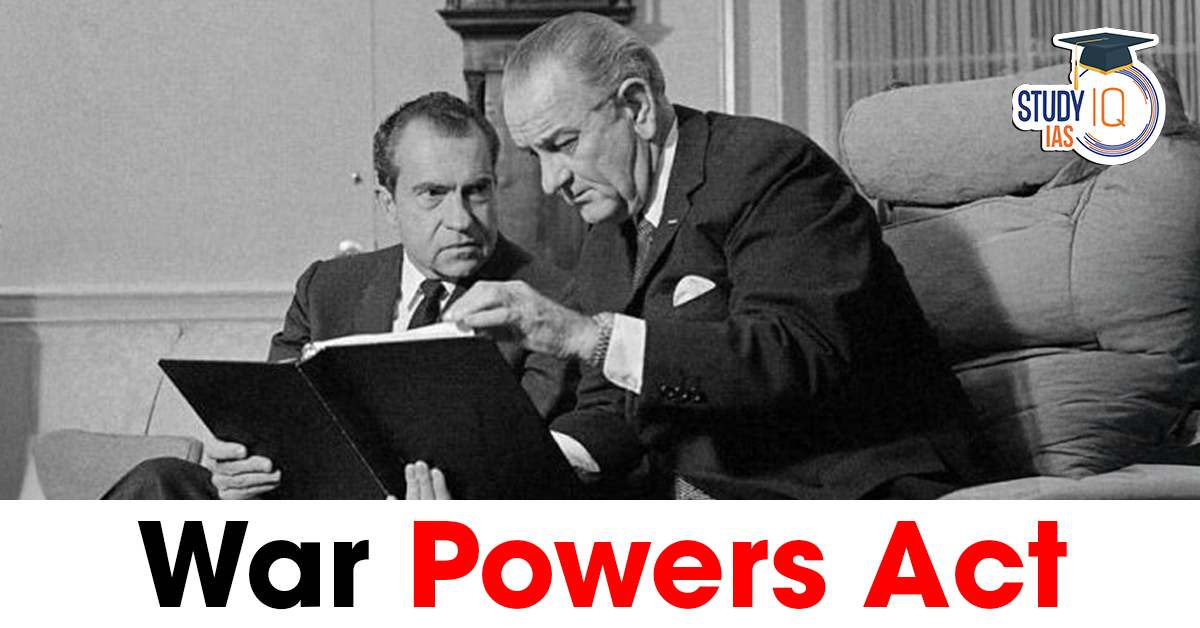
- Origin & Purpose: The War Powers Resolution (1973) was enacted to curb excessive presidential power in war-making (e.g. after the Vietnam War, where President Nixon engaged in conflict without Congress’s approval).
- Constitutional Balance: It aims to ensure shared war authority between the President and Congress (Congress declares war; the President acts as Commander-in-Chief).
- Mandatory Consultation: The President must consult Congress before deploying troops abroad whenever possible (e.g. intended to avoid unilateral decisions like Cambodia operations).
- 48-Hour Reporting Rule: The President must inform Congress within 48 hours of military deployment
- 60-Day Limit: Military engagement must end within 60 days unless Congress authorises continuation (core legal restriction on prolonged wars).
- 30-Day Extension Clause: The President can extend operations by 30 additional days for safe withdrawal.
Ambiguity in Practice
- Deadlines and interpretations remain disputed (e.g. debate whether the ceasefire period counts towards 60 days).
Options for Trump
- Seek Congressional Approval: Comply with the Act by getting formal authorisation to continue military action.
- Withdraw Military Forces: End or scale down operations within the deadline.
- Use 30-Day Grace Period: Extend involvement temporarily for orderly withdrawal of troops and assets (not for escalation but for exit strategy).
- Circumvent the Act (Past Precedent): Ignore or reinterpret provisions (e.g. Trump in Yemen 2019; earlier Presidents like Nixon or Barack Obama in Libya bypassed Congress).
- Exploit Legal Ambiguities: Argue over timeline definitions or ceasefire exclusions to delay compliance (e.g. debate over whether ceasefire counts in 60-day limit).

 Skyroot Vikram-1 Mission Aagaman: India'...
 Oor Pare Prehistoric Site: Location, Roc...
 Assam Election 2026: Exit Poll, Result D...














 WhatsApp





