Table of Contents
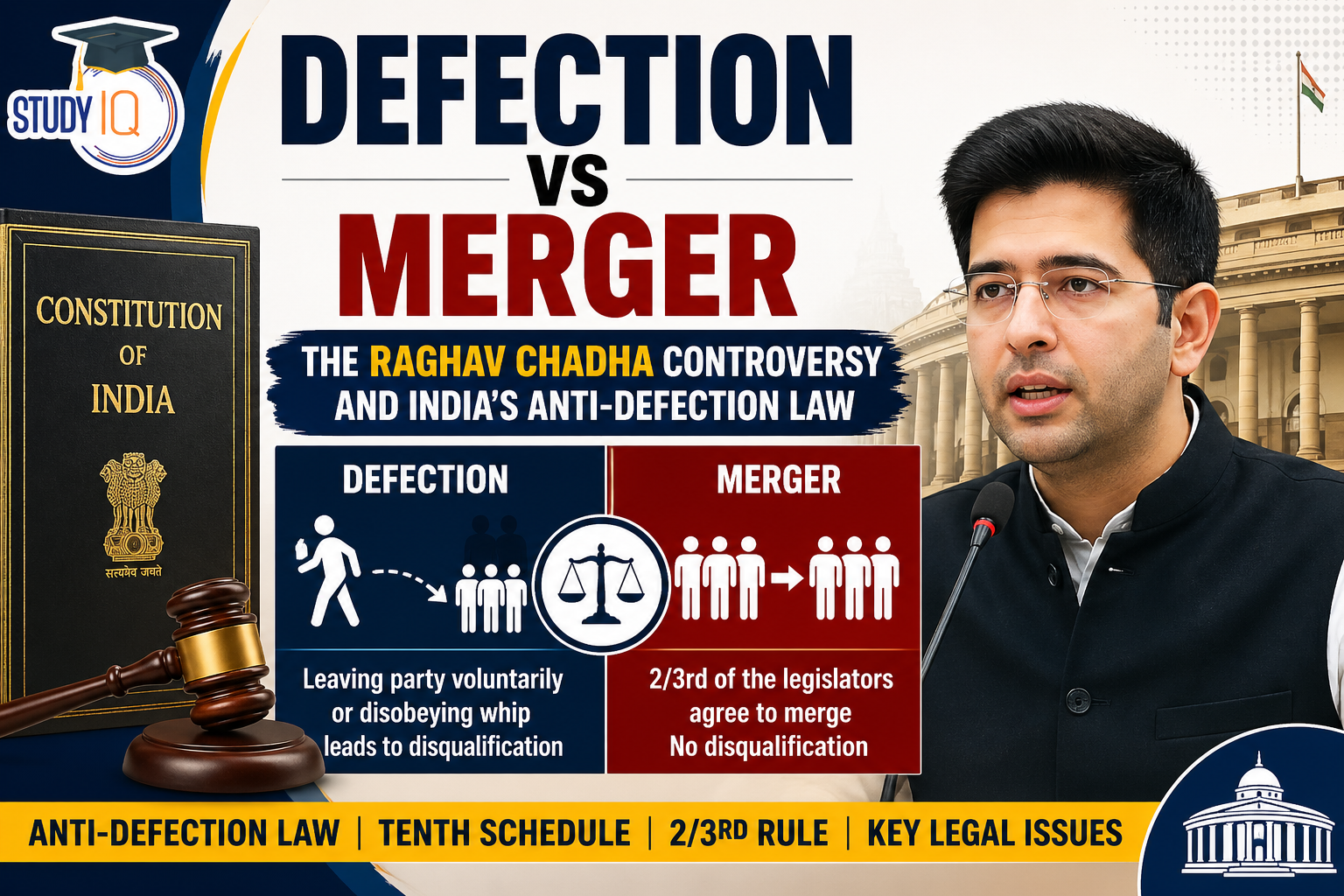
India’s parliamentary democracy depends on party discipline, stable governments, and constitutional ethics. Yet, political defections continue to test this framework. The ongoing debate around Defection vs Merger, highlighted by the controversy involving Raghav Chadha, has brought renewed focus to the Anti-Defection Law under the Tenth Schedule.
This article explains the constitutional provisions, legal interpretation, and real-world implications of defection and merger in India.
UPSC Daily Current Affairs 2026
What is Defection?
Defection occurs when:
- A legislator voluntarily gives up party membership
- Or votes against the party whip
Constitutional Basis
- Governed by Tenth Schedule (1985)
- Introduced through the 52nd Constitutional Amendment Act
Grounds for Disqualification
- Leaving the party voluntarily
- Voting/abstaining against the whip
- Joining another party after the election
Supreme Court view:
Even conduct outside the House can indicate defection.
What is Merger?
Merger is a constitutional exception to disqualification.
Provision (Para 4, Tenth Schedule)
No disqualification if:
- 2/3rd members of the legislature party agree to merge
Key Idea:
- Must be a collective and genuine political merger, not opportunistic shifting
Defection vs Merger: A Comparative Analysis
| Basis | Defection | Merger |
|---|---|---|
| Nature | Individual or small group | Collective shift |
| Legal Status | Leads to disqualification | Protected |
| Threshold | Not required | Minimum 2/3rd |
| Intent | Political opportunism | Structural political change |
| Constitutional Validity | Violates Tenth Schedule | Allowed under Para 4 |
Key Insight:
The distinction is not just numerical—it is also about intent and legitimacy.
Constitutional Framework of Anti-Defection Law
1. Tenth Schedule
- Added in 1985
- Aims to ensure stability of governments
- Prevents unethical party switching
2. 91st Constitutional Amendment (2003)
- Removed 1/3rd split provision
- Strengthened anti-defection framework
3. Adjudicating Authority
- Speaker (Lok Sabha) / Chairman (Rajya Sabha)
- Currently, Rajya Sabha decisions lie with Jagdeep Dhankhar
4. Judicial Review
- Established in Kihoto Hollohan vs Zachillhu (1992)
- Supreme Court held:
- Speaker’s decision = Quasi-judicial
- Subject to judicial review
Legislature Wing vs Organizational Wing Debate
This distinction lies at the heart of the Defection vs Merger controversy.
Legislature Wing
- MPs/MLAs inside Parliament or Assembly
Organizational Wing
- Party leadership, workers, structure
Critical Constitutional Question: Can legislators alone decide a merger?
Constitutional Interpretation:
- A valid merger must involve the political party as an organization
- Not just the legislature wing
Example:
- If leaders under Arvind Kejriwal do not approve → The merger claim becomes constitutionally questionable
The Raghav Chadha Controversy: Legal Strategy or Loophole?
The controversy involving Raghav Chadha highlights how political actors may use constitutional provisions strategically.
Key Features of the Case
- A group of MPs claims 2/3rd majority
- Labels the move as a “merger” instead of defection
Why “Merger” is Preferred?
- Avoids disqualification under Tenth Schedule
- Bypasses scrutiny of Election Commission of India
Comparison with Maharashtra Cases
- Shiv Sena/NCP disputes → “Real party” claim
- Present case → “Merger claim”
Insight:
This reflects a shift from identity-based disputes to numerical legality-based strategies.
Loopholes in the Anti-Defection Law
1. No Time Limit for Decision
- Speaker/Chairman can delay rulings indefinitely
- Leads to ineffective enforcement
2. Political Bias
- Presiding officers often belong to political parties
- Raises concerns about neutrality
3. Misuse of Merger Clause
- 2/3rd rule used as a technical shield
- Even without genuine party merger
4. Weak Enforcement Mechanism
- Judicial review takes time
- Members often complete tenure before decision
5. Ambiguity in “Merger”
- Constitution does not clearly define:
- Organizational consent
- Nature of merger
Judicial Insights & Interpretations
Kihoto Hollohan Case (1992)
- Validated Anti-Defection Law
- Allowed judicial review
Other Key Observations
- Courts emphasize constitutional morality
- Focus on intent, not just numbers
Conclusion: Spirit vs Letter of Law
The Defection vs Merger debate, especially in the context of Raghav Chadha, reveals a fundamental tension:
Letter of Law
- 2/3rd majority allows merger
Spirit of Law
- Prevent opportunistic defections
Ground Reality:
- Political actors exploit grey areas
- Legal loopholes weaken constitutional intent
Way Forward: Reforming the System
To strengthen the Anti-Defection framework:
- Introduce time-bound decisions (as suggested by courts)
- Establish independent tribunal instead of Speaker
- Clearly define “merger” (including organizational consent)
- Promote constitutional morality over technical legality
 Three New Indian Heritage Sites on UNESC...
 Typhoon Champi Hits East Asia: Impact on...
 Agrivoltaics in India 2026: 10% of Suita...













 WhatsApp