Table of Contents
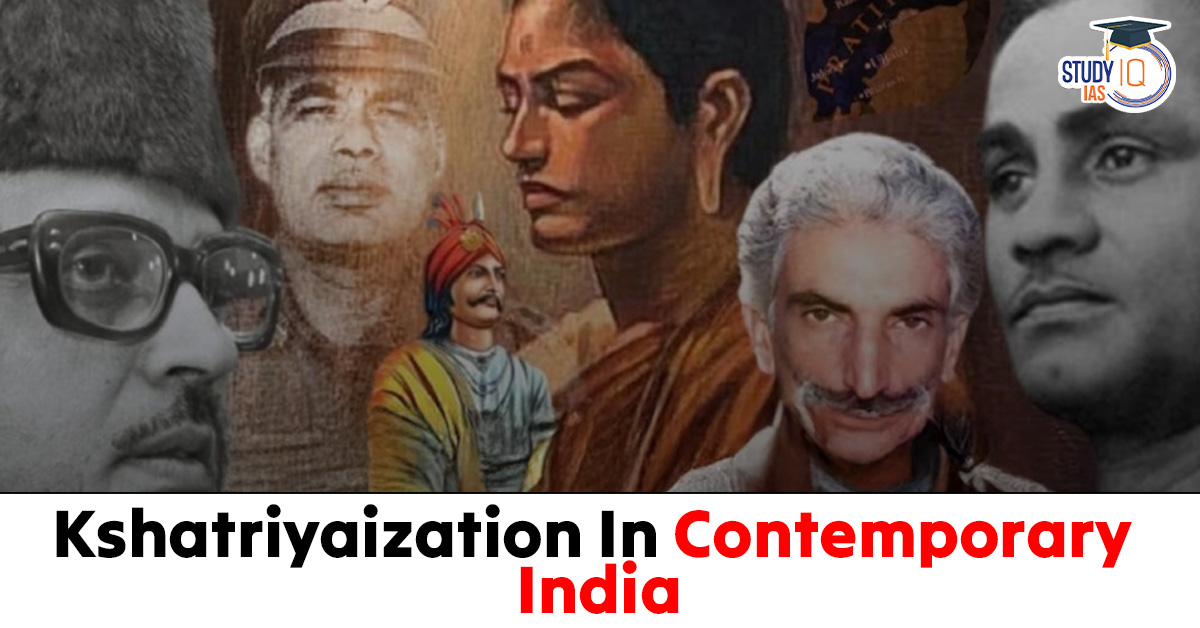
Context: Rising celebration of warrior icons like Maharaja Suheldev, Ahilyabai Holkar, Rani Velu Nachiyar, Rani Durgavati, among others, are being highlighted in public discourse to emphasise regional and martial histories.
| What is the Issue? |
|
Kshatriyaisation in Contemporary India: Conceptual Framework
- Sanskritization: Proposed by M.N. Srinivas, it refers to the process where lower castes imitate the rituals, customs, and lifestyles of higher castes to gain social mobility and improved status within the hierarchy.
- Kshatriyaisation: Explained by Hermann Kulke, it denotes a top-down process in which ruling elites or dominant groups promote a warrior (Kshatriya) identity to legitimise their political authority and expand social influence.
- Imitation Theory: B.R. Ambedkar argued that caste identities evolve through the “infection of imitation,” where communities emulate dominant groups to enhance their social standing.
- Power-centric caste: Andre Beteille emphasised that in modern India, caste hierarchies are increasingly shaped by political power, economic status, and social influence rather than purely ritual or religious factors.
Significance
- Social mobility: Assertion of Kshatriya identity enables communities to symbolically elevate their status, gain dignity, and challenge their historically lower position in the caste hierarchy.
- Political mobilisation: As highlighted by Christophe Jaffrelot, such identity construction helps consolidate communities into cohesive political groups, strengthening vote-bank politics.
- Cultural integration: Incorporating regional warrior histories into a broader national narrative fosters a sense of shared heritage and collective identity across diverse communities.
Challenges
- Reinforces hierarchy: Instead of dismantling caste inequalities, such processes may repackage and perpetuate hierarchical distinctions in new symbolic forms.
- Selective history: Emphasis on martial achievements can lead to partial or distorted interpretations of history, ignoring social, cultural, and economic complexities.
- Inter-caste tensions: Competing claims by different groups for Kshatriya status may intensify rivalries and social conflicts.
- Political misuse: Historical figures and identities may be strategically used to influence electoral outcomes rather than promote genuine historical understanding.
Contemporary Relevance
- Strategic identity politics: Promotion of warrior identities among communities like Marathas, Jats, and Yadavs reflects deliberate efforts to mobilise these groups for political support.
- Link to nationalism: These narratives connect caste pride with broader cultural-national ideologies, reinforcing a unified yet hierarchical identity framework.
- Dynamic caste system: The evolving reinterpretation of caste identities demonstrates that caste remains fluid and continues to adapt to changing political and social contexts.
Way forward
- Balanced historiography: Promote fact-based, inclusive history writing to avoid distortions.
- Egalitarian approach: Shift focus from hierarchical status to constitutional values of equality.
- Limit politicisation: Ensure historical figures are not excessively used for political agendas.
- Inclusive development: Address the socio-economic concerns of communities rather than relying solely on symbolic identity assertion.
Conclusion
While Kshatriyaisation fosters pride and mobilisation, it also risks reinforcing caste hierarchies and politicising history. There is a need for a nuanced approach to reconcile identity, history, and democratic values.

 16 Mahajanapadas: List, Capitals, Locati...
 Ghaznavid Empire in Punjab: History, Rul...
 Samvatsari Parva 2026: Know the Signific...






 WhatsApp