Table of Contents
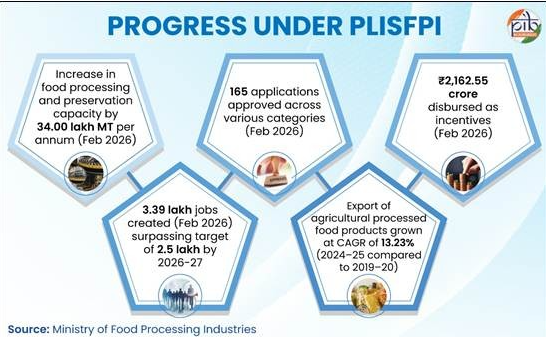
Context: The Ministry of Food Processing Industries has reported that the Production-Linked Incentive Scheme (PLISFPI) has significantly outperformed its targets, creating 3.39 lakh jobs against a goal of 2.5 lakh by 2026.
| Factsheet |
|
Opportunities in the Indian FPI
- Raw Material Abundance: India is the world’s second-largest producer of fruits and vegetables, providing a massive resource base for processing hubs.
- Growing Consumer Base: Rapid urbanisation and changing lifestyles have spiked demand for Ready-to-Eat (RTE) and Ready-to-Cook (RTC) segments.
- Global Health Trends: The rising global interest in millets and organic products provides India a niche market to export traditional and innovative superfoods.
- Supply Chain Integration: There is a vast opportunity to integrate Indian MSMEs into global value chains, particularly in segments like marine products and mozzarella cheese.
- Technological Adoption: Transitioning to advanced food preservation technologies (like IQF or Retort packaging) can drastically reduce India’s high post-harvest losses.
| Initiatives Taken |
|
Challenges
- Infrastructure Gaps: Inadequate cold chain facilities and last-mile connectivity still result in significant perishable wastage.
- Standardization Issues: Meeting stringent international phytosanitary and quality standards remains a hurdle for many small-scale processors.
- Fragmented Supply Chain: The presence of multiple intermediaries between the farm gate and the processor often increases costs and reduces efficiency.
- Limited MSME Credit: Despite government support, many small units struggle with high capital costs for upgrading to advanced technology.
- Low Processing Level: Currently, India processes only a small fraction of its total produce compared to developed nations, indicating an under-utilized capacity.
Way Ahead
- Incentivizing Ancillaries: Moving toward PLI 2.0 to support ancillary industries like specialized chemicals, gases, and packaging materials.
- R&D and Innovation: Strengthening the focus on Category II products (Organic/Innovative) to capture high-value health-conscious markets.
- Digitization of Logistics: Implementing real-time monitoring of food project progress via web-based MIS to ensure timely execution.
- Aggressive Global Branding: Utilizing the Category III incentives to establish Indian Food as a premium, safe, and sustainable global brand.
- Skill Development: Training the rural workforce to operate advanced production lines, ensuring that the 3.39 lakh jobs created are high-skill and sustainable.

 Circular Economy in India: Benefits, Cha...
 India Forex Reserve 2026: Record $785.7 ...
 Skyroot Vikram-1 Mission Aagaman: India'...














 WhatsApp