Table of Contents
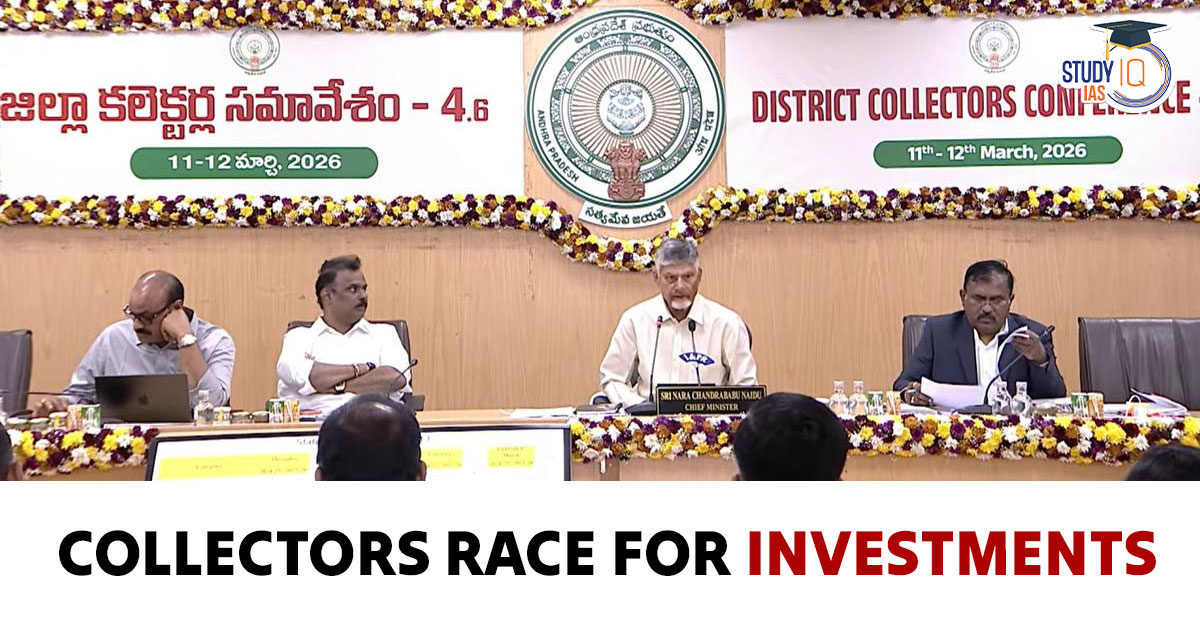
Context: At a recent conference in Andhra Pradesh, Chief Minister N. Chandrababu Naidu urged District Collectors to actively attract investments, complementing state-level bodies, while leading District Industries Promotion Committees to facilitate local industrial development.
Collectors as Drivers of Local Investment
- Expanded administrative role: District Collectors are increasingly acting as facilitators of economic development, going beyond traditional administrative duties to actively promote industrialisation and investment.
- Institutional coordination: They function in alignment with state-level investment bodies while heading District Industries Promotion Committees, ensuring that policy objectives are translated into local outcomes.
- Direct engagement with investors: Collectors are expected to interact with entrepreneurs, identify investment opportunities, and encourage businesses to establish operations within their districts.
- Improving administrative efficiency: A key responsibility includes ensuring timely approvals, reducing procedural delays, and creating a more predictable environment for investors.
Significance
- Decentralised economic development: Empowering district-level administration promotes balanced regional growth by reducing dependence on a few major urban centres.
- Utilisation of local potential: Collectors possess detailed knowledge of district-specific strengths such as natural resources, land availability, and sectoral advantages, enabling targeted investment promotion.
- Employment generation: Increased investments at the district level contribute to job creation and local economic expansion.
- Administrative accountability through ranking: Performance-based ranking of districts based on investment, employment, and efficiency introduces measurable accountability and incentivises better governance.
- Faster project implementation: Delegation of monitoring responsibilities to local officials ensures early identification and resolution of issues, improving project completion rates.
Challenges Associated
- Unequal starting conditions: Districts differ in terms of infrastructure, location, and resource endowments. Those near major cities or industrial hubs have inherent advantages over others.
- Concerns over fair competition: Ranking systems may not fully account for structural disparities, potentially disadvantageing less-developed districts.
- Implementation gaps: Attracting investment is only the first step; delays in providing infrastructure such as water, electricity, and connectivity, can hinder actual project execution.
- Administrative capacity constraints: Expanding the role of Collectors may strain existing administrative capacity, especially in districts with limited institutional support.
- Coordination challenges: Effective collaboration between multiple departments and agencies is necessary, and any gaps can slow down decision-making.
Way Forward
- Balanced evaluation framework: Ranking systems should incorporate contextual factors such as district capacity and resource constraints to ensure fairness.
- Strengthening infrastructure support: Investment promotion must be complemented by the reliable provision of basic infrastructure to ensure smooth project execution.
- Capacity building of local administration: Training and institutional support should be provided to enable Collectors and local officials to effectively handle investment facilitation roles.
- Sector-specific strategies: Districts should focus on sectors suited to their strengths, such as renewable energy, MSMEs, IT, or tourism, rather than adopting a uniform approach.
- Enhanced coordination mechanisms: Streamlined communication between departments and clear allocation of responsibilities can improve efficiency.
- Focus on execution, not just approvals: Continuous monitoring and follow-up are essential to ensure that investment proposals are translated into operational projects.

 Skyroot Vikram-1 Mission Aagaman: India'...
 Oor Pare Prehistoric Site: Location, Roc...
 Assam Election 2026: Exit Poll, Result D...














 WhatsApp