
Table of Contents
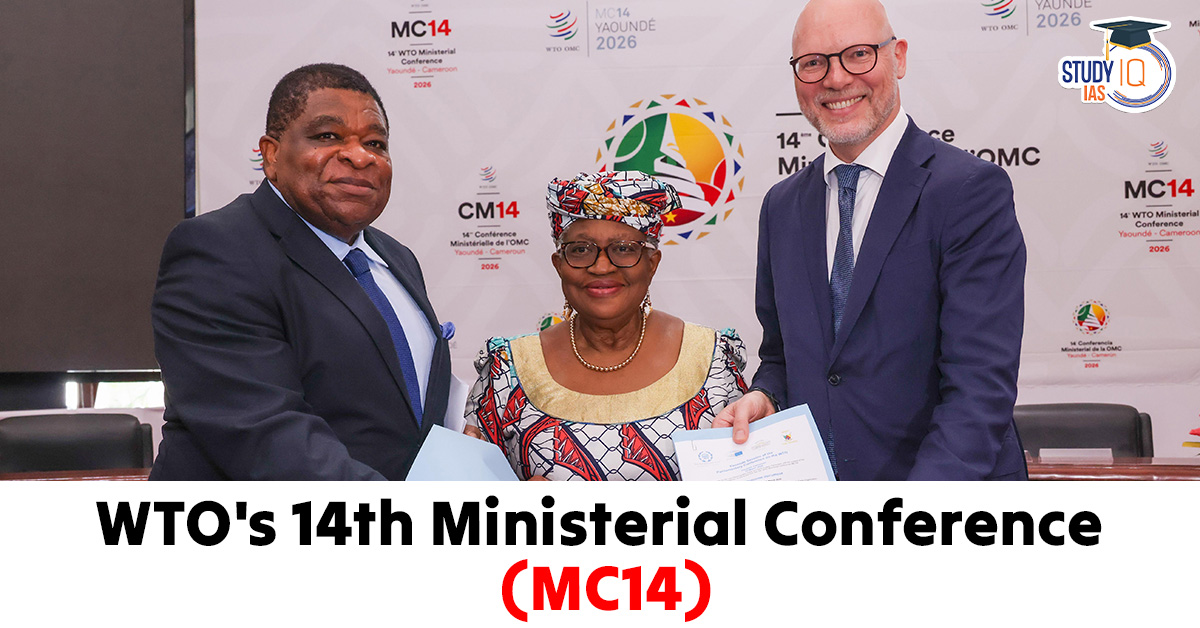
Context: The 14th Ministerial Conference of the World Trade Organisation will take place from 26–29 March 2026 in Yaoundé, Cameroon, amid rising trade tensions and weakening multilateral trade governance.
| About WTO |
Ministerial Conference
|
Key Issues discussed in 14th Ministerial Conference (MC14)
- Plurilateralism: Countries will discuss incorporating plurilateral agreements (e.g., Investment Facilitation for Development and Agreement on Electronic Commerce) into the WTO framework.
- It is included in Annex 4 of the WTO treaty and requires the consensus of all WTO members for inclusion.
- Eg. India opposes it as it will open a Pandora’s box and lead to the fragmentation of the system.
- E-commerce moratorium: The moratorium was adopted in the 1998 Geneva Ministerial Declaration and prohibits customs duties on electronic transmissions, renewed periodically at ministerial conferences. It is set to expire on March 31.
- SDT (Special and Differential Treatment):
- Developed countries (e.g., U.S.): Seek to restrict SDT benefits for large developing economies like India, China, and Brazil.
- Developing countries: Support continuation of SDT to ensure policy flexibility and development support.
- Dispute Settlement: Restoration of Appellate Body, paralysed since 2019 due to the U.S. blocking judge appointments.
India’s Role at WTO’s 14th Ministerial Conference (MC14)
- Leadership: Reassert role as voice of Global South, defending trade multilateralism and inclusive rule-making within the WTO system.
- Coalitions: Build alliances with developing and least-developed countries (LDCs) to collectively safeguard development-oriented trade policies.
- Dispute Settlement: Strongly push for the restoration of the WTO Appellate Body to revive the rules-based dispute resolution mechanism.
- Reforms: Support institutional reforms to modernise the WTO while preserving its development-oriented mandate.

 Pakistan as Mediator in Iran–US Confli...
 China’s Global Ocean Mapping Initiativ...
 Strait of Hormuz Crisis: Causes, Impact ...












 WhatsApp





