

Table of Contents
World Day for Glaciers, observed annually on 21 March, highlights the urgent need to address the rapid melting of glaciers and its global consequences. The observance gained momentum after the declaration of 2025 as the International Year of Glaciers’ Preservation, marking a shift from awareness to science-based action and policy intervention.
Glaciers are not just ice masses—they are critical components of the Earth’s cryosphere, regulating climate, sustaining freshwater systems, and supporting ecosystems and livelihoods worldwide.
What is the Cryosphere?
The cryosphere includes all frozen components of the Earth’s system:
- Glaciers
- Ice sheets (Greenland & Antarctica)
- Sea ice
- Snow cover
- Permafrost
It stores nearly 70% of the world’s freshwater, making it crucial for global water security.
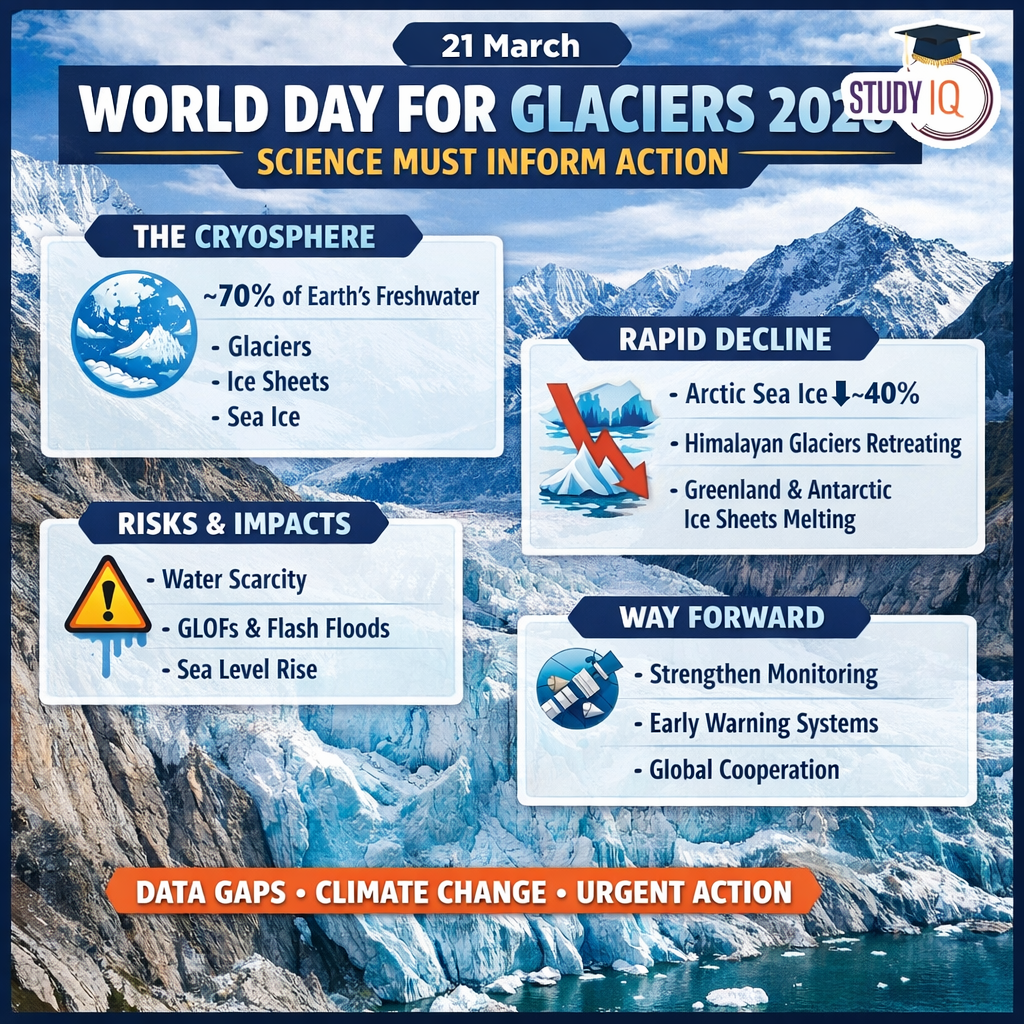
World Day for Glaciers 2026: Key Highlights
- Date: 21 March
- Declared by: United Nations
- Implemented by: World Meteorological Organization and UNESCO
- Focus: Glacier preservation, climate action, and disaster preparedness
- Context: Follow-up to the International Year of Glaciers’ Preservation (2025)
Why Are Glaciers Important?
1. Freshwater Reservoirs
Glaciers act as natural water towers, supplying freshwater to billions of people, especially in Asia (Himalayan region).
2. Climate Regulation
They reflect solar radiation (albedo effect) and help regulate global temperatures.
3. River Systems Support
Major rivers like the Ganga, Brahmaputra, and Indus depend on glacial meltwater.
4. Ecosystem Balance
Glaciers sustain unique ecosystems and biodiversity in fragile mountain regions.
Alarming Trends in Glacier Loss
- Arctic sea ice has declined by ~40% since 1979
- Greenland and Antarctic ice sheets are melting at accelerating rates
- Himalayan glaciers are retreating rapidly
These trends indicate a shrinking cryosphere, driven primarily by climate change and global warming.
Global Impacts of Glacier Melting
Water Security Crisis
Reduced glacier mass disrupts long-term water availability, affecting agriculture and drinking water.
Disaster Risks
- Glacial Lake Outburst Floods (GLOFs)
- Landslides and flash floods
- Increased vulnerability in mountain regions
Sea-Level Rise
Melting ice contributes significantly to rising sea levels, threatening coastal cities globally.
Ecological Disruptions
Changes in temperature and water flow impact ecosystems and biodiversity.
Core Message: Science Must Inform Action
A key theme emphasized by global agencies is that policy decisions must be guided by scientific data.
Why This Matters:
- Only ~1% of global monitoring stations are located in high mountain regions (>3000m)
- This creates significant data gaps, leading to weak or delayed policy responses
Science-based tools include:
- Satellite monitoring
- Glacier mass balance studies
- Climate modeling
- Early warning systems
Key Pillars for Glacier Protection
1. Collaboration
Glaciers are transboundary resources. International cooperation is essential.
2. Monitoring & Data Systems
Strengthening observation networks and data-sharing mechanisms is critical.
3. Science-Based Policy
Decision-making must integrate scientific research for climate adaptation and disaster management.
4. Investment & Partnerships
Funding and collaboration between governments, institutions, and the private sector are required.
International Year of Glaciers’ Preservation (2025): Outcomes
- Elevated glaciers as a global policy issue
- Strengthened science-policy interface
- Brought together 400+ organizations
- Identified major data and monitoring gaps
- Promoted inclusion of Indigenous knowledge
Decade of Action for Cryospheric Sciences (2025–2034)
This global initiative aims to:
- Strengthen cryosphere observation systems
- Improve data integration and sharing
- Enhance disaster prediction and climate adaptation
- Build long-term scientific infrastructure
It will also act as a bridge to the International Polar Year (2032–33).
India and Glacier Crisis: UPSC Perspective
Importance for India
- Himalayas = “Third Pole”
- Source of major rivers: Ganga, Indus, Brahmaputra
- Critical for water, agriculture, and hydropower
Emerging Challenges
- Rising frequency of GLOFs (e.g., Sikkim floods)
- Glacier retreat in Uttarakhand and Himachal Pradesh
- Increased disaster vulnerability
Government Initiatives
- National Mission on Sustaining Himalayan Ecosystem (NMSHE)
- Disaster early warning systems
- Climate adaptation policies
Way Forward
- Strengthen global and regional cooperation
- Expand glacier monitoring networks
- Invest in early warning and disaster resilience systems
- Integrate science into governance and policy-making
- Promote sustainable climate practices
|
Read More Notes |
|
| Environment Notes | Art and Culture Notes |
| Science and Tech | History Notes |
| Geography Notes | Indian Polity Notes |
| General Knowledge | International Relation |
|
Explore StudyIQ Courses |
|
 International Day of Forests 2026: Theme...
 World Sparrow Day 2026: Date, Theme, His...
 Scientific Cooperation in BRICS: Key Ini...











 WhatsApp





