
Table of Contents
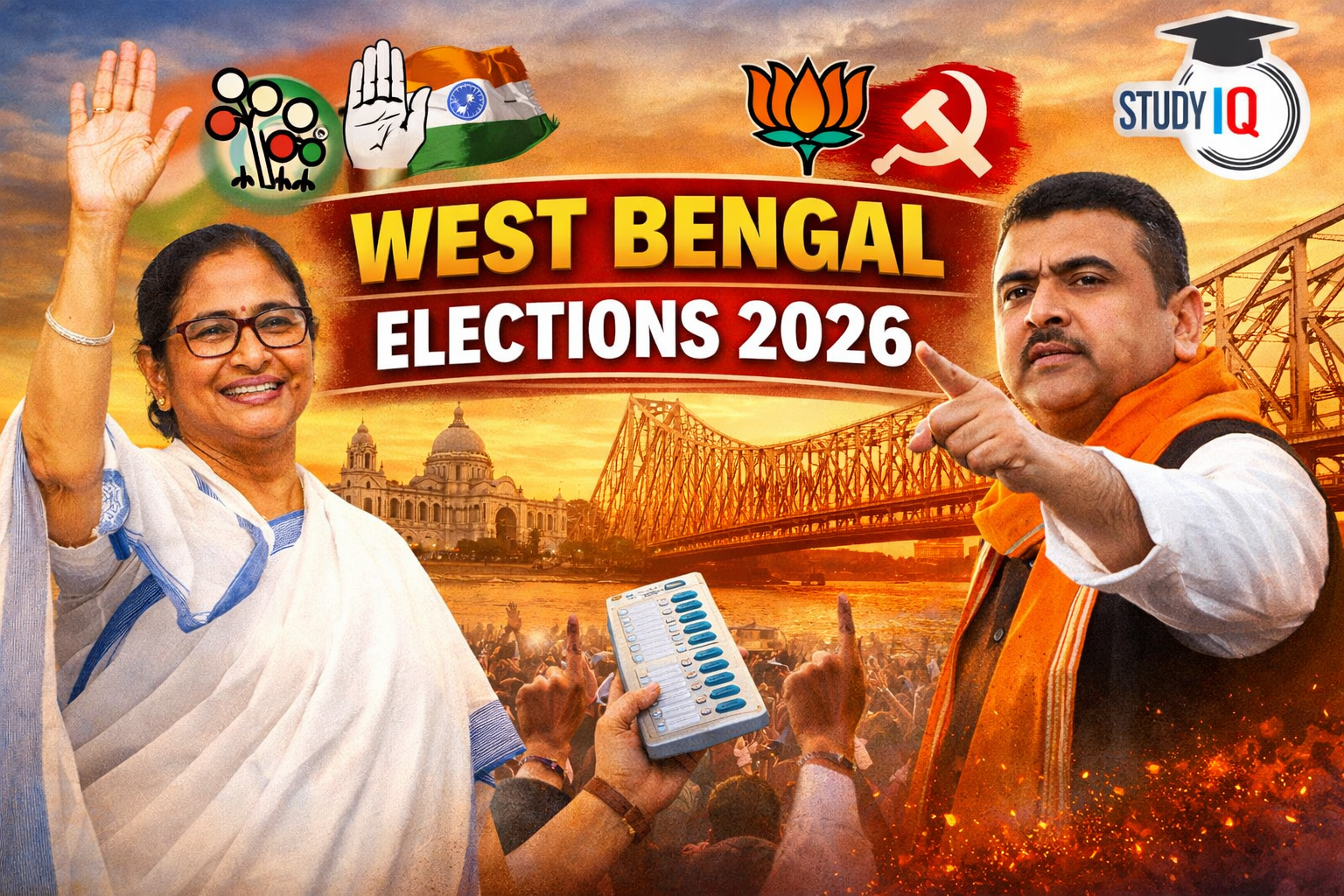
The West Bengal Assembly Election 2026 is one of the most closely watched state elections in India, carrying significant implications for both regional governance and national politics. With a direct contest between dominant political forces and emerging alliances, the 2026 elections are expected to redefine political narratives in eastern India.
West Bengal Elections 2026 Date
The elections will be conducted in two phases, reflecting administrative convenience and security considerations:
- Phase 1 Voting Date: 23 April 2026
- Phase 2 Voting Date: 29 April 2026
These elections will cover all 294 विधानसभा सीटें of the state.
West Bengal Elections 2026 Result Date
- Counting of Votes: 4 May 2026
On this day, results across all constituencies will be declared simultaneously, determining the formation of the next government in West Bengal.
Detailed West Bengal Elections 2026 Schedule
The Election Commission of India released the official schedule:
| Event | Phase 1 | Phase 2 |
|---|---|---|
| Notification Date | 30 March 2026 | Early April 2026 |
| Last Date of Nomination | 6 April 2026 | 9 April 2026 |
| Scrutiny of Nominations | 7 April 2026 | 10 April 2026 |
| Withdrawal of Candidature | 9 April 2026 | 13 April 2026 |
| Polling Date | 23 April 2026 | 29 April 2026 |
| Seats Covered | 152 | 142 |
Key Structural Facts
- Total Seats: 294
- Majority Mark: 148
- Type: Unicameral Legislature
- Tenure: 5 years (Article 172)
Political Context & Background
- The state has been governed by Mamata Banerjee since 2011 under the All India Trinamool Congress (TMC)
- The principal challenger is the Bharatiya Janata Party (BJP)
- The elections reflect a broader ideological contest:
- Regional identity vs national integration narrative
- Welfare politics vs governance reforms
Key Issues in West Bengal Election 2026
The election discourse is shaped by a mix of structural, political, and socio-economic factors:
1. Identity Politics & Regionalism
- “Bengali Asmita” vs national political narrative
- Strong emotional connect with regional culture
- TMC leveraging regional pride as a core strategy
2. Citizenship & Migration Debate
- Issues related to CAA/NRC
- Allegations of illegal migration affecting voter demographics
- Border districts (Murshidabad, North 24 Parganas) are critical
3. Law & Order and Political Violence
- Frequent clashes between party workers
- Violence remains a recurring election issue in Bengal
4. Corruption Allegations
- Recruitment scams (teacher recruitment, etc.)
- Opposition targeting ruling party’s credibility
- Governance vs welfare narrative clash
5. Economy, Unemployment & Industrial Growth
- Concerns over:
- Lack of private investment
- Industrial stagnation
- Youth unemployment
6. Rural Distress & Welfare Politics
- Welfare schemes:
- Lakshmir Bhandar
- Kanyashree
- Debate: Freebies vs sustainable development
7. Environment & Climate Issues (Emerging)
- Sundarbans vulnerability (cyclones, sea-level rise)
- Still low electoral priority but gaining traction
Major Political Parties in West Bengal 2026
1. All India Trinamool Congress (TMC)
- Leader: Mamata Banerjee
- Status: Incumbent ruling party
- Core Strategy:
- Welfare schemes
- Regional identity
- Women-centric policies
2. Bharatiya Janata Party (BJP)
- Leader in State: Suvendu Adhikari
- Strategy:
- Anti-incumbency
- Governance & corruption issues
- Strong central leadership backing
3. Indian National Congress (INC)
- Role: Alliance partner (with Left)
- Influence: Limited but regionally relevant
4. Communist Party of India (Marxist) (CPI-M) / Left Front
- Former dominant force (1977–2011)
- Strategy:
- Grassroots cadre mobilization
- Youth outreach
Key Candidates & Political Leaders
Mamata Banerjee (TMC)
- Incumbent Chief Minister
- Symbol of regional resistance
- Focus: Welfare + Bengali identity
Suvendu Adhikari (BJP)
- Leader of Opposition
- Key face of BJP’s Bengal strategy
Abhishek Banerjee (TMC)
- Rising leader
- Strategic campaign manager
Amit Shah (BJP)
- National strategist
- Driving BJP’s expansion in Bengal
Rahul Gandhi (INC)
- Campaigning for Congress alliance
- Focus on ideological positioning
Electoral Geography & Strategic Zones
High-Impact Regions:
- South Bengal: TMC stronghold
- North Bengal: BJP influence growing
- Border Areas: Sensitive (migration issues)
- Urban Seats (Kolkata, Howrah): Mixed voting patterns
Electoral Trends (2011–2021–2026)
| Year | Winner | Key Trend |
|---|---|---|
| 2011 | TMC | End of Left rule |
| 2016 | TMC | Consolidation |
| 2021 | TMC | Strong comeback vs BJP |
| 2026 | ? | High-stakes bipolar contest |
Governance vs Politics Debate
| TMC Narrative | BJP Narrative |
|---|---|
| Welfare success | Corruption & governance failure |
| Regional pride | National integration |
| Stability | Change |
Conclusion
The West Bengal Elections 2026 represent more than just a state-level contest—they symbolize a larger ideological battle between regional assertion and national political expansion. With intense campaigning, evolving alliances, and multi-dimensional issues, the outcome will significantly influence India’s political trajectory in the coming years.
|
Read More Notes |
|
| Environment Notes | Art and Culture Notes |
| Science and Tech | History Notes |
| Geography Notes | Indian Polity Notes |
| General Knowledge | International Relation |
|
Explore StudyIQ Courses |
|
 ISRO Launches Mission MITRA in Ladakh: A...
 Disaster Management in India, Classifica...
 Good Friday 2026: Date, History, Meaning...









 WhatsApp





