
Table of Contents
Context
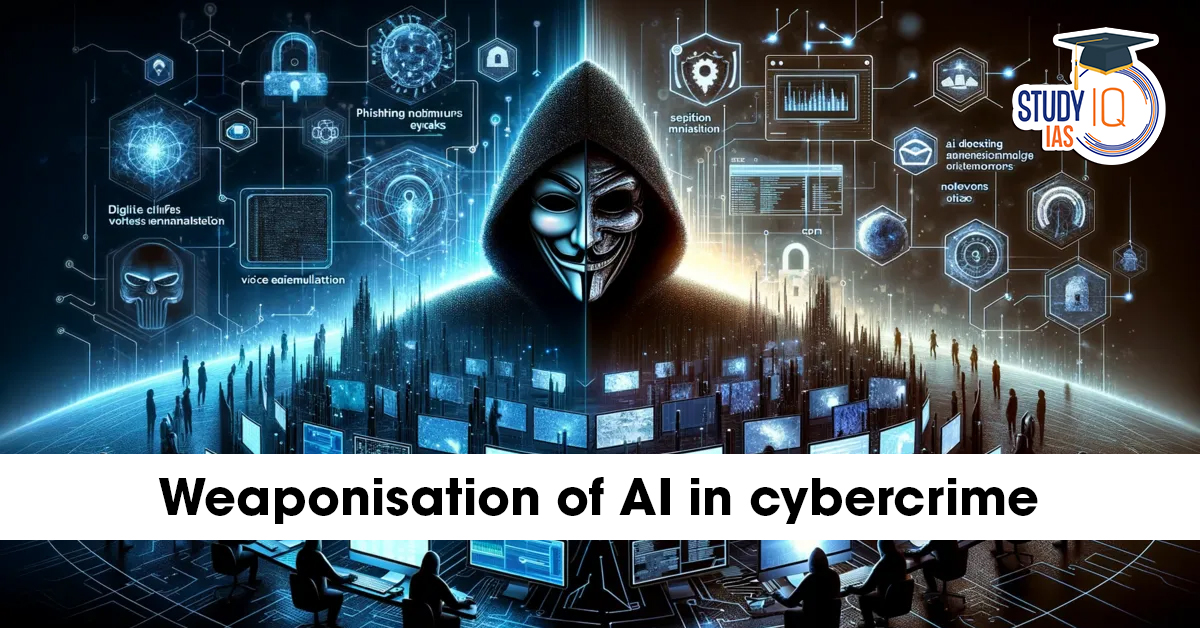
Artificial Intelligence (AI) has transformed global digital ecosystems. However, alongside legitimate innovation, criminal networks are increasingly “weaponising” AI tools to conduct large-scale cyber fraud, identity theft, ransomware attacks, and misinformation campaigns.
How AI Is Being Utilised by Cybercriminals
- Deepfake Scams: AI-generated voice clones and video deepfakes are used to impersonate CEOs, government officials, and celebrities to promote fake investment schemes or extract funds.
- g. Deepfake videos of public figures endorsing cryptocurrency scams.
- Phishing Emails: AI now generates perfectly structured, context-specific messages tailored to victims, making detection harder.
- Automated Malware Creation: AI tools can write malicious code, customise ransomware variants, and adapt malware to bypass antivirus systems.
- Large-Scale Social Engineering: AI chatbots simulate human conversation, build trust with victims over time, and manipulate them into sharing sensitive information or transferring money.
- Data Mining: AI analyses stolen datasets to identify vulnerable individuals — elderly citizens, small businesses, or specific demographic groups — increasing scam success rates.
- Cybercrime Marketplaces on Dark Web: There is a thriving black market for stolen data, malware kits, ransomware services, and AI-driven attack tools.
- g.Ready-made AI tools and “cybercrime-as-a-service” packages available on the dark web
|
How Interpol Is Responding to Emerging Threats |
| ● Cyber Fusion Centre Operations: Interpol’s Cyber Fusion Centre in Singapore acts as a real-time intelligence-sharing hub. It monitors global cyber threats and shares data among member states.
● Data-Driven Intelligence Analysis: Analysts examine millions of data points — malicious IP addresses, domain registrations, malware signatures, hacker aliases — to identify patterns and active networks. ● Coordinated Global Operations ○ Operation Secure (Asia): 26 countries dismantled over 20,000 malicious IPs and domains. ○ Operation Serengeti 2.0 (Africa): Arrested 1,209 cybercriminals, dismantled over 11,000 malicious infrastructures, and recovered nearly $97 million. ● Digital Forensics Laboratory: Interpol’s lab extracts and analyses data from laptops, smartphones, vehicles, and storage devices to support cross-border investigations. ● Real-Time Command and Coordination: A global monitoring centre tracks emerging cyber developments and coordinates rapid responses across jurisdictions. |
Strategic Challenges
- Jurisdictional Limitations: Cybercrime operates across borders, but law enforcement authority remains nationally confined, creating enforcement gaps.
- Volume and Speed of Attacks: AI enables automation, meaning attacks occur at unprecedented scale and speed, overwhelming traditional policing mechanisms.
- Legal Ambiguity Around AI: Questions arise: Who is liable — the programmer, the user, or the platform? AI-generated crimes challenge traditional criminal law frameworks.
- Deepfake Regulation Difficulty: Detecting deepfakes requires advanced verification systems. The technology is evolving faster than regulatory frameworks.
- Low Entry Barrier for Criminals: Ready-made AI-based hacking tools are accessible on the dark web, allowing even amateur criminals to conduct sophisticated attacks.
Way Forward
- Global Legal Harmonisation: Countries must harmonise cybercrime laws and extradition mechanisms to prevent safe havens for cybercriminals.
- AI Detection Tools and Counter-AI Systems: Invest in AI systems that detect deepfakes, anomalous network behaviour, and automated phishing patterns.
- Public Awareness and Digital Literacy: Governments must run large-scale digital literacy campaigns to educate citizens about deepfakes, scam calls, and phishing tactics.
- Regulating AI Tool Distribution: Stronger monitoring of AI tool distribution on dark web platforms and stricter oversight of open-source AI misuse.
- Public–Private Collaboration: Technology companies, cybersecurity firms, banks, and law enforcement must share threat intelligence in real time.
- Building Cyber Resilience in Developing Nations: Capacity building and resource sharing for low-income countries to prevent them from becoming soft targets.
- Ethical AI Governance Frameworks: Develop international standards to ensure AI tools include safeguards against malicious usage.
|
Read More Notes |
|
| Environment Notes | Art and Culture Notes |
| Science and Tech | History Notes |
| Geography Notes | Indian Polity Notes |
| General Knowledge | International Relation |
|
Explore StudyIQ Courses |
|
 West Bengal Elections 2026: Full Schedul...
 ISRO Launches Mission MITRA in Ladakh: A...
 Disaster Management in India, Classifica...













 WhatsApp





