
Table of Contents
Context
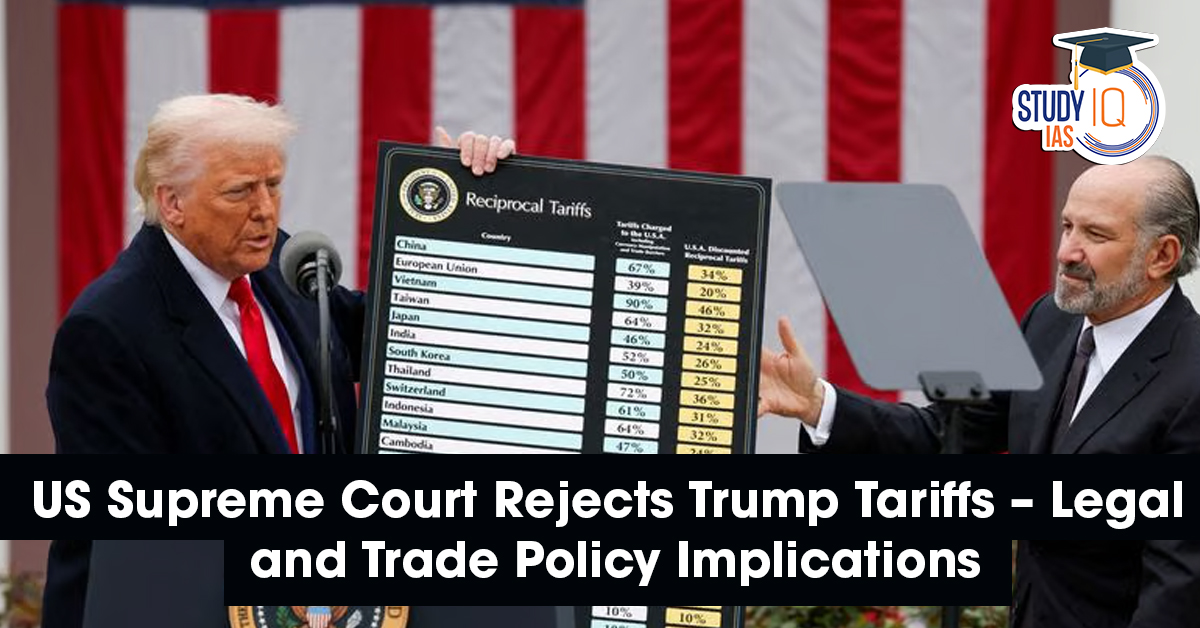
- The S. Supreme Court, in a 6–3 ruling, struck down President Donald Trump’s sweeping tariffs imposed under the International Emergency Economic Powers Act (IEEPA), 1977.
- The judgment marks a critical moment in the debate over separation of powers, executive overreach, and the future of U.S. trade policy.
- The ruling has significant implications for the global economy, including countries like India, which have been directly affected by U.S. tariff measures.
Impact on India-US Trade
- The removal of tariffs will benefit approximately 55% of India’s exports to the US, which were previously subjected to an 18% duty. These exports will now only face standard Most-Favoured Nation (MFN) tariffs.
- Certain tariffs will remain:
- Section 232 tariffs: 50% on steel and aluminum, and 25% on certain auto components.
- Products accounting for roughly 40% of export value, such as smartphones, petroleum products, and medicines, will remain tariff-exempt.
US Supreme Court Ruling
- The court ruled that Trump overstepped his authority by imposing tariffs under the International Emergency Economic Powers Act (IEEPA), a law meant for national emergencies.
- Chief Justice John Roberts clarified that IEEPA does not permit unilateral tariff actions without congressional approval.
| Trump’s Tariff Strategy – Economic and Foreign Policy Tool
● Trade war and economic leverage: Trump used tariffs as a revenue-generating instrument (estimated $300 billion annually if fully retained). ● It is used as a foreign policy tool, a means to renegotiate trade deals, and a pressure mechanism against China, Canada, Mexico, India, and Brazil. ● “Liberation Day” tariffs (April 2, 2025): ○ Announced “reciprocal tariffs” on most trading partners. ○ Justified under a “national emergency” related to trade deficits. ○ Also invoked IEEPA citing fentanyl trafficking and migration concerns. ● Economic impact: ○ Over $175 billion collected under IEEPA-based tariffs (Penn-Wharton estimate). ○ $195 billion net customs duty receipts in FY 2025 (record high). ○ Refund liability likely after the Supreme Court ruling. ○ Created global market uncertainty and financial volatility. |
Recent Developments
- Following the ruling, a joint statement was issued on an interim trade agreement between India and the US.
- The US has already removed some punitive tariffs on India as a gesture of goodwill, motivated by India’s agreement to cease purchasing oil from the Russian Federation.
|
Implications |
| ● For the U.S. political system: Reassertion of judicial review. Curtailment of expansive executive authority. Reinforcement of Congressional primacy in taxation.
● For Global trade: Potential rollback or restructuring of tariff regimes. Increased uncertainty in the short term. Possible shift toward more rules-based trade measures. Affects WTO dynamics and global trade governance. ● For India: Relief potential in select sectors (aircraft parts, auto components). Continued exposure to 232 tariffs. Trade diplomacy becomes critical. Strategic balancing amid U.S.–China competition. |
Future Implications
- The ruling may render recent US trade deals with countries like the UK, Japan, EU, and others ineffective, as partner countries might reconsider their validity.
- Trump could attempt to reimpose similar tariffs under different sections, but these require new investigations and could face legal challenges.
- The decision reinforces Congress’s role in trade policy, limiting presidential power to use tariffs as a broad enforcement tool.
Conclusion
- The Supreme Court’s ruling marks a pivotal constitutional correction in the United States, reinforcing the doctrine that emergency powers cannot be stretched into instruments of broad economic policy.
- For the global economy — and countries like India — the decision may reduce tariff unpredictability, but the era of strategic trade weaponisation is far from over.
- The episode underscores a larger global trend: trade policy is increasingly intertwined with national security, domestic politics, and geopolitical rivalry.
|
Read More Notes |
|
| Environment Notes | Art and Culture Notes |
| Science and Tech | History Notes |
| Geography Notes | Indian Polity Notes |
| General Knowledge | International Relation |
|
Explore StudyIQ Courses |
|
 Legal Issues in the Definition of Rape â...
 A Tribal Hamlet’s tryst with AI: Limbu...
 A Treatise for Federalism: The Kurian Jo...









 WhatsApp





