
Table of Contents
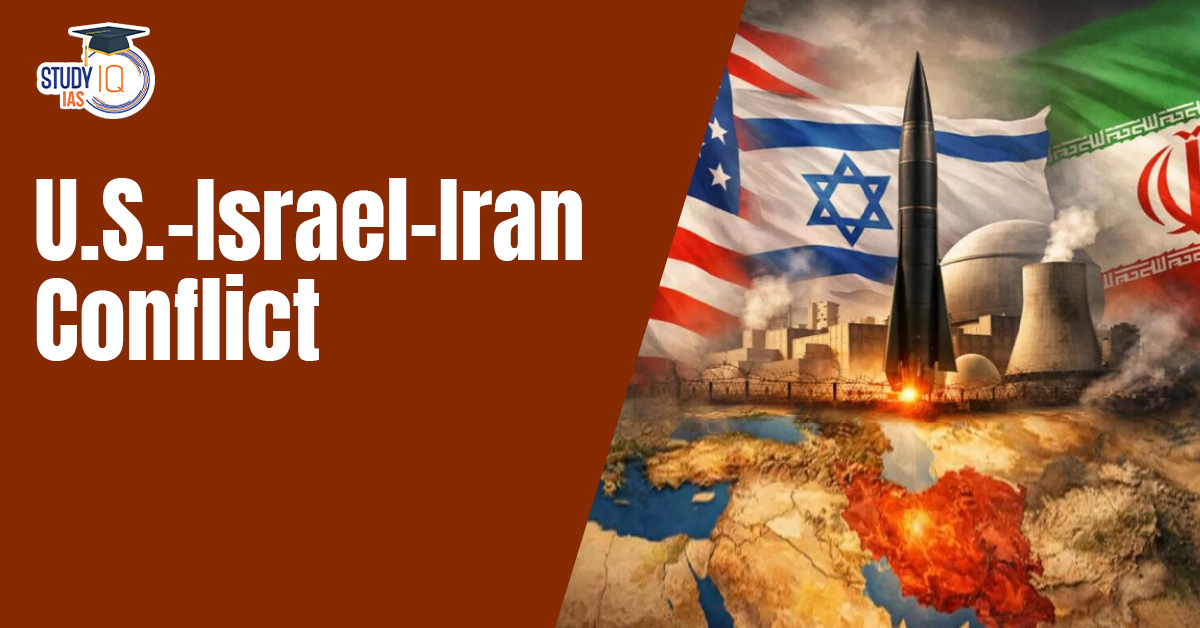
Context: The deepening US-Israel-Iran conflict has fractured the Persian Gulf’s delicate power balance, casting India’s “strategic silence” into a global spotlight.
Iran’s Assertiveness in West Asia
- Historical Continuity: Even under the Shah Mohammad Reza Phalavi, Iran positioned itself as the “Gendarme of the Gulf,” seizing islands from the UAE and intervening in Oman to project Persian power.
- Ideological Expansion: Post-1979, Tehran replaced secular nationalism with a Shia revolutionary framework, utilizing a “Forward Defense” strategy.
- The Proxy Network: Iran has cultivated a “Strategic Corridor” stretching to the Mediterranean by empowering non-state actors like Hezbollah (Lebanon), Hamas (Gaza), and the Houthis (Yemen).
- Asymmetric Leverage: Beyond its ballistic missile and nuclear programs, Iran’s control over the Strait of Hormuz, a chokepoint for 20% of global oil, provides it with a “veto power” over global energy security.
Why the Gulf Region is Difficult to Balance
- Demographic Asymmetry: Iran’s population of around 90 million far exceeds the combined citizen population of about 27 million in the Gulf Cooperation Council (GCC) states, creating a long-term imbalance in regional power.
- Fragmented Gulf Arab States: While Iran is a centralised nation-state, the Arab Gulf is divided among multiple monarchies, making collective strategic coordination difficult.
- Dependence on External Security Guarantees: The Gulf states rely heavily on the United States for military protection, making regional security dependent on Washington’s political decisions and strategic priorities.
- Failed Balancing Strategies: Several attempts to balance Iran have failed:
- Iraq under Saddam Hussein was initially supported as a counterweight to Iran during the Iran-Iraq War (1980-88).
However, Iraq later invaded Kuwait in 1990, creating a new security crisis.
- Rise of Iran after the Iraq War: The U.S. invasion of Iraq in 2003 dismantled Saddam’s regime and indirectly strengthened Iran’s influence in Iraq and across the region.
- Emerging Strategic Realignments: Fear of Iran’s growing influence has driven quiet cooperation between Israel and Gulf states, altering the geopolitical landscape of the Middle East.
India’s Silence on the West Asia War
India’s Policy of Strategic Neutrality:
India has avoided taking explicit sides in the conflict, emphasising strategic autonomy and diplomatic caution while maintaining relations with Iran, Israel, and Gulf states. However, it has drawn criticism as:
- Criticism of Moral Ambiguity: Critics argue that India’s silence amounts to moral evasion, especially given its historical commitment to non-alignment, anti-colonial solidarity, and peaceful conflict resolution.
- Expectations from a Global South Leader: As a country aspiring to play a larger role in global governance, India is expected to articulate a principled position on major conflicts, particularly those affecting developing countries.
- Contrast with Past Indian Positions: Historically, India took stronger moral stances, such as condemning the 2003 Iraq invasion, suggesting that strategic autonomy previously included ethical diplomacy.
Balancing National Interests:
India’s cautious approach is shaped by multiple strategic considerations:
- Energy Security: Near-total dependence on the Gulf for oil and gas.
- The Diaspora Factor: Over 9 million Indians live and work in West Asia, contributing vital remittances.
- The Israel Pivot: Deepening defence, technology, and intelligence ties with Tel Aviv.
- The Iran Link: Civilizational ties and the strategic importance of the Chabahar Port as a gateway to Central Asia.

 India’s Census 2027: World's Largest a...
 Olympic Policy on Transgender Women: Rul...
 Home Ministry’s AI Vision: Strategy, G...













 WhatsApp





