
Table of Contents
The UPSC Civil Services Examination (CSE) 2026 introduces significant rule changes that directly impact candidates already selected in civil services and those planning to reappear after service allocation. These new rules focus on reducing repeated service blocking, improving training utilization, and ensuring fairness in service allocation.
For serious aspirants, understanding these rules is extremely important because a wrong step related to training, exemption, or reattempt eligibility can lead to automatic cancellation of service allocation.
UPSC Application Form 2026: Steps to Apply Online
Overview of UPSC CSE 2026 New Rules
The new rules mainly affect four categories of candidates:
-
Candidates already selected in IAS or IFS
-
Candidates already selected in IPS
-
Candidates getting IPS or Group A service in CSE 2026
-
Candidates selected in CSE 2025 or earlier
These rules introduce training exemption limits, reattempt restrictions, and service choice conditions.
1. Restrictions for Candidates Already Selected in IAS or IFS
If Already Appointed Before CSE 2026
If a candidate is already appointed to IAS or IFS before CSE 2026:
-
They cannot appear for CSE 2026.
-
No reattempt is allowed while continuing in these services.
If IAS/IFS Is Allotted After Prelims 2026
If IAS/IFS is allotted after clearing Prelims but before Mains:
-
Candidate cannot appear in Mains 2026.
If IAS/IFS Is Allotted After Mains but Before Final Result
-
Candidate will not be considered for service allocation through CSE 2026.
Meaning:
If IAS or IFS is allotted at any stage of the CSE 2026 cycle, the attempt becomes invalid for other services.
2. Rules for Candidates Already Selected in IPS
Candidates already selected or appointed in IPS have limited flexibility:
-
They can appear again in CSE.
-
But they cannot opt for IPS again in CSE 2026.
-
They must choose other services only.
This prevents repeated IPS seat occupation by the same candidate.
3. New Rules for Candidates Selected in IPS or Group A Services Through CSE 2026
Candidates who get IPS or Central Group A services in CSE 2026 can appear in CSE 2027 only under strict conditions.
3.1 One-Time Training Exemption Rule
-
Candidate must take formal exemption from training authority.
-
This exemption can be used only once in lifetime.
3.2 Foundation Course Rule
-
Candidate must attend only the Foundation Course (FC).
-
Full training is not allowed if exemption is used.
3.3 If Candidate Does Not Join Training or Take Exemption
-
CSE 2026 service allocation will be cancelled automatically.
4. If Candidate Is Selected Again in CSE 2027
Service Choice Option
Candidate can choose:
-
Service allocated in CSE 2026
OR -
Service allocated in CSE 2027
Unchosen service will be cancelled.
If Candidate Does Not Get Service in CSE 2027
-
They can join service allocated in CSE 2026.
If Candidate Does Not Join Either Service
-
Both allocations will be cancelled.
5. Seniority Protection Rule
-
Seniority depends on date of joining service.
-
Seniority will not be reduced because candidate reappeared in exam.
6. Attempts Restriction After CSE 2027
-
Candidate cannot appear in CSE 2028 or later while continuing in service.
-
To appear again, candidate must resign from service.
To Use Further Attempts
Candidate must:
-
Not join service allocated via CSE 2026 or 2027.
-
Otherwise allocation will be cancelled.
7. Special Provision for Candidates Selected in CSE 2025 or Earlier
These candidates get one-time relaxation:
They can appear in:
-
CSE 2026 OR
-
CSE 2027
Without resigning, if:
-
Attempts remain.
-
Eligibility criteria are met.
For CSE 2028 or Later
They must resign from existing service to appear again.
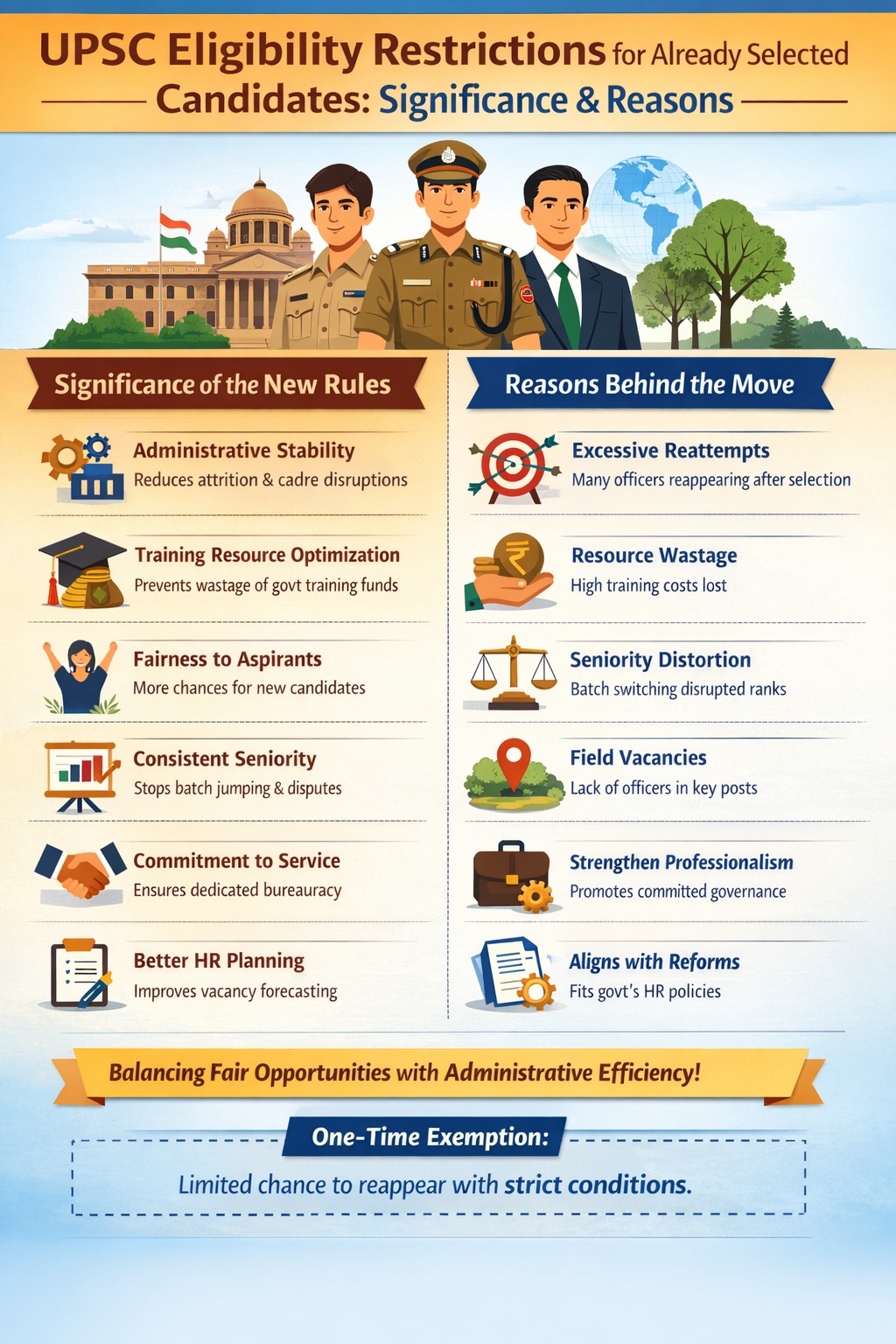
Why UPSC Introduced These New Rules
The objective behind these reforms includes:
-
Preventing multiple service holding by same candidates
-
Improving administrative training efficiency
-
Reducing seat blocking in top services
-
Ensuring faster service stabilization
Key Takeaways for UPSC Aspirants
-
IAS/IFS candidates cannot reappear while continuing in service.
-
IPS candidates can reappear but cannot choose IPS again.
-
Group A service candidates get only one controlled reattempt.
-
Training exemption is one-time lifetime opportunity.
-
Future attempts require resignation from service.
Conclusion
The UPSC CSE 2026 new rules represent a major shift toward structured career progression in civil services. Aspirants must carefully evaluate their service preference, attempt strategy, and training decisions before planning another attempt.
A clear understanding of these rules will help candidates avoid mistakes that could impact their long-term administrative career.
| Important Links |
|---|
| UPSC Syllabus 2026 |
| UPSC 2026 Eligibility |
| UPSC Exam Pattern 2026 |
| UPSC Prelims Syllabus 2026 |
| UPSC Syllabus in Hindi 2026 |
 India-China Trade Relations, Border Disp...
 Digital Arrest Scams, Key Measures and I...
 World Meteorological Day 2026: Theme, Hi...


 WhatsApp





