
Table of Contents
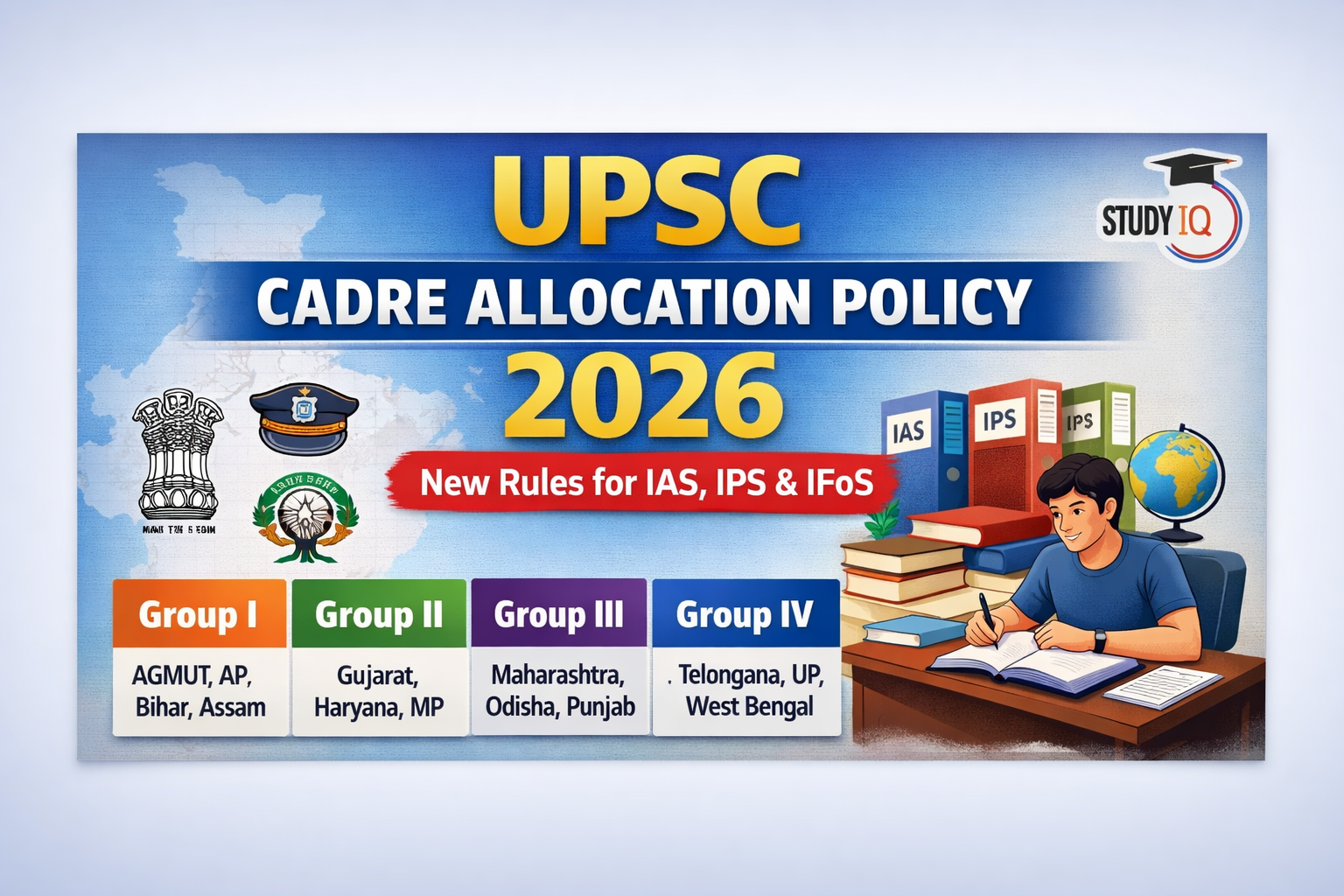
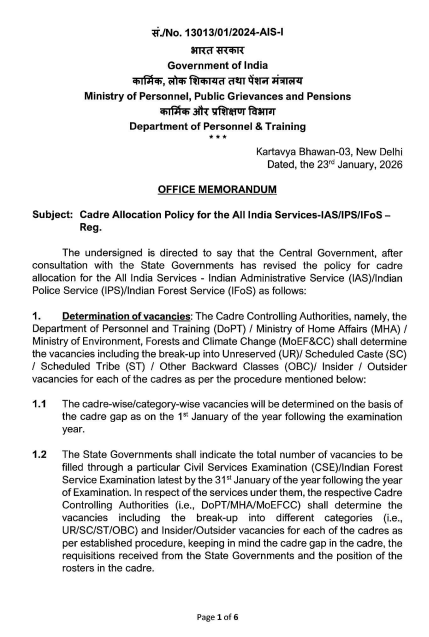
The UPSC Cadre Allocation Policy 2026 is one of the most important administrative reforms in India’s civil services framework in recent years. Notified by the Government of India through an Office Memorandum dated 23 January 2026, this policy revises and replaces the earlier cadre allocation mechanisms for the Indian Administrative Service (IAS), Indian Police Service (IPS) and Indian Forest Service (IFoS). It will be applicable from the Civil Services Examination (CSE) 2026 and the Indian Forest Service Examination 2026 onwards.
For UPSC aspirants, cadre allocation is not just a procedural formality. It determines the state or joint cadre in which an officer will serve for most of their professional career, influencing administrative exposure, governance challenges, professional growth, and even personal life. That is why any change in cadre policy becomes a major topic of discussion among civil service candidates.
The UPSC Cadre Allocation Policy 2026 introduces:
- A new 4-Group Cadre System, replacing the earlier zoning structure
- A more transparent and systematic roster and cycle-based allocation method
- Stronger safeguards for PwBD candidates
- Clear rules for insider and outsider allocation
- A defined mechanism for category interchange when vacancies remain unfilled
This makes the policy more predictable, equitable and nationally integrative.
What is Cadre Allocation in UPSC?
Cadre allocation is the process through which successful candidates in:
- IAS
- IPS
- IFoS
are assigned to a State Cadre or Joint Cadre after final selection. Once allocated, officers usually serve in that cadre for their entire career, except for central deputations or temporary postings.
Each cadre represents:
- A State (e.g., Bihar, Rajasthan, Kerala, Tamil Nadu)
- Or a Joint Cadre (e.g., AGMUT – Arunachal Pradesh, Goa, Mizoram and Union Territories; Assam–Meghalaya)
The cadre defines:
- Administrative responsibility
- Law and order jurisdiction (for IPS)
- Forest and wildlife management zones (for IFoS)
- Developmental and governance exposure
Thus, cadre allocation has a deep personal and professional impact.
Why Was a New UPSC Cadre Allocation Policy 2026 Needed?
Earlier cadre allocation policies faced several criticisms:
- Complexity in zoning systems
- Lack of clarity in category interchange
- Confusion in insider vs outsider balancing
- Limited transparency in cycle distribution
- Insufficient structural accommodation for PwBD candidates
The Cadre Allocation Policy 2026 aims to:
- Simplify the structure
- Improve transparency
- Strengthen equity
- Promote national integration
- Ensure constitutional fairness
By codifying detailed procedures in a single official framework, the Government has made the allocation process more rule-based and less discretionary.
Cadre Allocation Policy 2026 PDF
Cadre Controlling Authorities Under UPSC Cadre Allocation Policy 2026
The responsibility of determining vacancies has been clearly defined:
| Service | Cadre Controlling Authority |
|---|---|
| IAS | Department of Personnel & Training (DoPT) |
| IPS | Ministry of Home Affairs (MHA) |
| IFoS | Ministry of Environment, Forest & Climate Change (MoEF&CC) |
These authorities will publish vacancy details on their official websites every year.
Time-Bound Vacancy Determination Process
One of the most important reforms is the introduction of a strict timeline:
-
Vacancies will be calculated based on the cadre gap as on 1st January of the year following the Civil Services Examination.
-
State Governments must send their vacancy requisitions by 31st January.
-
Late submissions will not be considered.
This ensures predictability and prevents last-minute changes.
Category-wise Reservation Rules
Vacancies will be distributed among:
-
Unreserved (UR)
-
Scheduled Castes (SC)
-
Scheduled Tribes (ST)
-
Other Backward Classes (OBC)
EWS Clarification
Vacancies reserved for Economically Weaker Sections (EWS) will be treated as part of the Unreserved category and reflected in the UR roster.
New Insider Cadre Allocation Rules
An insider is a candidate allocated to their home state cadre.
Under the 2026 policy:
-
Insider allocation will strictly follow merit order and vacancy availability.
-
A candidate must give explicit willingness to serve in their home state to be considered for insider quota.
-
If vacancies are filled, remaining candidates will be treated as outsiders.
This removes ambiguity and ensures fairness.
Rotational Cycle System Introduced
The new system introduces a rotational cycle method:
-
Each cycle covers 25 cadres (states and joint cadres).
-
Each cycle includes 25 candidates in merit order.
-
If multiple candidates fall in the same cycle:
-
The higher-ranked candidate is allocated first.
-
Others move to the next cycle.
-
This mechanism ensures balanced distribution of officers across all cadres.
Outsider Allocation Process
After insider allocation:
-
Allocation for Persons with Benchmark Disabilities (PwBD)
-
Allocation for remaining candidates
Both stages follow the existing roster system to maintain reservation balance.
New Cadre Grouping System (4 Groups)
The earlier five-zone system has been replaced by four alphabetical groups.
| Group | State Cadres / Joint Cadres Included |
|---|---|
| Group I | AGMUT, Andhra Pradesh, Assam–Meghalaya, Bihar, Chhattisgarh |
| Group II | Gujarat, Haryana, Himachal Pradesh, Jharkhand, Karnataka, Kerala, Madhya Pradesh |
| Group III | Maharashtra, Manipur, Nagaland, Odisha, Punjab, Rajasthan, Sikkim, Tamil Nadu |
| Group IV | Telangana, Tripura, Uttarakhand, Uttar Pradesh, West Bengal |
 UPSC Marksheet 2025–26 Out: Marks Tren...
 UPSC Cut Off 2025-26: Prelims, Mains and...
 UPSC Reserve List 2025: Meaning, Categor...








 WhatsApp





