
Table of Contents
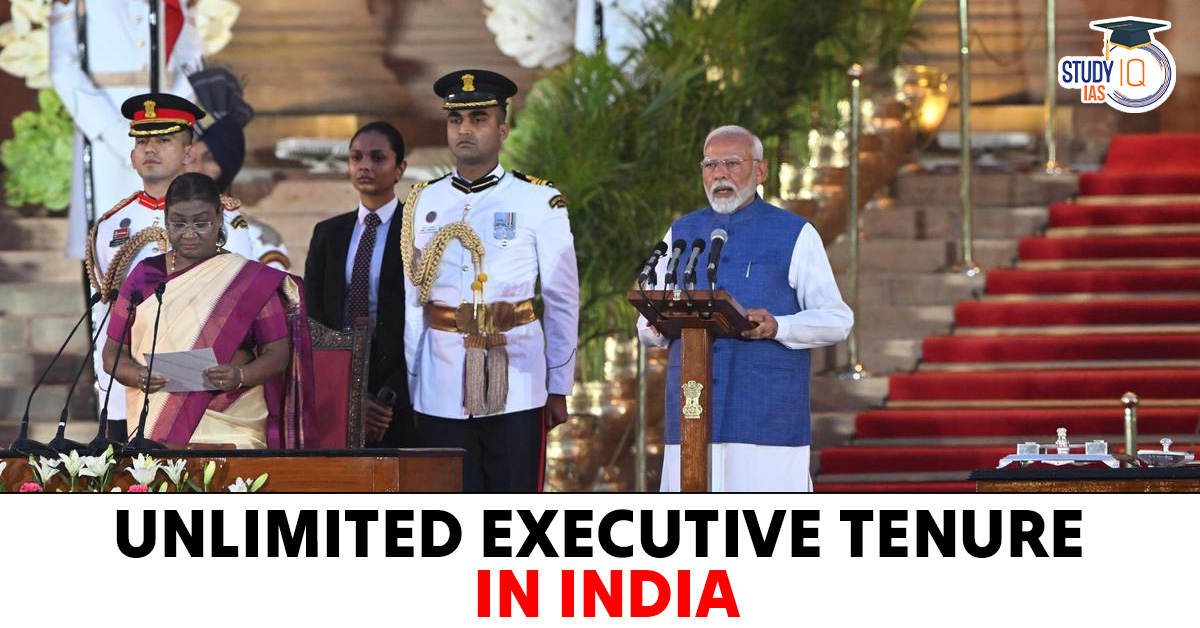
Context: The recent milestone of Narendra Modi surpassing Pawan Kumar Chamling in elected office highlights a structural feature. While democratic legitimacy is derived from electoral mandates, prolonged incumbency raises concerns about the concentration of executive power and its implications for institutional balance.
Unlimited Executive Tenure in India
Unlimited executive tenure in India refers to the absence of fixed term limits for key executive offices such as the Prime Minister and Chief Ministers. Unlike presidential systems, where constitutional caps restrict the number of terms an individual can serve, India’s parliamentary framework allows elected leaders to continue in office as long as they retain the confidence of the legislature.
Rooted in the principles of parliamentary democracy and political accountability, this arrangement emphasizes continuity and stability while simultaneously raising important debates about concentration of power, leadership rotation, and the robustness of democratic checks and balances.
Constitutional Framework Governing the Prime Ministerial Tenure
- Appointment and Legitimacy (Article 75): The Prime Minister is appointed by the President based on majority support in the Lok Sabha, ensuring democratic grounding of executive authority
- Collective Responsibility: The Council of Ministers remains accountable to the Lok Sabha, with the Prime Minister as its leader
- Flexible Tenure: The doctrine of “pleasure of the President” functions in practice as tenure dependent on parliamentary majority, not fixed duration
- Absence of Term Limits: The Constitution permits indefinite continuation in office, distinguishing India from presidential systems
- Accountability Mechanisms: Removal is ensured through loss of majority via no-confidence motions or defeat in key legislative votes
- Resignation Norms: Constitutional conventions require resignation upon losing majority support
- Dissolution Power: The Prime Minister can advise dissolution of the Lok Sabha to seek a fresh mandate
- Judicial Restraint: Courts refrain from intervening in matters of legislative confidence, upholding parliamentary supremacy
Shifts in Accountability and Global Comparisons
- Anti-Defection Law impact: Introduced through the Tenth Schedule of the Indian Constitution (52nd Amendment, 1985), it enforces party discipline but limits independent legislative action
- Weakened Oversight: Reduced scope for dissent diminishes the effectiveness of no-confidence motions
- Centralisation of Power: Loyalty shifts from the electorate to party leadership, strengthening executive dominance
- Constitutional Intent: Thinkers like B. R. Ambedkar emphasised continuous accountability via Parliament over fixed term limits
- Global Perspective: Countries like the United States impose term limits (22nd Amendment), while others like Brazil and Colombia constitutionally restrict executive tenure
- Scholarly Insight: Research shows that term limits alone are insufficient without strong institutional safeguards
|
Quick Facts about Unlimited Executive Tenure in India |
|

 Right to Promotion Consideration as a Fu...
 Telangana Platform-Based Gig Workers Bil...
 Remission Power of the Governor, Article...












 WhatsApp





