Table of Contents
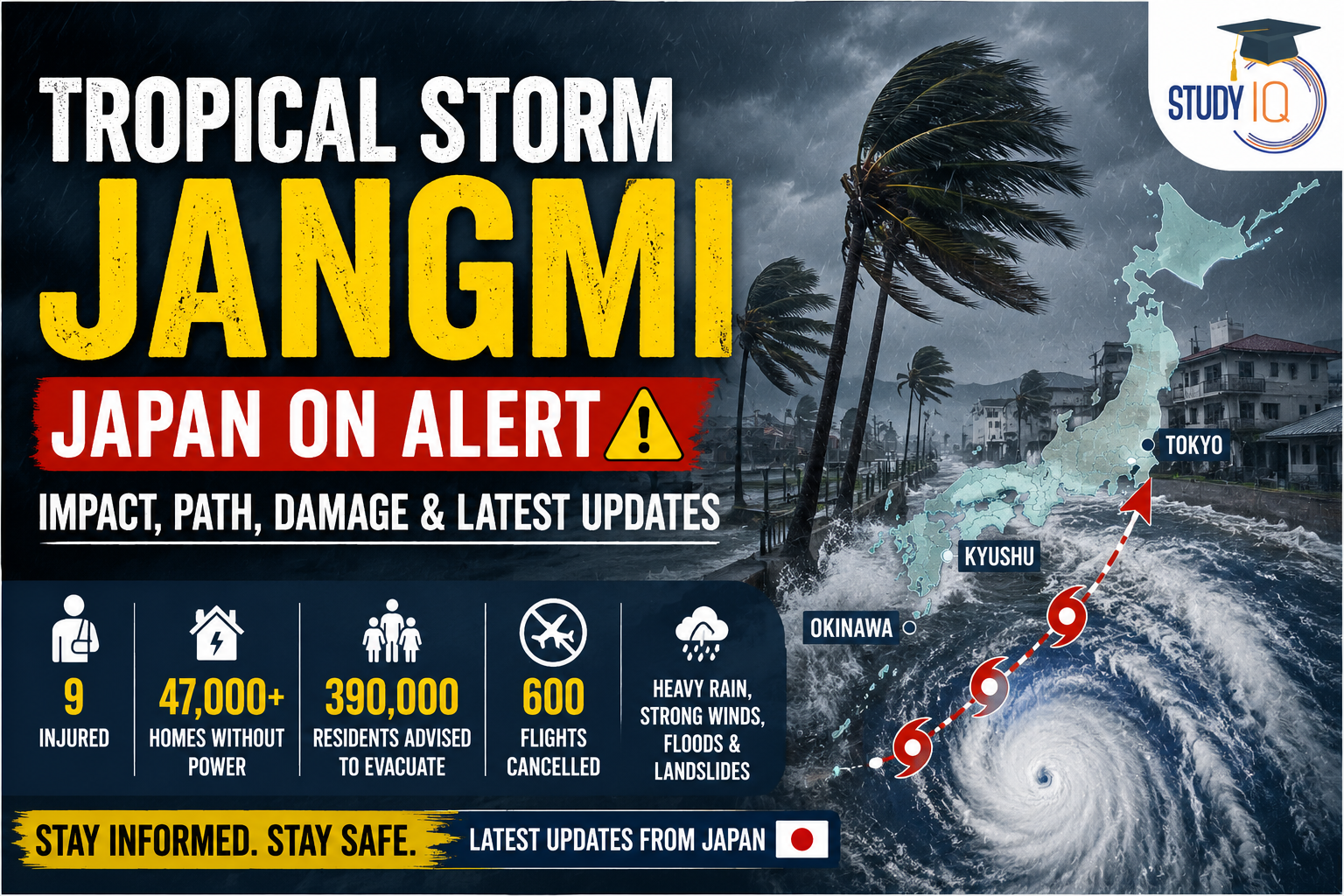
Tropical Storm Jangmi has caused significant disruptions across southwestern Japan, injuring at least nine people, cutting power to tens of thousands of households, and forcing airlines to cancel hundreds of flights. The storm, which was earlier classified as a typhoon, weakened into a severe tropical storm as it moved northward after striking Okinawa and parts of Kyushu in early June 2026.
The Japan Meteorological Agency (JMA) issued warnings for heavy rainfall, flooding, landslides, and high waves, urging residents in vulnerable areas to remain alert and follow evacuation advisories.
Read Also: UPSC Daily Current Affairs 2026
Tropical Storm Jangmi Path: Where Is the Storm Heading?
Jangmi formed over the warm waters of the western Pacific Ocean before intensifying into a typhoon near Japan’s southern islands. After making its closest approach to Okinawa, the storm gradually weakened but continued moving northeastward.
Storm Track Overview
- Originated in the western Pacific Ocean.
- Intensified into a typhoon before approaching Japan.
- Passed near Okinawa, bringing strong winds and heavy rain.
- Moved toward Kyushu and southwestern Honshu.
- Expected to continue northward toward central Japan, including regions around Tokyo.
Meteorologists warned that even after weakening, Jangmi could continue to produce dangerous weather conditions due to its large rainbands and strong gusty winds.
Nine Injured as Strong Winds and Flying Debris Cause Damage
Japanese authorities reported at least nine injuries linked to Tropical Storm Jangmi. According to local media reports, most injuries resulted from:
- Flying debris striking vehicles.
- Individuals losing balance due to powerful wind gusts.
- Falling objects and storm-related accidents.
Although casualties remained relatively limited, officials warned residents not to underestimate the dangers posed by severe tropical storms.
Thousands Without Power Across Okinawa and Kagoshima
One of the most immediate impacts of Tropical Storm Jangmi was widespread disruption to electricity services.
Power Outages Reported
- Approximately 17,000 households lost electricity in Okinawa.
- More than 30,000 households experienced outages in Kagoshima Prefecture.
- Utility crews were deployed to restore damaged power infrastructure.
Strong winds brought down trees and power lines, while heavy rainfall complicated restoration efforts in several locations.
Miyazaki City Issues Evacuation Advisory for Nearly 390,000 Residents
Authorities in Miyazaki City issued evacuation advisories covering the entire city’s population of approximately 390,000 people.
The decision was taken due to concerns over:
- Flash flooding
- River overflow
- Landslides
- Coastal storm surges
Japan’s emergency management agencies urged residents in low-lying and mountainous regions to move to safer locations whenever instructed by local authorities.
Airlines Cancel Hundreds of Flights
The storm significantly affected air travel across Japan.
Flight Cancellations
Japan’s two largest carriers:
- All Nippon Airways (ANA)
- Japan Airlines (JAL)
cancelled a combined 600 flights between June 1 and June 3, affecting thousands of passengers.
Airport operations in Okinawa, Kagoshima, and other southern regions experienced delays and disruptions due to adverse weather conditions.
Rail operators also warned of potential delays and service suspensions as the storm approached more densely populated regions.
Why Tropical Storm Jangmi Remained Dangerous After Downgrading
Many tropical cyclones continue to cause severe impacts even after being downgraded from typhoon status.
In the case of Jangmi:
- Heavy rainfall remained intense.
- Flood risks continued to increase.
- Saturated soil heightened landslide dangers.
- High waves threatened coastal communities.
Meteorologists emphasized that storm intensity should not be judged solely by wind speed, as rainfall-related disasters often account for the majority of damage and fatalities.
Why Japan Frequently Experiences Tropical Storms and Typhoons
Japan’s geographical position makes it one of the world’s most disaster-prone countries.
Key Reasons
1. Location in the Northwest Pacific Basin
The Northwest Pacific is the most active tropical cyclone basin globally, generating nearly one-third of all tropical cyclones each year.
2. Warm Ocean Waters
Sea surface temperatures exceeding 26.5°C provide the energy required for cyclone formation and intensification.
3. Kuroshio Current
The warm Kuroshio Current carries tropical heat northward, creating favorable conditions for storm development near Japan.
4. Mountainous Terrain
Japan’s rugged landscape increases the risk of flash floods and landslides during periods of intense rainfall.
Climate Change and Intensifying Weather Extremes
Scientists have increasingly linked rising global temperatures to more intense rainfall events associated with tropical cyclones.
Warmer oceans:
- Increase atmospheric moisture content.
- Enhance precipitation intensity.
- Raise the risk of coastal flooding due to sea-level rise.
While research continues regarding cyclone frequency trends, experts generally agree that extreme rainfall events are becoming more severe in many regions.
Japan’s Advanced Disaster Management System
Despite significant disruptions, Japan’s disaster preparedness framework helped minimize casualties.
The country relies on:
- Advanced weather forecasting technologies.
- Real-time mobile alert systems.
- Satellite-based monitoring.
- Hazard maps and evacuation planning.
- Public awareness campaigns.
These measures have made Japan a global leader in disaster risk reduction and emergency response.
Tropical Storm Jangmi 2026: Key Facts
| Category | Details |
|---|---|
| Storm Name | Jangmi |
| Classification | Severe Tropical Storm |
| Affected Areas | Okinawa, Kyushu, Kagoshima, Miyazaki |
| Injuries Reported | 9 |
| Households Without Power | More than 47,000 |
| Evacuation Advisory | Approximately 390,000 residents |
| Flights Cancelled | Around 600 |
| Major Threats | Flooding, landslides, strong winds, high waves |
Conclusion
Tropical Storm Jangmi 2026 has once again highlighted Japan’s vulnerability to powerful weather systems originating in the western Pacific. While the storm weakened from typhoon status, it continued to cause significant disruptions through heavy rainfall, power outages, transportation delays, and evacuation advisories. As climate-related weather extremes become increasingly prominent, investments in forecasting technology, resilient infrastructure, and community preparedness remain essential for reducing disaster risks and protecting lives.
 India–Poland Relations 2026: Strategic...
 Supreme Court on Children's Right to Int...
 Daily Current Affairs PDF 2026: Download...














 WhatsApp