
Table of Contents
Context
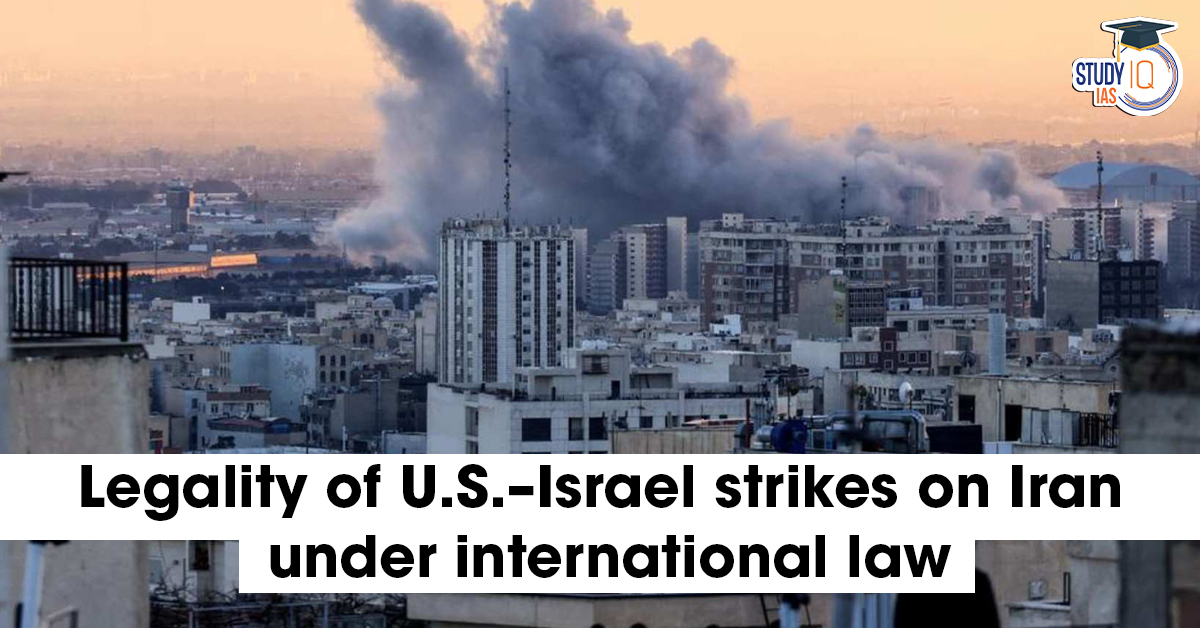
- S., Israel launches strikes on Iran as a ‘pre-emptive’ response to an imminent threat, raising questions about the legality of the use of force under the UN Charter; a missile strike on a girls’ primary school raises concerns over violations of International Humanitarian Law
Israel Attack Against UN Charter
UN Charter addresses the legality of starting a war (jus ad bellum). Israel and the U.S.strikes on Iran, framing the operation as a ‘pre-emptive’ response is against the UN charter
- Prohibition on the Use of Force: Article 2(4) of the UN Charter prohibits all member states from threatening or using force against the ‘territorial integrity’ or ‘political independence’ of another state.
- Absence of UN Security Council Authorization: Under the Charter, only the UN Security Council may authorise the ‘use of force’ against a member state in response to breaches of international peace.
- Preemptive strike against the UN charter: The UN charter (Article 51) permits the ‘use of force’ in self-defence, but only in response to an actual armed attack.
- g. Since Iran had not recently attacked either Israel or the United States, the legal basis for invoking Article 51 remains contested.
- Conditions for Anticipatory self defence: Even under broader interpretations, pre-emptive force is lawful only if Iran’s leadership had decided to attack the U.S, it can do so, or Force was the last resort. However, these conditions were not met as:
- During the June 2025 attack, Donald Trump had claimed that Iran’s nuclear programme had been “obliterated” thus it lacked capability
- The attack happened during the rounds of diplomatic negotiations in which Iran was nearing a deal to abjure nuclear weapons, freeze enrichment and hold zero stockpiles of weapons-grade material, in exchange for structured sanctions relief.
International Humanitarian Law (IHL)Violation
IHL governs how wars are fought (jus in bello) and ensures humane conduct regardless of the war’s initiation.A missile hit a girls’ primary school in Iran killing around 150 people and injuring nearly 100. Many of the victims are schoolchildren who violate the IHL as:
- Violation of the principle of distinction: ‘combatants’ and ‘military targets’ be clearly separated from ‘civilians’ and ‘civilian objects’ such as schools, hospitals, places of worship, and public transport, which was blatantly transgressed.
- Thus, If the school in Minab was not used for military purposes, the strike may violate the rule
- Convention on the Rights of the Child: This recognises children as rights-bearing individuals and requires States Parties, under Article 38(4), to take all feasible measures to ensure the protection and care of children affected by armed conflict.
- Rome Statute of the International Criminal Court: It defines the intentional targeting of civilians and attacks on buildings dedicated to education as war crimes.
- Thus, intentional attacks on Minhab School are considered war crimes.
However, IHL recognises that civilian objects may be incidentally affected during attacks on military objectives. However, such incidental harm to civilians or civilian objects is lawful only if it satisfies the requirements of ‘proportionality’, ‘precaution’, and ‘military necessity’.
- Principle of Precaution: Combatants must take feasible steps—such as verifying targets and selecting appropriate weapons—to minimise civilian casualties.
- Principle of Proportionality: Even when attacking legitimate military targets, the expected civilian harm must not be excessive compared with the anticipated military advantage.
- Principle of Military Necessity: Force may be used only when it is necessary to achieve a legitimate military objective.
Thus If the school was hit while targeting a nearby military facility, the legality depends on whether commanders took adequate precautions and whether civilian harm was proportionate.
Strategic Logic Behind the Conflict
- Possible Objective of Regime Change: Analysts suggest the military campaign may aim at weakening the Iranian regime and enabling political transformation.
- Energy and Geopolitical Calculations: It aims to integrate currently sanctioned Iranian oil into world markets under a more friendly government.
- Geostrategic objectives: Reduce Russia’s energy leverage over Europe and dilute China’s clout in the region by pulling Iran and its energy resources into the West’s orbit.
- Decapitation of Iranian Leadership: The killing of Ali Khamenei and other senior officials was intended to destabilise the Iranian regime and create conditions for political transformation.
- Destruction of Nuclear and Missile Infrastructure: Military operations have targeted uranium enrichment sites, missile launchers, and defence facilities in an attempt to cripple Iran’s strategic capabilities.
- Reducing Iran’s Regional Influence. By weakening Iran’s proxies and military assets, Washington and Tel Aviv aim to reshape the regional balance of power in West Asia.
|
Read More Notes |
|
| Environment Notes | Art and Culture Notes |
| Science and Tech | History Notes |
| Geography Notes | Indian Polity Notes |
| General Knowledge | International Relation |
|
Explore StudyIQ Courses |
|
 Mascots for Census 2027 in India: Theme,...
 Gravity Bombs Explained: Types, Features...
 India vs New Zealand: India Clinch T20 W...










 WhatsApp





