
Table of Contents
The Supreme Court of India, in Bhika Ram v. State of Rajasthan (2025)SC delivered by a Bench comprising Justices Sanjay Kumar and Alok Aradhe, set aside a Rajasthan government notification that had created revenue villages named after private individuals. By overturning the order of the Division Bench of the Rajasthan High Court, the Court reaffirmed a foundational principle of administrative law: the State is bound by its own policies, and administrative convenience or delay cannot legitimise an action that was illegal from its inception.
This decision assumes significance not merely as a dispute over village nomenclature but as a reaffirmation of constitutional equality, non-arbitrariness, and the rule of law in executive governance.
Background: Creation of the Revenue Villages
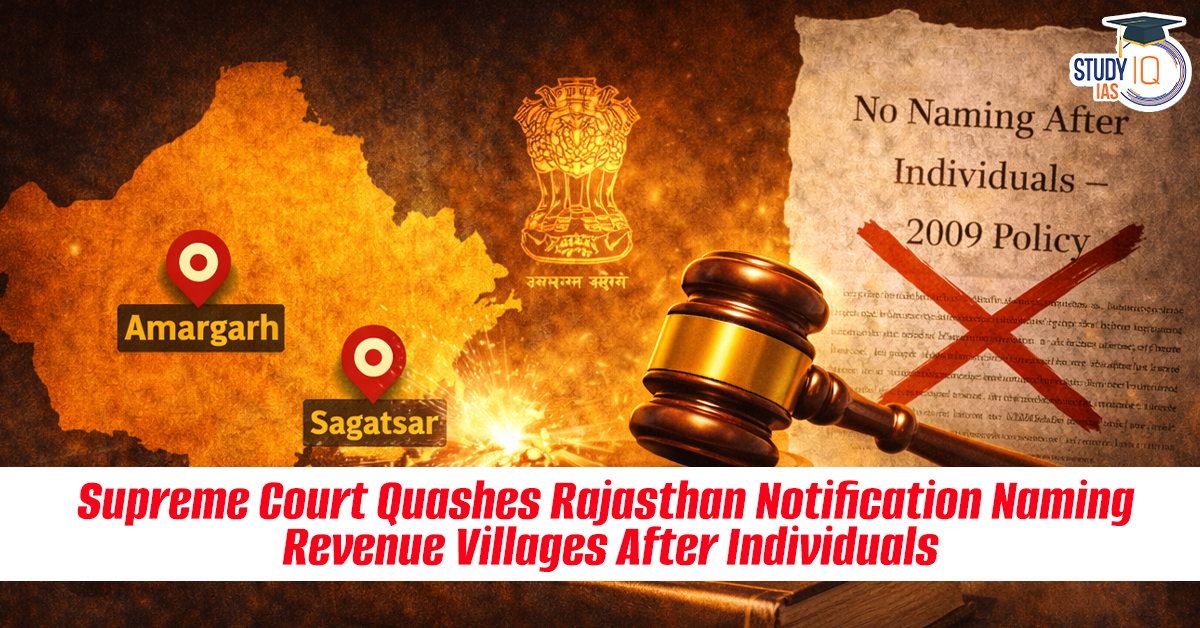
In December 2020, the Rajasthan government notified the creation of four new revenue villages—Nainoni Darziyon Ki Dhani, Sagatsar, Amargarh, and Hemnagar—by carving them out of the existing revenue village of Sohda in Barmer district, a sparsely populated desert region of western Rajasthan.
The administrative rationale was pragmatic. Given the scattered nature of habitations and the vast geographical expanse, residents sought smaller revenue units to facilitate efficient land administration, mutation, and inheritance records. To fulfil statutory requirements, two residents—Amarram and Sagat Singh—donated portions of their land for the establishment of the new villages.
Before issuance of the notification, the Tehsildar certified that all conditions for village creation were met and specifically recorded that the proposed villages were not associated with any individual, caste, religion, or community. On this basis, the District Collector formalised the villages, and their names were entered into official revenue records.
For nearly five years, the matter attracted no controversy.
The Legal Issue: Violation of Naming Policy
The dispute resurfaced in 2025 during a state-wide reorganisation of gram panchayat boundaries. Objections were raised, pointing out that “Amargarh” and “Sagatsar” were derived from the names of individuals who had donated land, which appeared to violate existing government policy.
Under Section 16 of the Rajasthan Land Revenue Act, 1956, the State has the authority to create and alter revenue villages. However, this power is regulated by executive policy. A 2009 government circular, particularly Clause 4, expressly prohibits naming a revenue village after any person, religion, caste, or sub-caste.
The objective of this restriction, as consistently recognised by courts, is to prevent symbolic state endorsement of individuals or groups, thereby safeguarding communal harmony and social neutrality.
Proceedings Before the High Court
A Single Bench of the Rajasthan High Court, applying this policy framework, quashed the 2020 notification in July 2025. The court held that the naming of the villages was contrary to Clause 4 of the 2009 circular and permitted the State to rename them in accordance with policy.
On appeal, however, a Division Bench reversed this decision. It adopted a timing-based approach, observing that:
- The villages were created in December 2020.
- Main High Court judgments strictly enforcing the naming restriction were delivered only in 2025.
- Reopening completed administrative actions could disturb settled matters and potentially “open a Pandora’s Box”.
Accordingly, the Division Bench allowed the villages to retain their names.
Supreme Court’s Reasoning and Findings
The Supreme Court decisively rejected the High Court’s reasoning and restored the Single Bench’s order. The Court clarified that the issue was not one of retrospective application, but of initial illegality.
Main observations of the Court include:
- Binding Nature of Policy Decisions
The 2009 circular was already in force when the villages were named. The Court held that executive policy decisions bind the Government, unless amended, withdrawn, or replaced in a lawful manner. - Illegality at Inception Cannot Be Cured by Time
The breach occurred at the very moment the villages were named. Merely because the issue was flagged years later does not legitimise an action that was unlawful from the outset. - Article 14 and Administrative Arbitrariness
The Court held that any action taken in violation of a binding policy, without valid justification, is arbitrary and violative of Article 14 of the Constitution. Administrative finality, the Court emphasised, cannot sanctify an illegality. - Purpose of the Naming Restriction
Clause 4 of the circular was framed with the express object of maintaining communal harmony. Naming public administrative units after individuals risks creating symbolic preference and social imbalance, which the State must avoid.
Consistency with Earlier Judicial Approach
The judgment aligns with earlier decisions, including a February 2025 ruling of the Rajasthan High Court concerning village names such as “Gogaji Ki Jaal”, where the Court held that naming a revenue village after a local deity worshipped by a specific community violated the same 2009 circular.
Across these cases, courts have consistently interpreted the naming restriction as substantive rather than procedural, rooted in constitutional values of secularism, equality, and neutrality of the State.
Conclusion
The Supreme Court’s decision serves as a clear reminder that executive discretion is not unfettered. Even well-intentioned administrative actions—such as easing land governance through village reorganisation—must strictly comply with existing policies and constitutional principles. By holding that administrative convenience, delay, or perceived finality cannot override illegality, the Court has reinforced the rule of law and the binding nature of governmental policy. The judgment also underscores the importance of symbolic neutrality in public administration, ensuring that State actions do not, even inadvertently, confer undue recognition on individuals or communities. In doing so, the Court has reaffirmed that constitutional equality and policy discipline remain paramount in governance, regardless of how quietly or long an illegality may have gone unnoticed.










 WhatsApp





