
Table of Contents
Context: Companies like Japan’s Shimizu Corporation are now proposing mega-scale engineering projects to make space-based solar power a reality.
Space Based Solar Power Core Concepts: Orbit vs. Lunar Surface
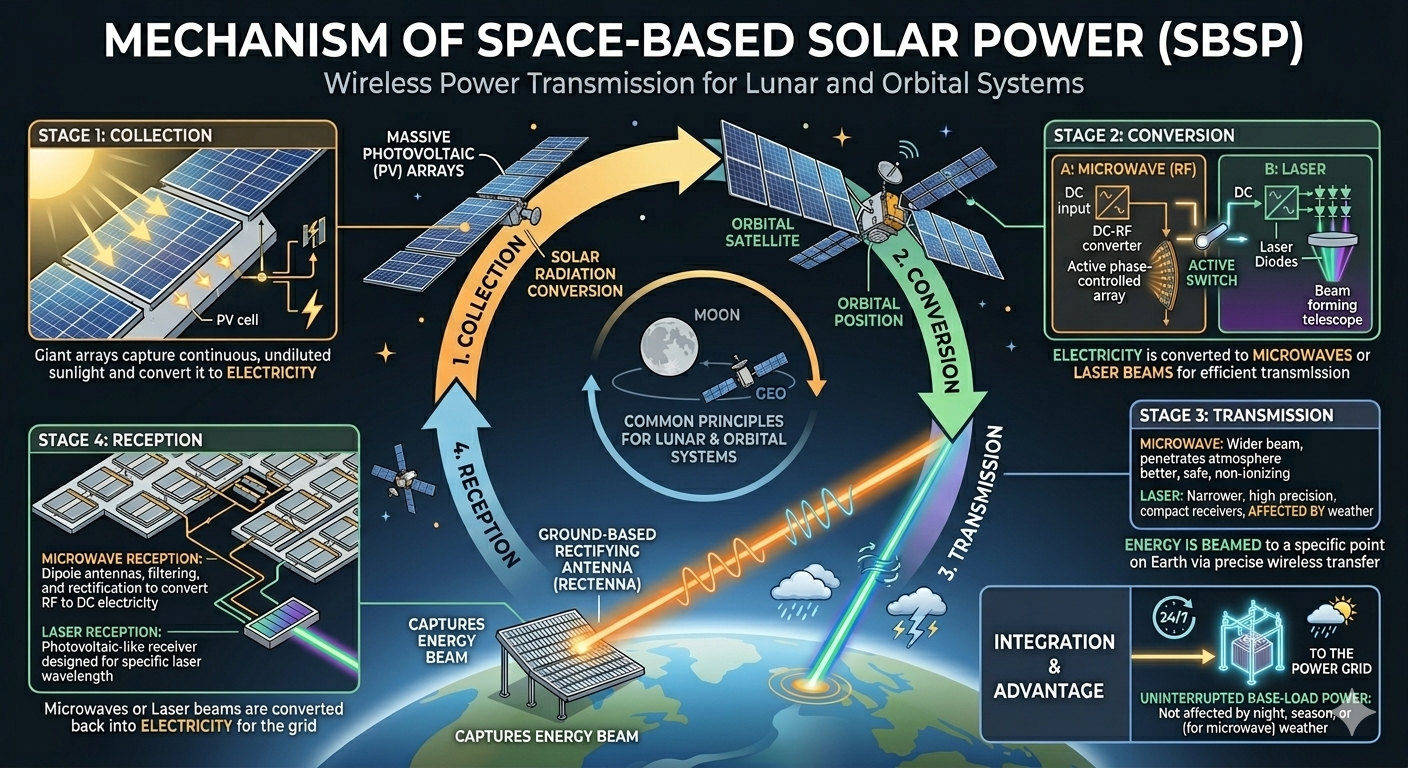
The fundamental goal is to collect sunlight where it is most abundant, outside Earth’s atmosphere, and transmit it back for consumption.
- The “Lunar Ring” Proposal: Shimizu Corporation suggests an 11,000 km belt of solar panels along the moon’s equator. Robots would build this structure using lunar soil (regolith) and beam the energy to Earth via microwaves.
- Space-Based Solar Power (SBSP): A more traditional concept involving giant arrays of satellites in Geostationary Orbit (GEO). Unlike Earth-based panels, these would collect sunlight 24/7, unaffected by weather, seasons, or the day-night cycle.
Challenges: Why It Isn’t Here Yet?
- Logistical Costs: Even with cheaper launches (e.g., SpaceX), transporting thousands of tonnes of hardware to the moon or deep orbit remains prohibitively expensive.
- Energy Loss: Beaming power through Earth’s atmosphere is inefficient; a significant portion of the energy is lost as heat during transmission.
- Space Debris: In orbit, a single collision with a piece of space junk could destroy a multi-billion dollar array, creating even more debris in a “Kessler Syndrome” chain reaction.
- The Terrestrial Rival: Rapidly falling costs and increasing efficiency in terrestrial solar and battery technologies make the massive financial and logistical risks of space-based power systems currently difficult to justify.

 Role of Midwives in Maternity Care: Func...
 Tar-balls Management Rules 2026: Key Pro...
 Multi-Hazard Early Warning Decision Supp...













 WhatsApp





