
Table of Contents
The Sharavathi Lion-Tailed Macaque Sanctuary is an ecologically significant protected area located in the Western Ghats, a global biodiversity hotspot. Recently, it has gained attention due to the proposed Sharavathi Pumped Storage Hydroelectric Project (2000 MW), triggering a major environment vs development debate.
Location and Geographical Features
-
Located in the Western Ghats across:
-
Shivamogga district
-
Uttara Kannada district of Karnataka
-
-
Named after the Sharavathi River, which:
-
Flows entirely within Karnataka
-
Drains into the Arabian Sea at Honnavar
-
The region receives high rainfall, supporting dense forests and rich biodiversity.
Formation and Expansion
-
Initially known as Sharavathi Valley Wildlife Sanctuary
-
Expanded in 2019 by:
-
Merging with Aghanashini Lion-Tailed Macaque Conservation Reserve
-
Including adjacent forest areas
-
Aim: To create a continuous habitat for endangered species, especially the Lion-Tailed Macaque.
Flora: Unique Ecosystem
The sanctuary hosts diverse forest types:
1. Southern Tropical Evergreen Forests
-
Dense, multi-layered vegetation
-
High endemism
2. Semi-Evergreen Forests
-
Transitional ecosystem between evergreen and deciduous forests
3. Myristica Swamps (Key Highlight)
-
Rare freshwater swamp ecosystems
-
Dominated by nutmeg family (Myristicaceae) trees
-
Considered ancient (relict) ecosystems
-
Function as:
-
Carbon sinks
-
Water regulators
-
Biodiversity hotspots
-
These swamps are extremely fragile and globally rare.
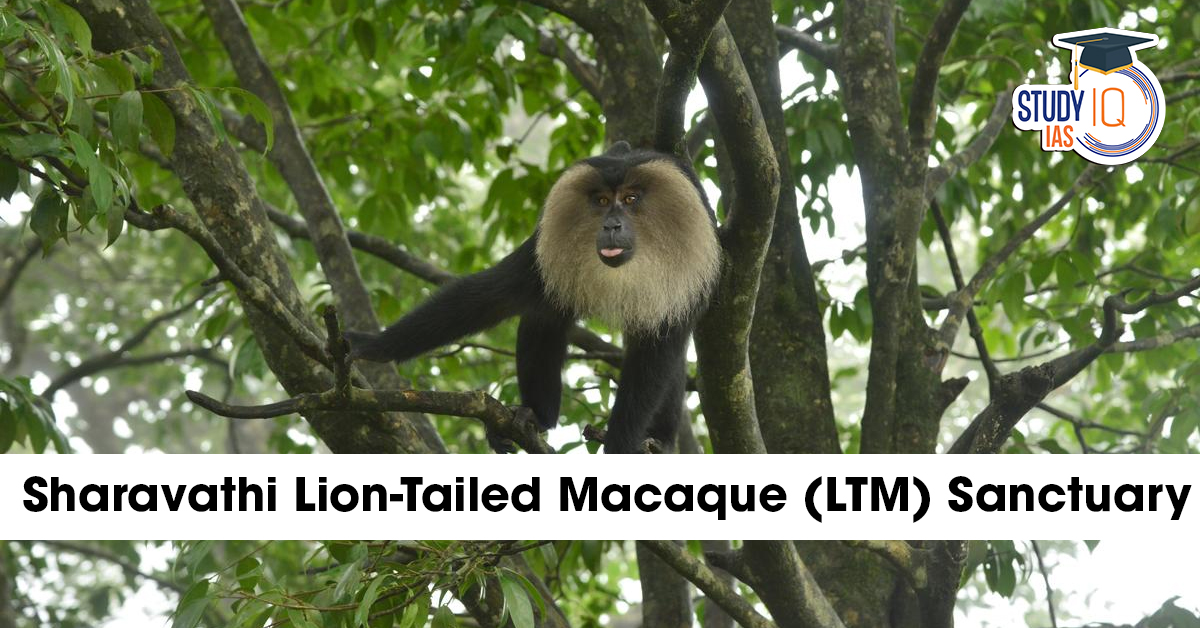
Flagship Species: Lion-Tailed Macaque
-
Scientific Name: Macaca silenus
-
Status: Endangered (IUCN Red List)
-
Endemic to: Western Ghats
Key Features:
-
Black body with a silver-white mane
-
Arboreal (tree-dwelling) species
-
Highly sensitive to habitat fragmentation
It acts as an indicator species for healthy evergreen forests.
Other Important Fauna
-
Tiger
-
Leopard
-
Malabar Giant Squirrel
-
Great Indian Hornbill
-
King Cobra
The sanctuary supports a rich food chain and ecological balance.
Environment vs Development Debate
Project: Sharavathi Pumped Storage Hydroelectric Project (2000 MW)
A pumped storage project:
-
Stores energy by pumping water uphill
-
Releases it to generate electricity during peak demand
Arguments in Favor (Development Perspective)
-
Boosts renewable energy capacity
-
Ensures grid stability
-
Helps meet climate commitments
-
Reduces dependence on fossil fuels
Environmental Concerns
-
Habitat fragmentation of Lion-Tailed Macaque
-
Loss of Myristica swamps and forest cover
-
Threat to endemic biodiversity
-
Disruption of ecological corridors
-
Impact on hydrological systems
Central Issue: Balancing energy security with ecological conservation.
Conclusion
The Sharavathi LTM Sanctuary exemplifies the development–conservation dilemma in India. While hydropower projects support clean energy goals, they can also cause irreversible ecological damage in fragile ecosystems like the Western Ghats.
|
Read More Notes |
|
| Environment Notes | Art and Culture Notes |
| Science and Tech | History Notes |
| Geography Notes | Indian Polity Notes |
| General Knowledge | International Relation |
|
Explore StudyIQ Courses |
|
 The Carbon Credit Paradox: Industrial CC...
 RELIEF Scheme to Support Exporters Amid ...











 WhatsApp





