
Table of Contents
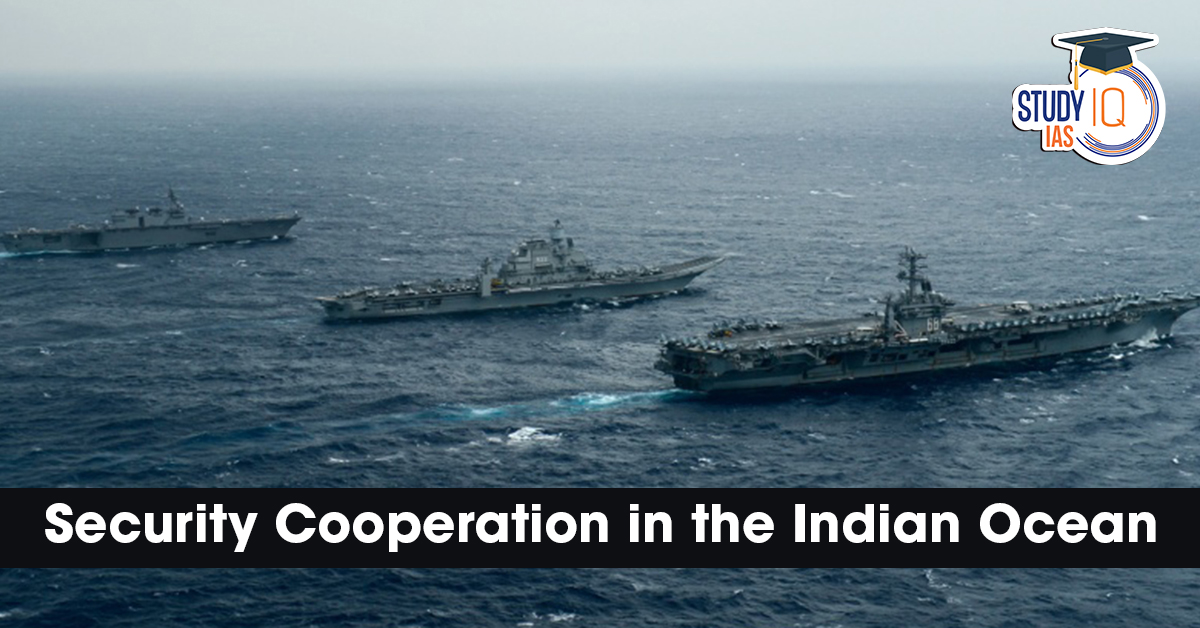
The Indian Ocean carries over 80% of the world’s oil trade and connects three continents, making it one of the most strategically vital regions on earth. Yet, it remains one of the least institutionalised when it comes to security cooperation. In 2025, the Colombo Security Conclave (CSC) has emerged as the most promising home-grown platform to fill this gap. With Seychelles joining as the sixth full member and Malaysia attending as a guest at the New Delhi summit, the CSC is rapidly becoming the centrepiece of a new, inclusive maritime security architecture led by India.
What is the Colombo Security Conclave (CSC)?
Started in 2011 as a quiet trilateral dialogue between India, Sri Lanka and the Maldives, the CSC lost momentum for a few years due to political changes in member countries. It was formally revived in 2020 with a broader mandate and has grown steadily ever since.
Current membership (2025): India • Sri Lanka • Maldives • Mauritius • Bangladesh • Seychelles Guest: Malaysia
The Conclave now operates at National Security Adviser level and focuses on five key pillars:
- Maritime Safety and Security
- Counter-Terrorism and Radicalisation
- Combating Trafficking and Transnational Organised Crime
- Cyber Security
- Humanitarian Assistance and Disaster Relief (HADR)
Why the Indian Ocean Needs Stronger Security Cooperation
- Economies of island and coastal nations depend almost entirely on the sea — fisheries, tourism, ports, and shipping lanes.
- Traditional threats like piracy have declined, but new non-traditional threats are rising fast: drug smuggling, human trafficking, illegal fishing, and cyber attacks on critical port infrastructure.
- Climate change and extreme weather events hit small island states hardest, making HADR a permanent agenda item.
- Unlike the South China Sea or the Atlantic, the Indian Ocean has no single overarching security organisation — mechanisms remain scattered and overlapping.
This is where the CSC steps in: small enough to take quick decisions, large enough to matter, and deliberately non-confrontational.
India’s Unique Template: SAGAR and Beyond
India has consciously avoided great-power-style alliances and instead built a layered, cooperative model centred on its SAGAR (Security And Growth for All in the Region) vision, launched in 2015 and expanded into MAHASAGAR in recent years.
Key elements of India’s approach:
- Information Fusion Centre – Indian Ocean Region (IFC-IOR) in Gurugram for real-time maritime domain awareness
- Gifting of patrol vessels, coastal radars, and Dornier aircraft to neighbours
- Regular joint exercises (SLINEX, DOSTII, MILAN) and coordinated patrols
- Leadership in Indian Ocean Naval Symposium (IONS) and assumption of IORA chairmanship (2025–2027)
- First-responder role in disasters (cyclone relief, COVID vaccine delivery under Mission SAGAR)
- Active participation in Quad maritime initiatives without turning CSC into an anti-China bloc
This combination of capacity building, information sharing, and disaster response has earned India trust that pure military alliances rarely achieve.
The China Challenge: Divergent Perceptions
India views the expanding Chinese presence — port projects, research vessels, and naval deployments — as a strategic concern. Most CSC members, however, also receive major infrastructure funding from China and do not share the same level of threat perception. The CSC cleverly sidesteps this divide by focusing on common functional threats (trafficking, illegal fishing, disaster relief) rather than naming any country. This keeps the door open for cooperation while quietly strengthening regional resilience.
Challenges Ahead for the CSC
- Lack of a permanent secretariat (still ad-hoc)
- Domestic political volatility in some member states
- Resource constraints of smaller island nations
- Overlapping mandates with IORA, IONS, and other forums
- Balancing big-power competition without alienating partners
The Road Ahead
The 2025 expansion shows the model is working. Possible next steps:
- Establishing a small permanent secretariat
- Inviting Mozambique, Comoros or Tanzania in the coming years
- Creating a dedicated CSC disaster-response task force
- Deepening Blue Economy and marine environment cooperation under India’s IORA chairmanship
Conclusion
The Colombo Security Conclave, backed by India’s SAGAR vision and practical initiatives like IFC-IOR and capacity-building grants, offers a made-in-the-region template for Indian Ocean security: inclusive, development-oriented, non-confrontational, and focused on real threats that affect people’s daily lives.
In an ocean historically divided by colonial spheres and contemporary rivalries, the CSC is quietly building something rare — a cooperative security community led by the region, for the region.
 Mascots for Census 2027 in India: Theme,...
 The Legality of The U.S.-Israel Strikes ...
 Gravity Bombs Explained: Types, Features...







 WhatsApp





