
Table of Contents
Context
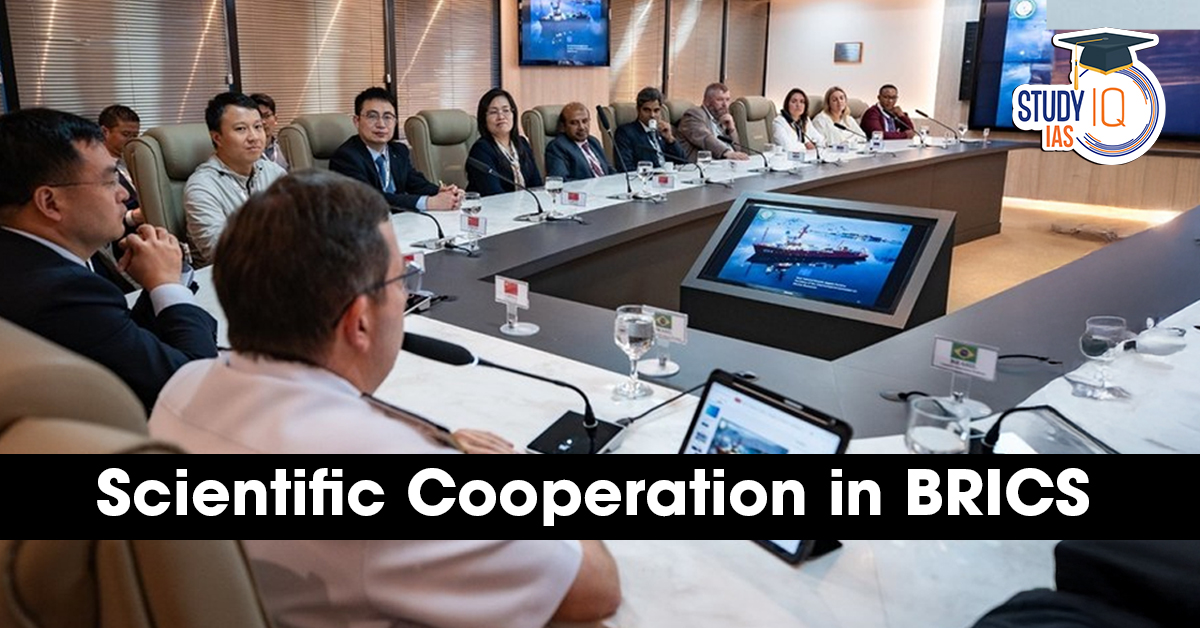
- BRICS (Brazil, Russia, India, China, South Africa + new members) promotes a multipolar world order and cooperation in science, technology and innovation (STI) to reduce Western dominance.
Importance of STI Cooperation in BRICS
- Alternative to Techno-Nationalism: In a world of sanctions and export controls, BRICS enables collaborative research
- g., joint vaccine research during COVID-19.
- Global South Capacity Building: Helps reduce technology dependence by sharing knowledge.
- g., AI and digital health initiatives among members.
Institutional Framework of Cooperation
- Formalisation of STI Agenda (2015 MoU): Established STI as a core pillar, enabling structured collaboration and funding.
- STIEP Working Group: Promotes innovation, entrepreneurship, and technology transfer
- g., startup networks and incubators.
- Role of National Agencies: Countries coordinate through agencies (e.g., CSIR and DBT in India) to implement projects.
- BRICS Technology Transfer Centre (TTC): Facilitates cross-border technology commercialisation, though large-scale success remains limited.
- AI as Strategic Pillar (2025 Declaration): Promotes inclusive and development-oriented AI governance.
- BRICS+ Expansion: Inclusion of countries like UAE, Egypt, Iran enhances global reach and knowledge sharing.
Key Areas of Collaboration
- From Basic Science to Applied Innovation: Shift from fundamental research to technology transfer and commercialisation.
- Socially Relevant Sectors: Focus on energy, water, health, environment (e.g., climate tech and public health research).
- Advanced Technologies: Collaboration in AI, High Performance Computing (HPC), ICT, and space (e.g., BRICS Institute of Future Networks).
Achievements
- Growing Research Collaboration: Increased joint projects and knowledge exchange (e.g., ICT and HPC progress).
- Space Cooperation: 2021 agreement enhanced collaboration in satellite data sharing and applications.
- Pandemic Response: Strengthened cooperation in vaccines, biosecurity, and digital health systems.
Challenges
- Low R&D Investment (GERD): Except China, BRICS countries have lower research spending compared to advanced economies like South Korea.
- Uneven Capacity Among Members: Differences in scientific capabilities (e.g., weaker systems in new BRICS+ members).
- Limited Commercialisation: Many innovations fail to reach market scale despite research success.
- Lack of Permanent Institutional Mechanism: Rotational leadership leads to discontinuity in long-term projects.
- Concerns in BRICS+ Expansion
- Heterogeneity of Members: Diverse economies make policy coordination difficult (e.g., differing priorities of Iran vs UAE).
- Limited Participation: New members show uneven involvement in joint research calls.
Way Forward
- Permanent STI Mechanism: Establish a central BRICS Secretariat (like EU’s Horizon Programme) for continuity.
- Mega-Science Projects: Launch large projects (e.g., climate research or space missions) to deepen cooperation.
- Strengthening Innovation Systems: Increase R&D funding and infrastructure across members.
- Focus on Governance of Technology: Develop frameworks for AI regulation, digital ethics, and emerging tech governance.
Role of India (2026 Presidency)
- Leadership Opportunity: India can drive focus on resilience, innovation, and sustainability.
- Bridging Global South Gaps: Promote cooperation in digital divide, climate resilience, and public health.
|
Read More Notes |
|
| Environment Notes | Art and Culture Notes |
| Science and Tech | History Notes |
| Geography Notes | Indian Polity Notes |
| General Knowledge | International Relation |
|
Explore StudyIQ Courses |
|
 Explained: India’s West Asia Reset Ami...
 Cholesterol Makes Cell Nuclei Squishy: H...










 WhatsApp





