
Table of Contents
Context
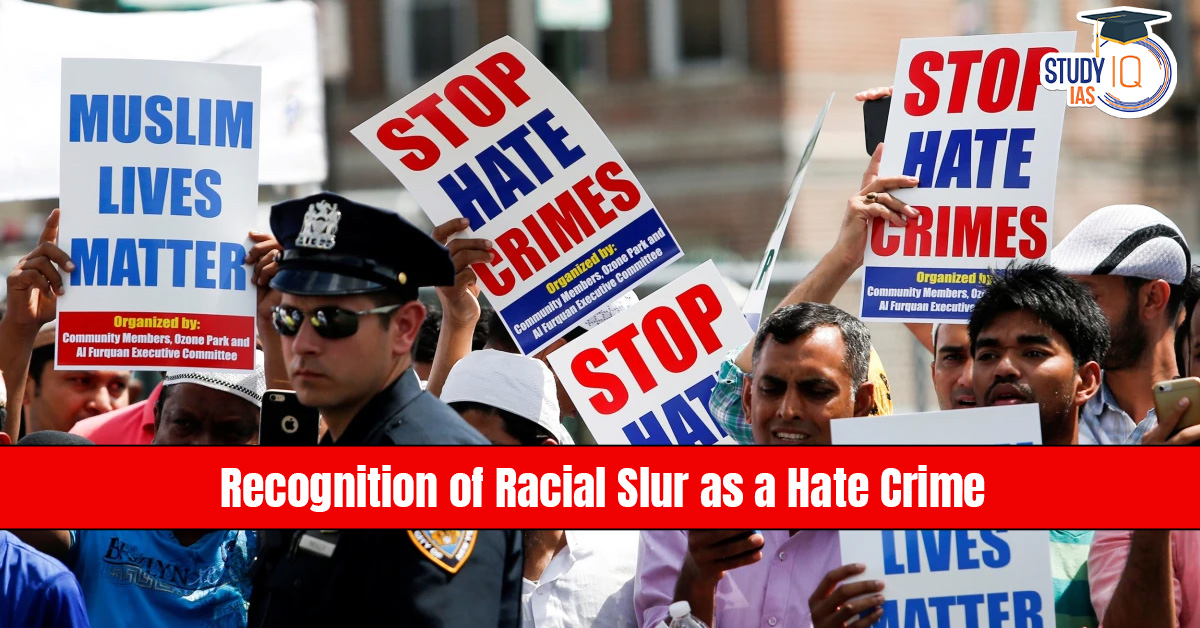
The Supreme Court of India has asked the Union government to examine a plea seeking recognition of racial slurs as a distinct hate crime category. The matter arose during hearings on a petition that highlighted gaps in India’s current criminal law framework regarding racially motivated violence.
About Hate Speech
The United Nations describes hate speech as any form of communication, whether spoken, written, or behavioural, that expresses hostility or employs insulting or discriminatory language against an individual or group based on identity markers such as religion, ethnicity, nationality, race, skin colour, social origin, gender, or similar attributes.
Notably, Indian law does not yet provide a precise statutory definition of hate speech.
| Judicial concerns on racial slurs |
| ● The Court cautioned that classifying crimes purely on the victim’s identity may risk social fragmentation.
● It observed that, after decades of Independence, national unity should be strengthened through equal treatment of all citizens. ● The bench acknowledged the seriousness of hate motivated offences and sought the government’s considered response. ○ The petition claims the incident is part of a broader pattern of racial hostility faced by individuals from the North Eastern region. ○ The petition argues that India’s criminal justice system currently treats racially motivated attacks as ordinary crimes, without special recognition of hate intent. ● The recent criminal law reforms, including the Bharatiya Nyaya Sanhita, address hate related harms in general terms but do not specifically recognize racial slurs as a separate hate offence. ● It calls for clearer statutory recognition and procedural safeguards. |
India’s Legal Framework Against Hate Speech
- BNS Section 196 (earlier IPC Section 153A): Punishes acts that promote hostility between groups on grounds such as religion, race, or language.
- BNS Section 299 (earlier IPC Section 295A): Penalises intentional and malicious actions aimed at hurting religious sentiments.
- BNS Section 353: Targets statements that may incite offences against the State or disrupt public order.
- Information Technology Act, 2000 Section 66A: Earlier used to regulate offensive online content but struck down by the Supreme Court of India in the Shreya Singhal v. Union of India for vagueness and excessive breadth.
- Tehseen Poonawalla v. Union of India: Directed States to appoint nodal officers to prevent hate crimes and mob violence, particularly targeted attacks.
Key Features of the Karnataka Hate Speech Bill, 2025
- Explicit Definition: Includes speech that causes harm, hostility, or disharmony based on religion, caste, sex, gender identity, sexual orientation, race, disability, or place of birth.
- Punishment Framework: Provides imprisonment from 2 to 10 years along with fines depending on gravity and repetition.
- Collective Liability: Office-bearers of organisations may be held responsible if offences are linked to the organisation.
- Online Regulation: Empowers the State to block or restrict digital hate content.
- Suo Motu Powers: Allows police to initiate action without a formal complaint in specified situations.
Challenges in Regulating Hate Speech
- Low Conviction Rate: Only about one-fifth of cases under Section 153A end in conviction (NCRB data).
- Risk of Over-criminalisation: More than 2,000 arrests annually but weak evidence often results in acquittals.
- Digital Amplification: Roughly 70 percent of hate content originates from online or social media platforms (NCRB).
- Subjectivity in Definition: In 2023, the Supreme Court of India observed the difficulty of objectively defining hate speech, increasing the risk of misuse.
- Political Context: FIRs related to hate speech reportedly rise by 30 to 50 percent during election periods (Common Cause, 2022).
Important Supreme Court Judgments
- Pravasi Bhalai Sangathan v. Union of India: The Court declined to create new criminal provisions without legislation and asked the Law Commission to examine the issue.
- Ramji Lal Modi v. State of Uttar Pradesh: Upheld the validity of Section 295A IPC, holding that speech deliberately outraging religious feelings can be restricted to maintain public order.
- Shreya Singhal v. Union of India: Invalidated Section 66A of the IT Act for being vague and chilling free speech online.
- Tehseen Poonawalla v. Union of India: Emphasised that protecting citizens from hate crimes is a “sacrosanct duty” of the State.
Way Forward
- Clear Statutory Definition: Adopt a harm-based test focusing on incitement and targeted harm, as suggested in the Law Commission’s 267th Report.
- Independent Nodal Mechanism: Establish monitoring bodies independent of the police hierarchy, similar to the UK’s Crown Prosecution Service hate crime units.
- Digital Compliance Protocols: Introduce mandatory 48-hour takedown timelines and traceability for repeat offenders online.
- Strengthen Evidence Standards: Develop robust forensic protocols for audio and video hate content to improve conviction rates, building on cyber-forensic practices such as those used by the Delhi Police.
|
Read More Notes |
|
| Environment Notes | Art and Culture Notes |
| Science and Tech | History Notes |
| Geography Notes | Indian Polity Notes |
| General Knowledge | International Relation |
|
Explore StudyIQ Courses |
|
 World Day of Social Justice 2026: Theme,...
 NHAI to Develop India’s First Bee Corr...
 Loggerhead Turtles – Ecology, Habitat,...











 WhatsApp





