
Table of Contents
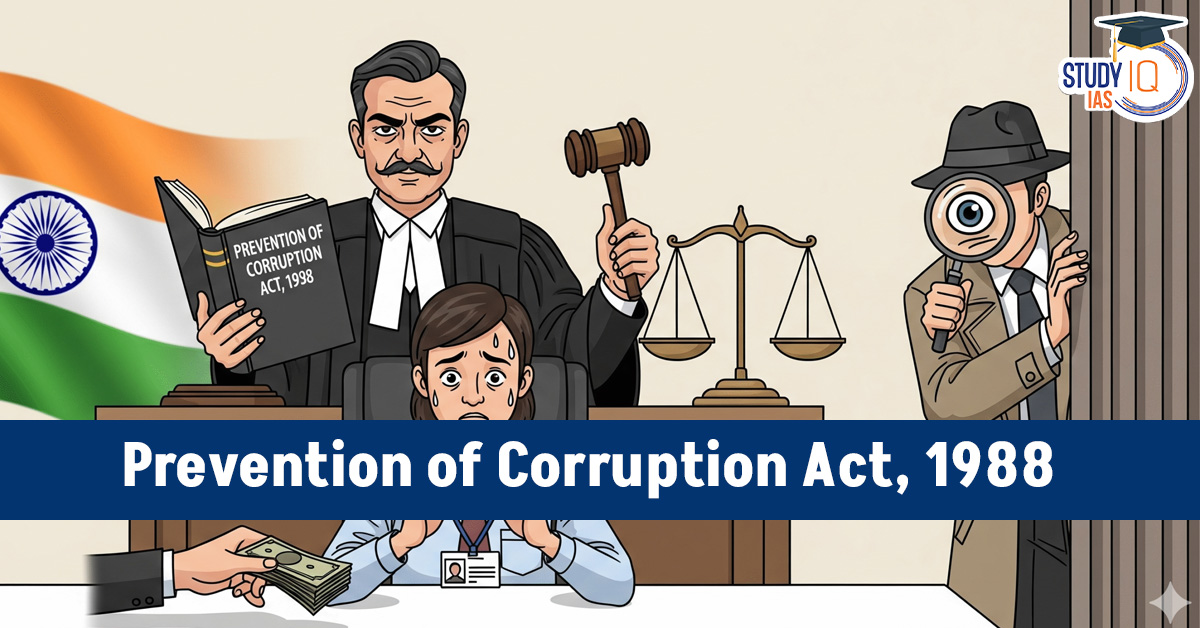
Corruption continues to be a significant obstacle to democratic administration, economic advancement, and public confidence in institutions. The Prevention of Corruption Act, 1988 (PCA) serves as the primary legal foundation for addressing corruption in public life in India. The Act was established to unify and enhance previous anti-corruption legislation, demonstrating India’s dedication to integrity in public administration. Over the years, judicial interpretation, legislative amendments, and international commitments have influenced its scope and implementation.
The Prevention of Corruption Act, 1988 is a significant statute aimed at combating the malady of corruption. It is an efficacious tool to mitigate this malevolence. The efficacy of the movement against the evil of corruption is contingent upon the implementation of this legislation. Combating corruption has emerged as a critical developmental concern in India in recent years. An increasing number of policymakers, businesses, and civil society organizations have commenced addressing the issue transparently. The overall comprehension of corruption has markedly increased. Until recently, it was common to hear discussions on anti-corruption solely in terms of law enforcement. In contrast, the majority of professionals in the sector currently recognize that public education and prevention hold similar significance. The field has recognized the essential role of civil society in facilitating effective and enduring reform.
Historical Context and Necessity for the Prevention of Corruption Act: Colonial Heritage and Initial Anti-Corruption Law
Before independence, corruption-related crimes were governed by the Indian Penal Code of 1860 (IPC), specifically Sections 161 to 165, which penalized bribes and the misuse of governmental authority. Nonetheless, these provisions were insufficient in tackling systemic and institutional corruption. The post-independence expansion of the welfare state and the discretionary powers of public officials resulted in a notable increase in corruption cases, requiring a specialized legal structure.
The Prevention of Corruption Act, 1947 was the inaugural comprehensive effort to mitigate corruption, instituting presumptions against public officials and procedural frameworks for investigation. Nonetheless, the disjunction between the IPC and the 1947 Act resulted in interpretative ambiguity and ineffective enforcement.
Implementation of the Prevention of Corruption Act, 1988
To rectify these deficiencies, Parliament promulgated the Prevention of Corruption Act, 1988, amalgamating the contents of the 1947 Act and pertinent parts of the IPC into a singular statute. The aim was to enhance legal frameworks, streamline prosecution, and guarantee expeditious trials via appointed Special Judges.
The Act was specifically intended to tackle the increasing belief that corruption has evolved into a systemic menace to governance, development, and democratic accountability.
Objectives and Key Characteristics of the PCA, 1988
The Prevention of Corruption Act aims to:
- Mitigate corruption among public servants
- Sanction the exploitation of official authority for personal benefit
- Guarantee accountability in governmental administration
- Enhance investigative and prosecution procedures
Principal attributes comprise:
Comprehensive definition of “public servant,” encompassing government officials, judges, employees of public sector enterprises, and others executing public responsibilities.
- Criminalization of compensation beyond legal remuneration
- Assumption of guilt upon the establishment of acceptance of undue advantage
- Designated Courts for expedited adjudication of corruption cases
- Enhanced punishments encompassing imprisonment and monetary penalties
Important Definitions (Section 2)
(a) Public Duty
A public duty is any duty where:
- The State,
- The public, or
- The community at largehas an interest.
In simple terms, if a job affects public welfare, it involves public duty.
(b) Public Servant
The Act gives a very wide meaning to “public servant” to ensure no one escapes accountability.
A public servant includes:
- Government officers (appointed, elected, or nominated)
- Employees of local authorities (municipalities, panchayats)
- Employees of government-controlled or government-aided companies
- Judges and judicial officers
- Court-appointed officials (liquidators, receivers, commissioners)
- Arbitrators appointed by courts or public authorities
- Election officials
- Office-bearers of government-aided cooperative societies
- Members of service commissions and selection committees
- University officials, teachers, and staff
- Employees of educational, scientific, cultural, or social institutions receiving government funds
Key idea: Anyone performing public functions or receiving government support can be treated as a public servant.
Appointment of Special Judges (Section 3)
To ensure fast and effective trials, the Act provides for Special Judges.
Central or State Governments can appoint Special Judges by notification.
Special Judges try:
- Offences under the PCA
- Attempts, conspiracies, or abetment of corruption
Who can be a Special Judge?
Only a Sessions Judge, Additional Sessions Judge, or Assistant Sessions Judge.
Minister, Chief Minister, and Prime Minister: Public servant or not?
Ministers, Prime Ministers, and Chief Ministers are considered public servants under Section 21 (12) of the Indian Penal Code, which aligns with paragraph (i) of Section 2 (c) of the Prevention of Corruption Act, 1988. The Supreme Court in M. Karunanidhi v. Union of India established that Ministers are appointed and dismissed by the Governor, receive salaries for public work, and receive salaries from government funds.
A Legislative Assembly Member (MLA) is not considered a public servant under Section 21 of the Indian Penal Code, but falls under sub-Clause (viii) of Clause (c) of Section 2 of the Prevention of Corruption Act, 1988. The High Court of Orissa ruled that an M.L.A. occupies an office and performs public duties in Habibulla Khan v. State of Orissa. In the appeal, the Supreme Court assumed M.L.A. was a public servant. In P.V. Narasimha Rao v. State (C.B.I) (decided 17-4-1998), a 5-judge Bench of the Supreme Court ruled that a Member of Parliament is obligated to perform public duties as part of their office. MPs fall within sub-paragraph (viii) of clause (c) of section 2 of the Prevention of Corruption Act, 1988, despite no authority granting prosecution sanction under section 19 (1). For offences punishable under sections 7, 10, 11, 13, and 15 of the Act against an M.P. in a criminal court, the prosecuting agency must obtain permission from the Chairman of the Rajya Sabha or Speaker of the Lok Sabha before filing a charge sheet. Sanction is not required for court cognizance.
Offences Under the Act
Corruption and Improper Benefit
Sections 7 and 8 prohibit the receipt or effort to get undue advantages by a public servant, as well as the act of offering bribes. The Act employs a strict responsibility framework, emphasizing the demand or acceptance rather than the effective execution of the corrupt act.
Criminal Misconduct
Section 13 delineates criminal misconduct, encompassing the abuse of public authority, misappropriation of assets, and illegal enrichment that is disproportionate to verifiable income sources. This clause has been essential in prosecuting prominent corruption cases.
Abetment and Attempt
The Act penalizes abetment and attempts by acknowledging corruption as a collaborative offense including both the giver and the receiver.
Investigation of Corruption Cases (Section 17)
Only senior police officers can investigate PCA cases:
- Inspector (CBI cases)
- Assistant Commissioner (metros)
- Deputy Superintendent (other areas)
Lower-ranked officers cannot investigate or arrest without court permission.
Investigating Agencies
- CBI- central government cases
- State Anti-Corruption Bureaus (ACBs)- state cases
- Vigilance Departments- internal probes
They can:
- Search and seize property
- Arrest the accused persons
- Collect evidence
Section 17A (2018 Amendment): Prior Sanction Rule
If corruption involves a policy decision or official recommendation, investigators must take:
Central Government approval (Union matters)
State Government approval (State matters)
This aims to protect honest officials but is often criticised for slowing investigations.
Attachment of Property (Section 17C)
Authorities can attach property believed to be:
- Proceeds of corruption
- Acquired through bribes or illegal income
This includes:
- Movable property (cash, vehicles)
- Immovable property (land, buildings)
- Agencies like CBI or ACBs initiate attachment.
Forfeiture of Property (Section 18A)
Property attachment and forfeiture follow the Criminal Law Amendment Ordinance, 1944
In corruption cases, the Special Judge replaces the District Judge
This ensures that illegal assets are permanently taken away after the legal process.
The Function of the Judiciary in Interpreting the PCA
Indian courts have significantly influenced the extent and implementation of the PCA. The judiciary has constantly underscored that corruption undermines constitutional governance and public confidence.
Fundamental Judicial Principles:
- Strict interpretation of procedural measures to avert misuse
- Balancing due process with public interest
- Recognition of corruption as an offence against society
In State of Madhya Pradesh v. Ram Singh, the Supreme Court characterized corruption as a “plague” endangering democracy. In Subramanian Swamy v. Manmohan Singh, the Court emphasized the necessity for expeditious sanction of prosecution, noting that delays compromise the rule of law.
Judicial bodies have elucidated evidentiary criteria, asserting that proof of demand and acceptance of a bribe is needed for conviction, while concurrently permitting statutory presumptions to take effect after fundamental facts are proved.
Amendments to the PCA and Their Consequences
The Prevention of Corruption (Amendment) Act, 2018
The 2018 reforms represented a substantial transformation in India’s anti-corruption framework, harmonizing local legislation with the United Nations Convention against Corruption (UNCAC). Significant amendments encompass:
- Criminalization of bribery by private individuals eliminates the previous asymmetry that solely targeted public servants.
- Implementation of a previous sanction requirement for investigations involving public servants, including retired officials.
- Redefinition of criminal misconduct, limiting its scope to deliberate unlawful enrichment
- Although designed to safeguard honest officials against baseless prosecution, critics contend that the punishment requirement could insulate influential persons and undermine enforcement efforts.
Recent Trends
In recent years, law enforcement agencies have heavily depended on the PCA in cases concerning senior bureaucrats, lawmakers, and corporate entities. Judicial bodies have reaffirmed that political status does not grant immunity from legal prosecution.
Nonetheless, apprehensions remain about selective enforcement, protracted trial durations, and diminished conviction rates. These problems highlight the conflict between anti-corruption goals and procedural protections.
Societal Significance and Contemporary Challenges
Corruption directly impacts service provision, economic efficacy, and social equity. Corruption in sectors like infrastructure, public procurement, health, and education disproportionately affects marginalized groups.
The PCA is an essential tool for reinstating public trust; yet, its efficacy is contingent upon:
- Independence of investigative agencies
- Judicial efficacy and capability
- Political determination and administrative clarity
- Public awareness, civil society engagement, and media oversight have become essential in maintaining anti-corruption initiatives.
Comparative and International Perspectives on International Anti-Corruption Frameworks
Worldwide, anti-corruption legislation is progressively emphasizing systemic risk, corporate accountability, and transparency. Instruments such as the UNCAC, the UK Bribery Act of 2010, and the US Foreign Corrupt Practices Act (FCPA) underscore:
- Liability of corporations for criminal offences
- Extraterritorial jurisdiction
- Regulatory adherence and preventive measures
- India’s Standing in the Global Arena
In contrast to the regulatory frameworks of the UK and US, India’s PCA is primarily oriented towards enforcement rather than prevention. The 2018 changes established private-sector liability; nonetheless, India lacks a comprehensive compliance-based defence framework.
Nonetheless, adherence to UNCAC standards has bolstered India’s credibility in international collaboration and transnational inquiries.
The Function of the Judiciary in the International Sphere
Indian courts are progressively utilizing comparative jurisprudence by referencing international conventions and foreign rulings to understand domestic law. This approach strengthens constitutional morals and aligns Indian anti-corruption laws with international standards.
Conclusion
The Prevention of Corruption Act, 1988 serves as a fundamental element of India’s legislative framework to combat corruption. Its evolution signifies the transformation of societal expectations, constitutional principles, and international commitments. Despite legislative amendments and judicial interventions enhancing the framework, issues related to implementation, institutional independence, and procedural delays persist.
For the PCA to achieve its maximum efficacy, it must function within a comprehensive framework of openness, accountability, and ethical governance. As India’s economy and administrative intricacies expand, the Act’s significance will increasingly amplify. Ultimately, addressing corruption is not solely a legal endeavour but a constitutional need vital to democratic legitimacy and the rule of law.
 Trial by Social Media: Public Shaming, D...
 Governors’ Address to State Legislatur...
 Mandating Prior Approval for Corruption ...









 WhatsApp





