
Table of Contents
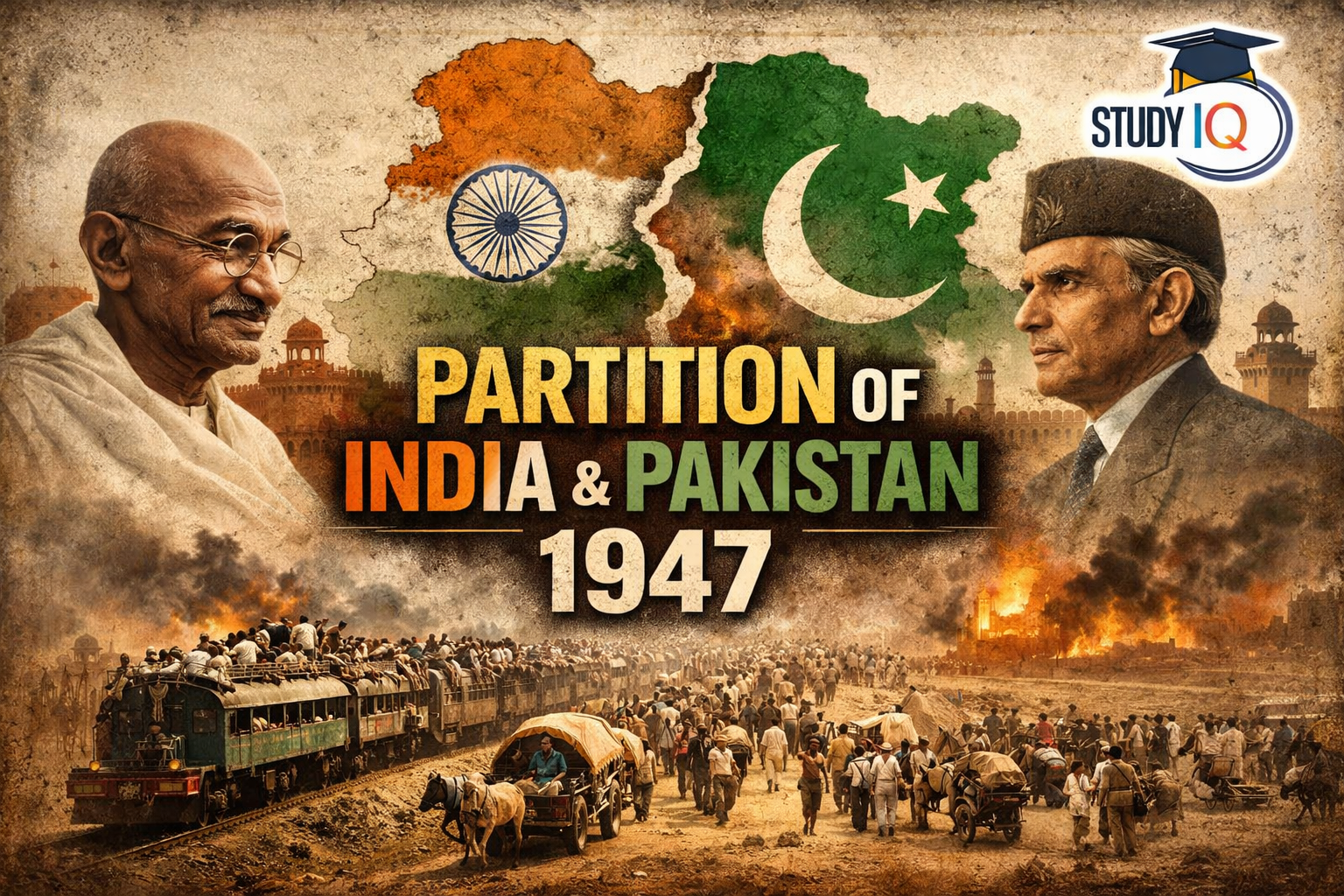
The Partition of India and Pakistan in 1947 marks one of the most defining—and tragic—turning points in modern South Asian history. It led to the creation of two independent dominions:
- India (15 August 1947)
- Pakistan (14 August 1947)
The division, executed under the Indian Independence Act 1947, formally ended nearly 200 years of British colonial rule. However, it also triggered one of the largest forced migrations in human history, accompanied by unprecedented communal violence.
What Was the Partition of India?

- The boundary, known as the Radcliffe Line, was drawn by Sir Cyril Radcliffe
- Punjab and Bengal were divided based on religious demographics
Key Statistics:
- 14–18 million people displaced
- 1 million deaths
- Massive refugee crisis across borders
Historical Background: Why Did Partition Happen?
The Partition was not a sudden event but the culmination of decades of political, social, and communal developments.
1. British Divide and Rule Policy
The British administration deliberately fostered communal divisions:
- Separate electorates under Morley-Minto Reforms (1909)
- Communal Award (1932) institutionalized religious politics
- Encouragement of the All-India Muslim League
Result: Weakening of a unified nationalist movement
2. Rise of Communalism
- Economic and educational backwardness among sections of Muslims
- Religious revivalist movements
- Growing mistrust between communities
3. Two-Nation Theory
The ideological foundation of Partition was the Two-Nation Theory, championed by:
- Muhammad Ali Jinnah
- Influenced by Allama Iqbal
It argued that:
Hindus and Muslims were separate nations with distinct identities.
4. Political Deadlock (1937–1947)
- Muslim League’s poor performance in 1937 elections → insecurity
- Failure of negotiations like the Cabinet Mission Plan 1946
- Increasing demand for Pakistan
Timeline of Key Events Leading to Partition
| Year | Event | Significance |
|---|---|---|
| 1905 | Partition of Bengal | Beginning of communal politics |
| 1940 | Lahore Resolution | Demand for a Muslim homeland |
| 1942 | Cripps Mission | Failed proposal |
| 1945-46 | Elections | League emerges as Muslim representative |
| 1946 | Direct Action Day | Massive violence |
| 1947 | Mountbatten Plan | Blueprint for Partition |
Key Personalities Involved
Indian National Congress
- Mahatma Gandhi → Opposed Partition
- Jawaharlal Nehru → Accepted reluctantly
- Sardar Vallabhbhai Patel → Pragmatic acceptance
Muslim League
- Muhammad Ali Jinnah → Led demand for Pakistan
British Leadership
- Lord Louis Mountbatten → Implemented Partition
Immediate Consequences of Partition
Humanitarian Crisis
- Largest migration in history (~14 million)
- Communal riots → ~1 million deaths
- Women faced violence, abduction, displacement
Economic Disruption
- Jute fields in East Pakistan separated from mills in India
- Trade networks collapsed
Political Fallout
- Beginning of the India-Pakistan rivalry
- Triggered the Kashmir Conflict 1947
Long-Term Impact of Partition
1. Geopolitical Tensions
- Persistent India-Pakistan conflict
- Militarization and wars (1947, 1965, 1971)
2. Social and Cultural Impact
- Breakdown of composite culture
- Deep communal divisions
- Refugee-led urban transformation (Delhi, Lahore)
3. Psychological and Literary Legacy
Partition trauma shaped literature and cinema:
- Themes: loss, identity, displacement
- Generational memory continues
Was Partition Inevitable? (Analytical Perspective)
Argument FOR inevitability:
- Deep communal divide
- Failure of political negotiations
- Rising violence (1946)
Argument AGAINST inevitability:
- Cabinet Mission offered a united India
- Leadership failures worsened the crisis
Balanced Conclusion:
Partition was not inevitable, but became unavoidable due to political miscalculations, colonial strategy, and communal polarization.
Conclusion
The Partition of India and Pakistan in 1947 was not just a political event—it was a human tragedy of immense scale. While it achieved independence from colonial rule, it also left behind:
- Deep scars of violence
- Long-term geopolitical conflict
- A divided civilizational legacy
Understanding Partition is essential not only for history but also for analyzing modern South Asian politics, identity, and international relations.
|
Read More Notes |
|
| Environment Notes | Art and Culture Notes |
| Science and Tech | History Notes |
| Geography Notes | Indian Polity Notes |
| General Knowledge | International Relation |
|
Explore StudyIQ Courses |
|
 Nalanda University in Bihar: History, Re...
 Prithviraj Chauhan History: Biography, B...
 Chandela Dynasty: History, Rulers, Archi...











 WhatsApp





