Table of Contents
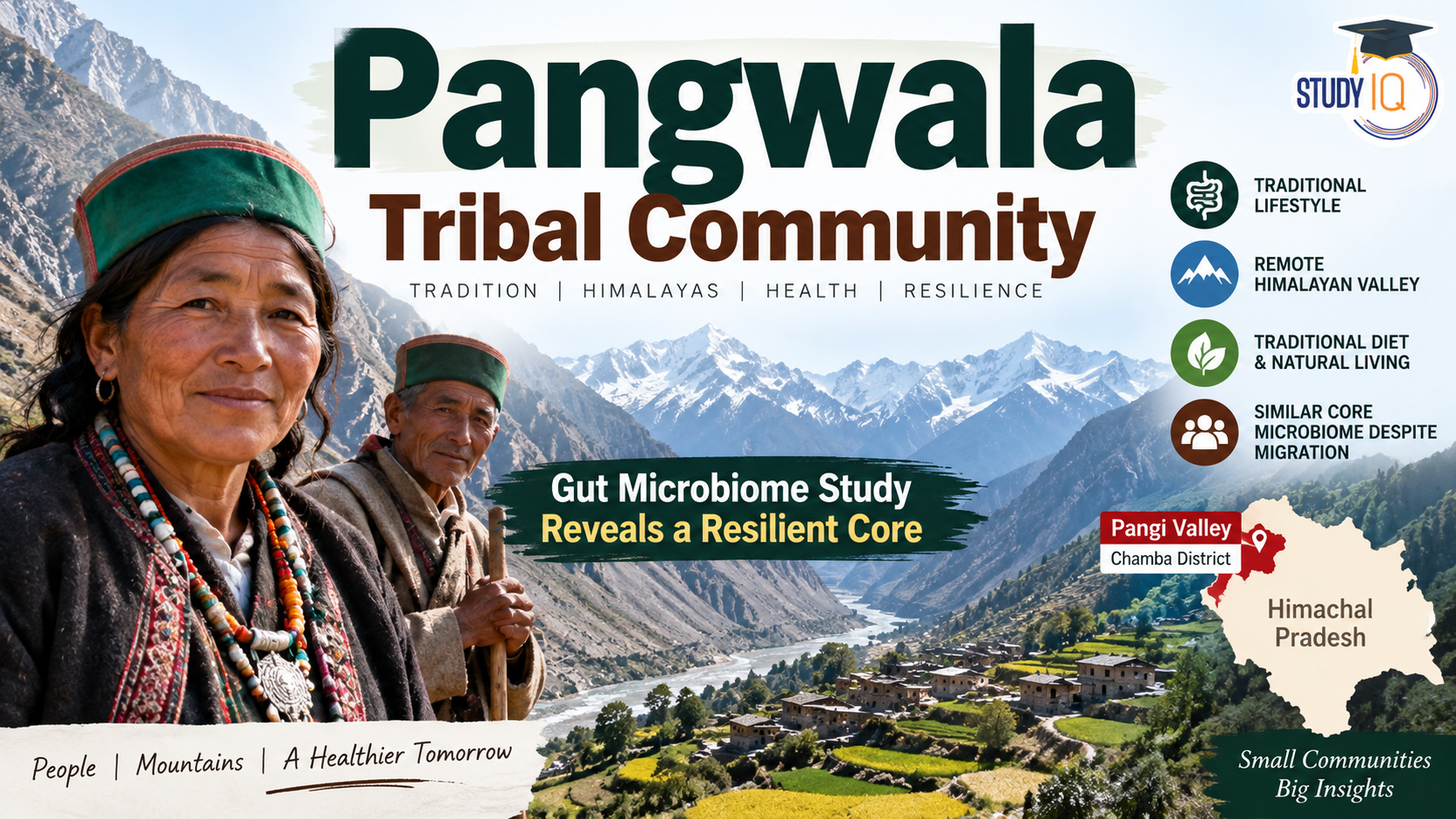
The Pangwala tribal community of Himachal Pradesh has recently come into focus following a scientific study examining the gut microbiome of people living in the remote Pangi Valley and those who have migrated to urban areas. The study provides an interesting intersection of tribal life, migration, traditional diets, microbiology and antimicrobial resistance, making the Pangwala community relevant for UPSC Prelims and Mains preparation.
Read Also: UPSC Daily Current Affairs 2026
Who are the Pangwala?
The Pangwala are a Scheduled Tribe community primarily associated with the Pangi Valley of Chamba district in Himachal Pradesh. The community has traditionally lived in the remote Himalayan environment of the valley and has developed livelihood practices suited to its challenging terrain and climate.
Pangi is one of the relatively remote tribal areas of Himachal Pradesh. Geographic isolation, difficult terrain and harsh winters have historically influenced the social and economic life of its inhabitants.
Where is Pangi Valley Located?
Pangi Valley is located in Chamba district of Himachal Pradesh, in the western Himalayan region. The valley lies in the Pir Panjal Himalayan region and is associated with the upper reaches of the Chandrabhaga (Chenab) river system.
Its remote mountainous location has historically limited connectivity with the rest of Himachal Pradesh, although road connectivity has improved over time.
Quick Geography Facts
- Community: Pangwala
- Valley: Pangi Valley
- District: Chamba
- State: Himachal Pradesh
- Region: Western Himalayas
- Mountain system: Pir Panjal
- Important river system: Chandrabhaga/Chenab
Pangwala Community: Traditional Lifestyle
The traditional lifestyle of the Pangwala community has been closely connected with the Himalayan environment. Agriculture, livestock and the use of locally available natural resources have played an important role in the lives of people living in Pangi.
The recent microbiome study highlighted differences between people continuing to live in Pangi and those who have migrated to urban areas. Native residents were reported to have stronger connections with livestock, natural spring water, traditional agriculture and locally available foods, while younger generations and migrants have increasingly been exposed to commercially available and processed foods.
Why are Pangwala Tribals in the News?
A study titled “Decoding the functional landscape and resistome profile of the gut microbiome in the Pangwala tribal community of India” examined the gut microbiome of the community.
The research analysed 28 healthy volunteers using Whole Metagenome Shotgun sequencing. Researchers examined not only bacteria but also fungi, viruses, metabolic functions and antibiotic-resistance genes.
One of the significant findings was that people living in Pangi Valley and those who had migrated to urban areas retained a broadly similar core gut microbiome despite differences in their lifestyle, diet and environment.
Key Scientific Findings
Prevotella copri emerged as the dominant bacterial species in both native and migrated groups, with relatively greater abundance among people continuing to live in Pangi.
The researchers also identified Bifidobacterium among the abundant genera. Some Bifidobacterium strains have potential probiotic and postbiotic characteristics.
The study also highlighted the concept of functional redundancy. Although the composition of microorganisms may change, different microorganisms can perform similar functions, helping the gut ecosystem maintain important activities.
Antimicrobial Resistance and the Pangwala Study
Another important finding concerned antimicrobial resistance (AMR).
Researchers detected resistance genes against more than 100 antibiotics in the gut microbiome of the healthy volunteers. Resistance was particularly prominent against antibiotics such as vancomycin and teicoplanin, while resistance to several tetracycline-class antibiotics was also widespread.
However, the presence of antibiotic-resistance genes does not mean that the participants had antibiotic-resistant infections. Instead, the findings indicate that the human gut can serve as a reservoir of antimicrobial-resistance genes.
This makes the study relevant to the broader One Health approach, which recognises the interconnectedness of human health, animal health and the environment.

 World Bamboo Day 2026: Date, Theme, Hist...
 Places in News: Sohar Port, Oman-Locatio...
 Daily Current Affairs PDF 2026: Download...














 WhatsApp