
Table of Contents
India once again proved its status as one of the world’s most biodiverse countries in 2025 with the discovery of several new species of flora and fauna. These discoveries, made across diverse ecosystems ranging from the Western Ghats and Northeast India to the Andaman & Nicobar Islands and the Himalayas, highlight the importance of scientific exploration, conservation efforts, and ecological research.
The new species discovered in India in 2025 not only enrich the country’s biological records but also emphasize the urgent need to protect fragile habitats that are under threat from climate change, deforestation, and human activities.
Why New Species Discoveries Matter
The discovery of new species has both scientific and environmental significance:
-
Enhances biodiversity records: It helps scientists better understand India’s ecological richness.
-
Supports conservation planning: Newly discovered species often indicate sensitive ecosystems that need protection.
-
Strengthens India’s global image: Reinforces India’s role as a global biodiversity hotspot.
-
Important for UPSC and competitive exams: Such discoveries are frequently asked in Prelims and Mains under Environment & Ecology.
Major New Species Discovered in India in 2025
1. New Amphibian Species
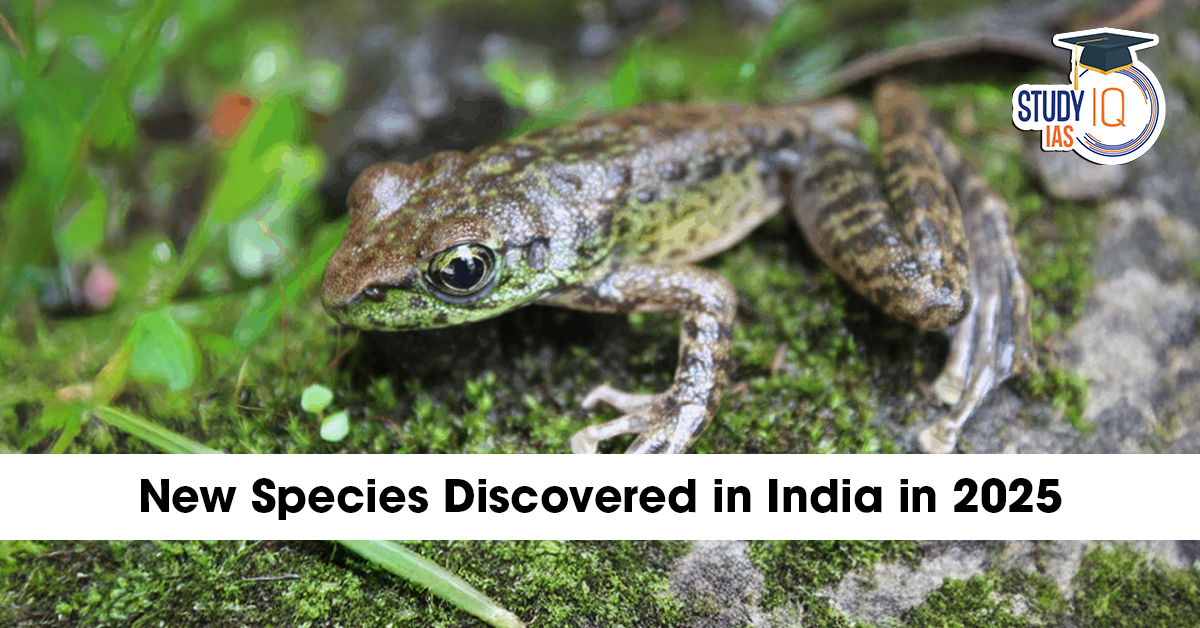
Several new frog species were reported from the Western Ghats and Northeast India in 2025. These regions are already recognized as biodiversity hotspots. The newly identified frogs showed:
-
Unique vocal patterns
-
Distinct skin texture and coloration
-
Specialized habitat adaptation to forest streams and wetlands
Amphibians are ecological indicators, so their discovery signals relatively healthy ecosystems.
2. New Insect Species
India recorded multiple new insect species in 2025, especially beetles, butterflies, and ants:
-
Western Ghats: New species of beetles adapted to moist forest floors
-
Eastern Himalayas: Rare moth and butterfly species
-
Central India: New ant species with unique colony behavior
Insects play a crucial role in pollination, soil health, and food chains. Their discovery improves understanding of ecosystem functioning.
3. New Plant Species
Botanists discovered several flowering plant species in 2025, particularly in:
-
Arunachal Pradesh
-
Meghalaya
-
Andaman & Nicobar Islands
Key features included:
-
Rare medicinal properties
-
Unique floral structures
-
Extremely limited geographical distribution
Many of these plants are already considered endangered due to habitat loss.
4. New Reptile Species
New species of lizards and snakes were discovered in rocky terrains and forested regions:
-
Western Ghats yielded new gecko species
-
Northeast India reported rare snake varieties
-
Adaptations included camouflage skin and nocturnal behavior
These findings strengthen India’s reputation as a center of reptile diversity.
5. New Marine Species
Marine biologists recorded new species of:
-
Corals
-
Crustaceans
-
Small reef fishes
especially near the Andaman Sea and Lakshadweep region. This shows that India’s marine biodiversity is still largely unexplored.
Regions Leading in New Species Discoveries
| Region | Importance |
|---|---|
| Western Ghats | Amphibians, insects, reptiles |
| Northeast India | Plants, butterflies, frogs |
| Andaman & Nicobar Islands | Marine species, plants |
| Eastern Himalayas | Rare mammals and insects |
| Central India | Ants, beetles, grassland flora |
Role of Indian Institutions in 2025 Discoveries
Major institutions involved included:
-
Zoological Survey of India (ZSI)
-
Botanical Survey of India (BSI)
-
Wildlife Institute of India (WII)
-
Indian Institute of Science (IISc)
-
Several universities and international research collaborations
These bodies continue to document and protect India’s biological heritage.
Conservation Concerns
While discoveries are encouraging, they also raise serious concerns:
-
Many new species are already critically endangered
-
Habitat destruction threatens survival even before proper classification
-
Climate change is shrinking suitable habitats
-
Mining, infrastructure projects, and tourism pose risks
This highlights the need for stronger environmental policies and protected areas.
Importance for UPSC and Competitive Exams
For UPSC and State PSC aspirants, “New Species Discovered in India 2025” is important under:
-
GS Paper III: Environment and Ecology
-
Prelims: Biodiversity and current affairs
-
Mains: Conservation strategies, biodiversity hotspots, role of ZSI and BSI
Possible questions:
-
“Discuss the significance of new species discoveries in India for biodiversity conservation.”
-
“How do such discoveries strengthen India’s environmental commitments?”
India: A Global Biodiversity Hotspot
India hosts four major biodiversity hotspots:
-
Western Ghats
-
Himalayas
-
Indo-Burma Region
-
Sundaland (Andaman & Nicobar Islands)
Most of the species discovered in 2025 came from these regions, proving their unmatched ecological importance.
Conclusion
The new species discovered in India in 2025 reflect the country’s immense and still-unexplored natural wealth. These findings are not just scientific achievements but also a reminder of our responsibility to conserve ecosystems that sustain such life forms. Protecting biodiversity is crucial for environmental balance, climate resilience, and sustainable development.
India’s 2025 discoveries reaffirm one simple truth: nature still holds many secrets, and preserving it is our greatest duty.
 Viksit Bharat Shiksha Adhishthan Bill 20...
 Cyclone Maila Intensifies Over Solomon S...
 List of Military Exercises of India 2026...













 WhatsApp





