
Table of Contents
Context
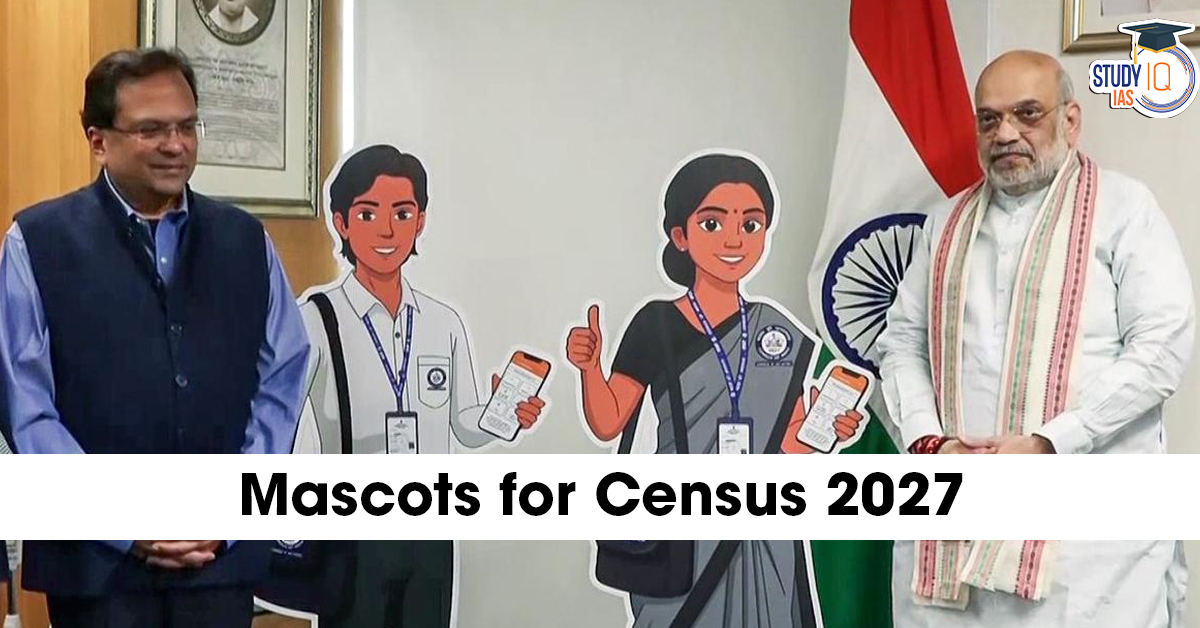
The upcoming Population Census 2027 in India marks a major shift toward digital data collection. The mascots ‘Pragati’ and ‘Vikas’ were unveiled to promote public awareness and participation in the census process.
Mascots for Public Outreach
The mascots Pragati (female enumerator) and Vikas (male enumerator) have been introduced to represent the census initiative in a relatable manner. They symbolise inclusive participation of both women and men in national development and are intended to communicate the objectives and importance of the census to citizens across different regions.
Digital Transformation of the Census
- Census 2027 will be the first fully digital census in India.
- Data will be collected using mobile applications and digital platforms developed by the Centre for Development of Advanced Computing (C-DAC).
- A key innovation is the self-enumeration facility, allowing households to submit information online before the enumerator’s visit. The data submitted will later be verified by enumerators during field operations.
Key Digital Platforms
Four major digital tools have been introduced to facilitate census operations:
- Houselisting Block Creator (HLBC): A web-based mapping tool that helps officials create houselisting blocks using satellite imagery, ensuring uniform geographic coverage.
- Houselisting Operations (HLO) Mobile Application: A secure mobile application used by enumerators to collect and upload housing data directly from the field.
- Self-Enumeration (SE) Portal: An online platform through which households can voluntarily submit their information. A unique Self-Enumeration ID is generated for verification.
- Census Management and Monitoring System (CMMS): A centralised digital dashboard used by administrators to monitor census activities, track progress, and manage field operations.
Phases of Census 2027
The census will be conducted in two stages:
- Houselisting and Housing Census: Scheduled between April and September 2026.
- Population Enumeration: Planned for February 2027, with earlier enumeration in certain mountainous regions such as Ladakh and parts of Jammu and Kashmir, Himachal Pradesh, and Uttarakhand due to climatic conditions.
Constitutional and Legal Basis of the Census
- Legal Framework: The Census in India is conducted under the provisions of the Census Act, 1948, which authorises the Central Government to collect demographic and socio-economic information from the population.
- Constitutional Status: Census is listed under Entry 69 of the Union List in the Seventh Schedule of the Constitution of India. Therefore, it is a subject under the exclusive jurisdiction of the Union Government.
- Periodicity: The population census is generally conducted once every ten years, making it the largest regular administrative data collection exercise in the country.
- Administrative Authority: The exercise is carried out under the supervision of the Ministry of Home Affairs.
- Official Notification: Before the census begins, the Census questionnaire and operational details are formally notified in the Official Gazette to ensure legal validity and transparency.
Conduct of the Digital Census
- Data Collection Through Mobile Applications
- Enumerators will collect data using a secure mobile application rather than paper forms.
- The application is designed to support real-time data upload, GPS-based location tagging, and automatic error detection, which helps reduce inaccuracies during data entry.
- The use of mobile devices or tablets will replace traditional paper-based questionnaires, improving efficiency and reducing administrative costs.
- Self-Enumeration Facility
- For the first time, households will have the option to submit their information online through a self-enumeration portal.
- Respondents will access the portal using unique login credentials or OTP-based authentication.
- Through this facility, a household can upload details of all its members before the enumerator’s visit.
- This feature is expected to improve participation, particularly in urban areas where digital access is higher.
- Data Management and Monitoring
- A central digital platform will be used to monitor census operations in real time.
- Authorities will be able to track progress at multiple administrative levels, including state, district, block, and enumeration unit.
- Data protection will be ensured through encryption systems, secure servers, and protected cloud storage.
Information Collected in the Census
- Individual-Level Information
- Personal details such as name, age, sex, and marital status will be recorded.
- Data on mother tongue, literacy level, and educational attainment will also be collected.
- Information about economic activity and employment status will help assess workforce participation.
- Housing and Living Conditions
- The census will collect information about the duration of residence at the present location.
- Details of housing type, household amenities, and living conditions will be recorded.
- These indicators provide insights into the overall quality of life and infrastructure access.
- Migration-Related Information
- Migration patterns will continue to be studied using established indicators such as:
- Place of birth
- Place of last residence
- Duration of stay at the current residence
- Respondents will also indicate reasons for migration, including employment, education, marriage, family movement, or displacement.
- Such information helps in understanding internal migration, urbanisation trends, and labour mobility.
Importance of a Digital Census
- Greater Transparency and Accuracy: Digital forms include automated checks that detect incomplete or inconsistent entries.
- This reduces manual errors and prevents duplication of records.
- Reduction in Administrative Costs: Digital data collection reduces expenses related to printing, transporting, and storing large volumes of paper forms.
- Over time, it can significantly lower operational costs.
- Faster Data Processing: Data collected through digital systems is transmitted directly to secure servers.
- This allows quicker compilation of statistics and faster release of reports.
- Improved Policy Formulation: Reliable demographic data assists governments in planning education, healthcare, welfare schemes, and infrastructure development.
- It also helps analyse population trends, migration patterns, and labour force characteristics.
- Strengthening Digital Governance: The adoption of digital tools supports broader initiatives aimed at expanding technology-based governance and public administration in India.
Key Challenges
- Digital Divide: Limited access to smartphones and internet connectivity in rural or remote areas may affect digital data collection.
- Cybersecurity Risks: The large volume of personal information collected requires strong safeguards to prevent data breaches or misuse.
- Training of Field Personnel: A large number of enumerators and supervisors must be trained to operate digital applications effectively.
- Data Privacy and Confidentiality: Census information must remain confidential.
Ensuring privacy requires strong legal safeguards, secure technology systems, and effective oversight mechanisms.
|
Read More Notes |
|
| Environment Notes | Art and Culture Notes |
| Science and Tech | History Notes |
| Geography Notes | Indian Polity Notes |
| General Knowledge | International Relation |
|
Explore StudyIQ Courses |
|
 The Legality of The U.S.-Israel Strikes ...
 Gravity Bombs Explained: Types, Features...
 India vs New Zealand: India Clinch T20 W...











 WhatsApp





