
Table of Contents
Context: Union Home Minister recently informed the Lok Sabha that Naxalism has been largely eliminated from the Bastar region of Chhattisgarh, marking a major milestone in the government’s campaign to make India free of Maoist violence by March 2026.
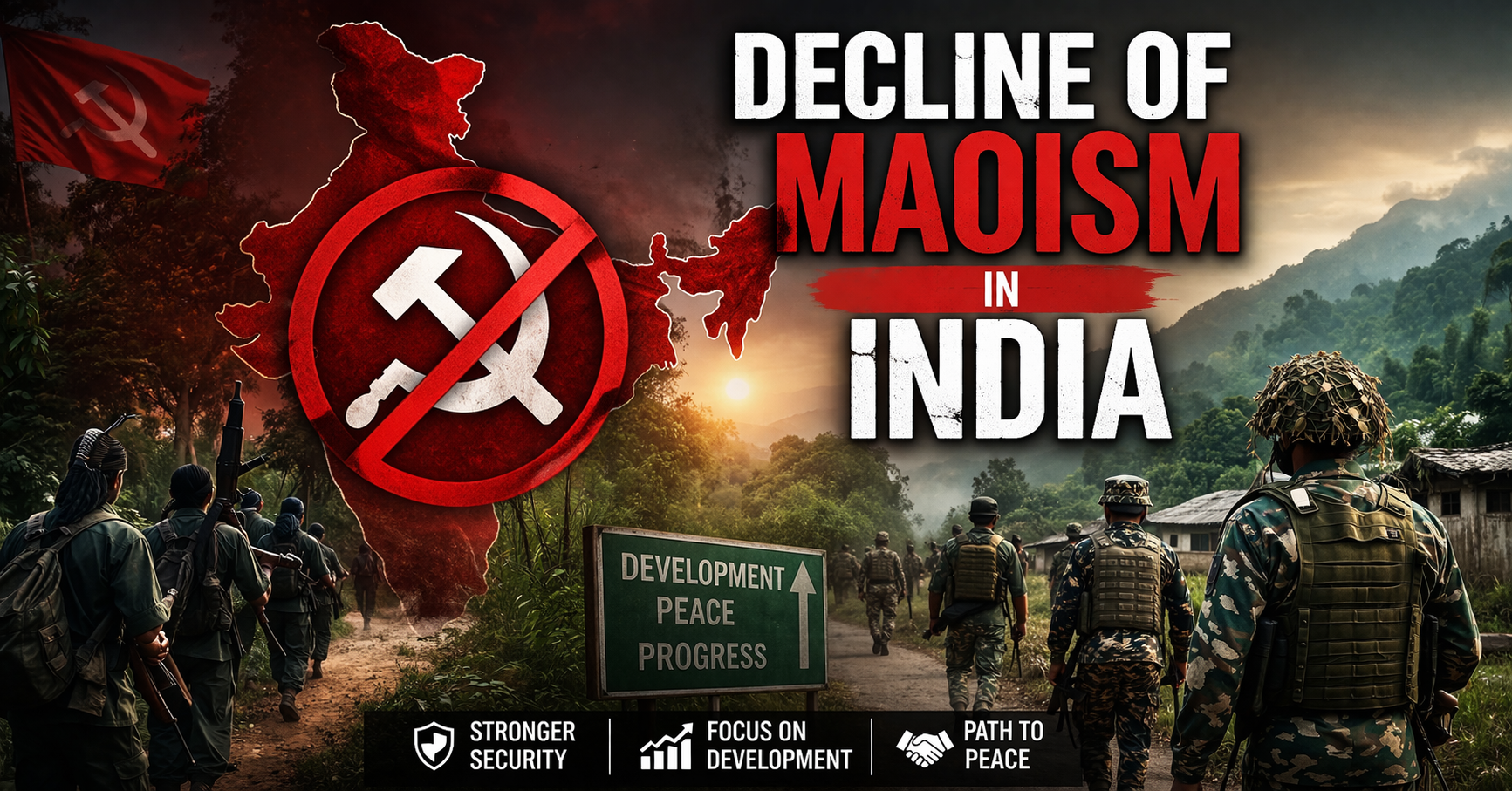
Decline of Maoism in India
- Leadership Loss: Major Maoist leaders eliminated or surrendered (CPI-Maoist chief Basavaraju killed in 2025 encounter).
- Cadre Neutralisation: A large number of Maoists killed or surrendered (531 Maoists neutralised in Chhattisgarh since 2024).
- Eg. Very few active Maoist cadres remain (<40 active Maoists reported in Chhattisgarh)
- Organisational Collapse: Top leadership weakened (24 Politburo and Central Committee members killed/surrendered).
- Territorial Loss: Security forces regained Maoist strongholds (103 new security camps covering ~8,000 km² in Bastar region). LWE-affected districts declined sharply (~200 districts in the early 2000s to 38 districts by 2025).
- Violence Decline: LWE-related incidents and deaths reduced by over 80% since 2010.
Strategy to Tackling Maoism
- Security Operations: Intensified joint operations by CRPF, state police and intelligence agencies targeting Maoist leadership.
- Eg. Under Clear–Hold–Develop Strategy, security forces clear insurgent zones, establish camps and enable civil administration.
- Area Domination: Establishment of forward police camps and security bases in remote Maoist zones.
- Infrastructure Push: Expansion of roads, bridges and connectivity projects in Maoist regions (BRO road networks in Bastar).
- Expansion of road networks and bridges to connect remote Maoist-affected areas (BRO built 75 km roads and 20 Bailey bridges in 15 months in Bijapur–Sukma region).
- Improving all-weather transport access for remote villages (benefits 25+ villages previously isolated during the monsoon).
- Roads enable faster troop movement and logistics support in Maoist-dominated terrain (security forces earlier depended on helicopters for supplies).
- Strategic Corridors: Key routes help monitor Maoist movement corridors across state borders (Chhattisgarh–Telangana routes).
- Development Outreach: Improving access to healthcare, education, markets and welfare schemes in tribal regions.
- Rehabilitation: Encouraging surrender and reintegration of Maoist cadres through rehabilitation schemes.
- Administrative Expansion: Strengthening governance presence in previously inaccessible areas.
- Technology Use: Deployment of AI surveillance, drone monitoring and data analytics in security operations.
Also Read: Operation Sankalp for Naxals
What should the State do with the vacuum Maoists leave?
- Governance Expansion: Strengthen schools, healthcare centres and welfare delivery in remote tribal regions.
- Local Institutionalisation: Recruit local youth into police, administration and governance structures.
- Sustained Security Presence: Maintain security camps temporarily to prevent criminal or extremist groups from filling the vacuum.
- Development Acceleration: Expand roads, markets, telecom connectivity and livelihood opportunities in tribal belts.
- Administrative Responsiveness: Ensure efficient grievance redressal and accountable governance to build state legitimacy.
- Rehabilitation: Reintegrate surrendered Maoist cadres through livelihood and social rehabilitation schemes.
Can Maoism or Violent Far-Left Politics Rise Again?
- Remote Pockets: Some forest regions remain poorly governed (Abujhmad, Bastar interior), where state presence is still weak.
- Youth Discontent: Unemployment and economic inequality may fuel radical mobilisation in some regions.
- Ideological Adaptation: Radical groups may shift to urban issue-based activism (land rights, environmental protests).
- Local Grievances: Land alienation, tribal displacement and mining conflicts can revive resentment against the state.

 Extracellular RNA (exRNA): Types, Functi...
 Jungle Cats: Habitat, Characteristics an...
 EV Charging Infrastructure: Background, ...













 WhatsApp





