
Table of Contents
Mangrove forests in India occupy a very small area, yet they play a massive role in protecting coastlines, supporting biodiversity, fighting climate change, and sustaining coastal livelihoods. For UPSC CSE aspirants, mangroves are a high-yield topic in Environment, Geography, Disaster Management, and Current Affairs.
With updated data, government initiatives like the MISHTI Scheme, and increasing focus on blue carbon ecosystems, mangrove conservation has become a core part of India’s environmental strategy.
What are Mangrove Forests?
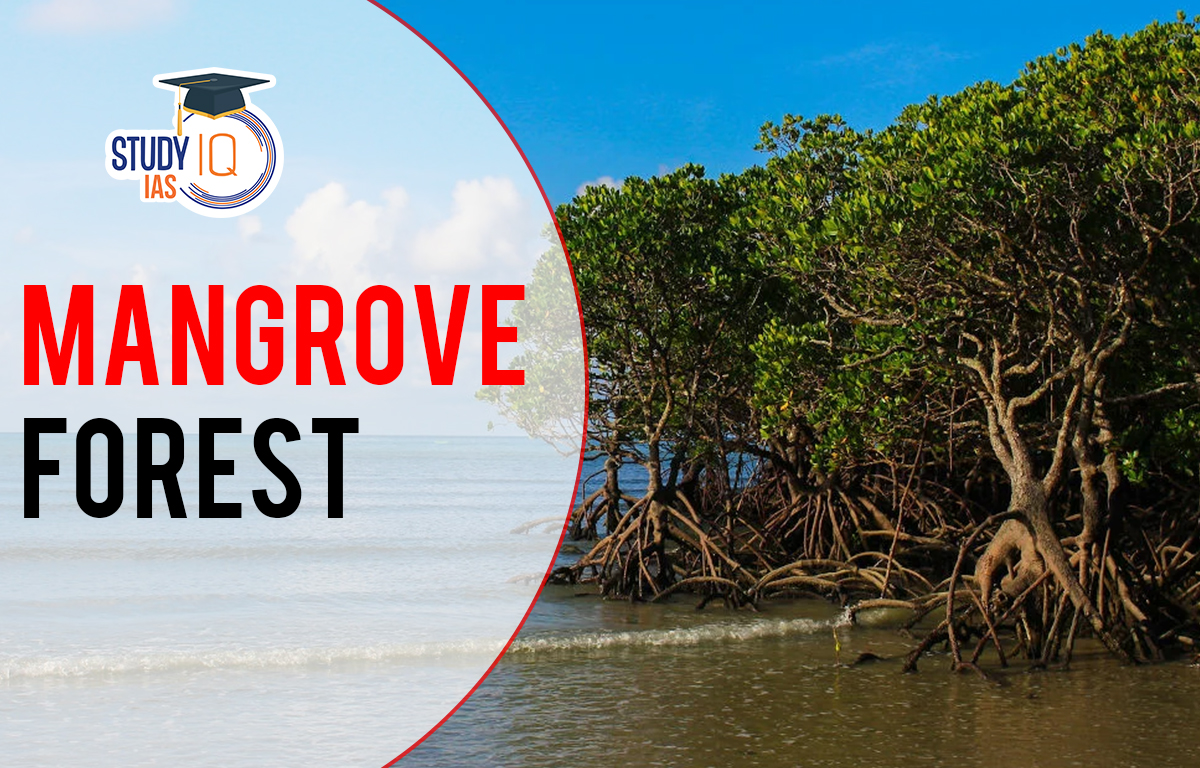
Mangroves are salt-tolerant trees and shrubs that grow in intertidal zones, where land meets the sea. They thrive in brackish water, muddy soil, and oxygen-poor environments.
Key features:
-
Salt-excreting leaves and bark
-
Aerial and prop roots (pneumatophores) for breathing
-
Strong soil-binding capacity
-
High adaptability to saline and tidal conditions
They form one of the most productive ecosystems on Earth.
Mangrove Forest Cover in India (Latest Data 2026)
As per the India State of Forest Report (ISFR 2023), which remains the latest official reference in 2026:
-
Total Mangrove Cover: 4,991.68 sq km
-
Percentage of India’s geographical area: ~0.15%
-
Trend: Continuous increase since 2001
-
Net increase since 2001: +509.68 sq km
Despite occupying a tiny area, mangroves contribute disproportionately to:
-
Carbon sequestration
-
Disaster risk reduction
-
Fisheries productivity
-
Biodiversity conservation
Growth Trend of Mangroves in India
| Period | Increase |
|---|---|
| 2001–2023 | +509.68 sq km |
| 2013–2023 | +363.68 sq km |
| 2019–2021 | +17 sq km |
This reflects the success of conservation programs and restoration projects.
State-wise Distribution of Mangrove Forests in India
Top contributors:
| Rank | State/UT | Share |
|---|---|---|
| 1 | West Bengal | 42.45% |
| 2 | Gujarat | 23.66% |
| 3 | Andaman & Nicobar Islands | 12.39% |
Together, these three account for nearly 78% of India’s mangrove cover.
Other important regions:
-
Odisha
-
Andhra Pradesh
-
Tamil Nadu
-
Kerala
-
Puducherry
-
Maharashtra
-
Goa
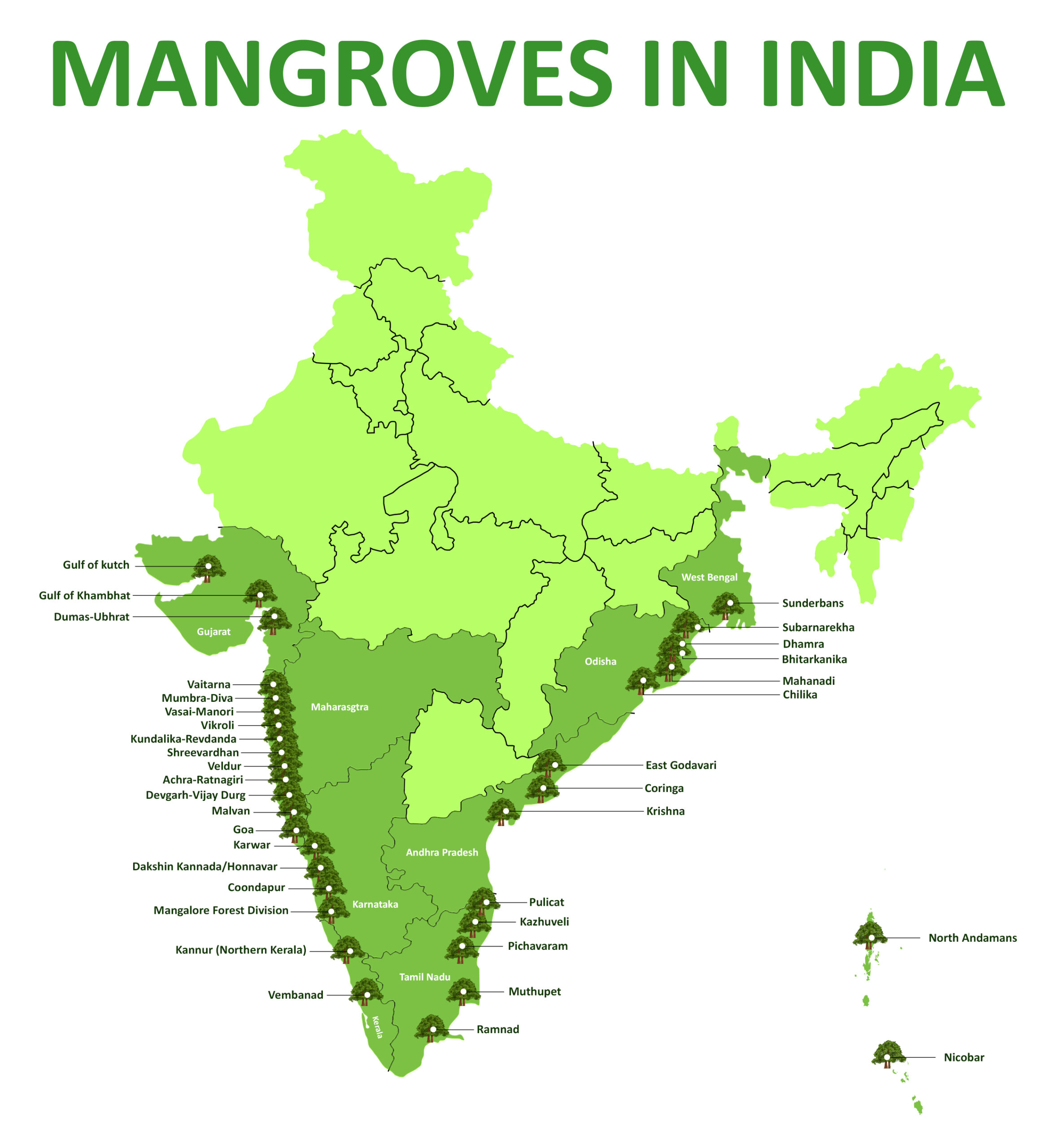
Mangrove Map of India
Mangroves are concentrated in:
-
East Coast: Sundarbans, Mahanadi delta, Godavari–Krishna delta
-
West Coast: Gulf of Kutch, Konkan coast, Kerala backwaters
-
Islands: Andaman & Nicobar Islands
For prelims, remember:
Maximum mangroves are on the east coast, but Gujarat dominates the west coast.
Major Mangrove Ecosystems in India
1. Sundarbans (West Bengal)
-
World’s largest mangrove forest
-
UNESCO World Heritage Site
-
Famous for Royal Bengal Tigers
-
India-Bangladesh shared ecosystem
2. Bhitarkanika (Odisha)
-
Second largest mangrove system in India
-
Saltwater crocodiles and olive ridley turtles
-
High bird diversity
3. Pichavaram (Tamil Nadu)
-
Rapidly expanding mangrove ecosystem
-
4,500 ha (2021) → 9,039 ha (2024)
-
Example of successful restoration
4. Krishna–Godavari Mangroves (Andhra Pradesh)
-
Supports fisheries and aquaculture
-
Important livelihood base
5. Kutch Inland Mangroves (Gujarat)
-
Only inland mangroves in India
-
Survive in arid, saline desert conditions
Importance of Mangrove Forests
1. Climate Change Mitigation (Blue Carbon)
Mangroves store huge amounts of carbon in soil and biomass.
-
India’s mangroves sequester nearly 4.9 million tonnes of carbon annually
-
Much more efficient than terrestrial forests
2. Coastal Protection
They act as natural barriers against:
-
Cyclones
-
Tsunami waves
-
Storm surges
-
Coastal erosion
Example:
During Cyclone Amphan (2020), Sundarbans reduced the impact on coastal settlements.
3. Fisheries and Livelihoods
-
Nursery ground for 80% of commercial fish species
-
Supports millions of fishermen
-
Essential for food security
4. Biodiversity Conservation
-
About 5,746 species recorded
-
84% are animal species
-
Habitat for tigers, crocodiles, dolphins, migratory birds
5. Water Purification
-
Trap sediments and pollutants
-
Improve water quality
-
Stabilize coastal ecosystems
Threats to Mangrove Forests in India
-
Aquaculture
-
Biggest driver of mangrove loss
-
Shrimp and fish farming replace mangrove areas
-
-
Agricultural Expansion
-
Rice cultivation
-
Oil palm plantations
-
-
Urbanization & Industrialization
-
Ports, SEZs, coastal cities
-
Infrastructure projects
-
-
Pollution
-
Plastics
-
Industrial effluents
-
Oil spills
-
-
Overexploitation
-
Timber
-
Fuelwood
-
Charcoal production
-
-
Invasive Species
-
Prosopis juliflora threatens native mangrove species
-
-
Climate Change
-
Sea level rise
-
Changing salinity
-
Increased cyclone frequency
-
MISHTI Scheme: India’s Flagship Mangrove Initiative
Full Form:
Mangrove Initiative for Shoreline Habitats & Tangible Incomes (MISHTI)
Launched:
5 June 2023 (World Environment Day)
Ministry:
Ministry of Environment, Forest and Climate Change (MoEFCC)
Objectives:
-
Restore degraded mangrove ecosystems
-
Enhance coastal resilience
-
Generate livelihood opportunities
-
Promote community participation
Key Targets:
-
Restoration of 540 sq km of mangroves
-
Coverage in 11 States + 2 UTs
-
Funding through CAMPA funds
-
Budget (FY 2024–25): ₹17.96 crore
Unique Features:
-
Corporate participation through CSR
-
Community-centered restoration
-
Climate + livelihood integration
Legal Protection for Mangroves in India
-
CRZ Notification 2019
-
Mangroves declared Ecologically Sensitive Areas
-
-
Environment Protection Act, 1986
-
Wildlife Protection Act, 1972
-
Mangrove areas declared sanctuaries/national parks
-
-
Biological Diversity Act, 2002
-
Indian Forest Act, 1927
International Support: ECRICC Project
ECRICC – Enhancing Coastal Resilience of Indian Coastal Communities
-
Funded by Green Climate Fund
-
Started in 2019
-
States: Andhra Pradesh, Maharashtra, Odisha
-
Target: Restore 10,575 hectares
-
Achieved: 3,114 hectares (29%)
Why Mangroves are Important for UPSC CSE 2026
Mangroves connect:
-
Climate Change + Disaster Management
-
Biodiversity + Economy
-
Environment + Livelihood Security
-
Static + Current Affairs
They appear in:
-
Prelims factual questions
-
GS Mains (Environment, Geography, Disaster Management)
-
Essay papers
-
Case studies on sustainable development
Key Facts for Quick Revision
-
Total mangrove cover: 4,991.68 sq km
-
Largest state: West Bengal
-
MISHTI launched: 2023
-
MISHTI target: 540 sq km
-
World’s largest mangrove: Sundarbans
-
Only inland mangroves: Kutch (Gujarat)
-
Carbon sequestration: 4.9 million tonnes/year
Conclusion
Mangrove forests may occupy just 0.15% of India’s land area, but their ecological, economic, and climatic importance is monumental. Through initiatives like MISHTI, India is aligning mangrove conservation with climate resilience and sustainable livelihoods.

 World Pharmacists Day 2026: Date, Theme,...
 UPSC EPFO Exam Strategy 2026: Complete 3...
 Census Town in India: Criteria, Meaning ...














 WhatsApp





