
Table of Contents
Context
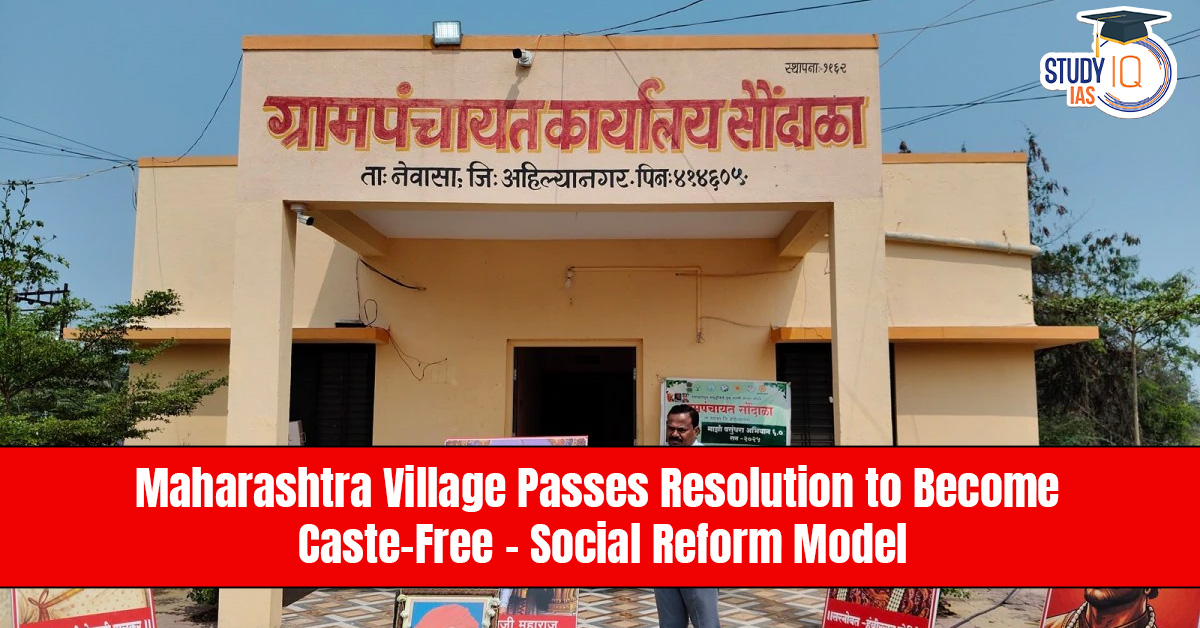
A small village in Maharashtra has drawn attention for adopting a community resolution aimed at preventing discrimination and strengthening social harmony. The initiative reflects a locally driven attempt to institutionalise equality in everyday village life.
Case study of Soundala village, Maharashtra
| Maharashtra Village Passes Resolution to Become Caste-Free |
| ● Location: Soundala village, located about 60 km from Ahilyanagar in Maharashtra
● Initiative: The gram sabha passed a resolution on 5 February to declare itself “caste-free” and to eliminate discrimination across social categories. ● Leadership of the resolution: The move was led by village sarpanch Sharad Argade, who framed the resolution around the principle “My religion – humanity,” signalling a shift from identity-based divisions to a shared civic ethos. ● Village demographics: The village has about 2,500 residents. About 65% belong to the Maratha community, around 20% (approximately 60 families) are from Scheduled Castes, some of whom follow Christianity, and three Muslim families also reside in the village. Core Provisions of the Resolution ● Equality across social categories: The resolution explicitly states that there shall be no discrimination based on caste, religion, creed, or race, and that all residents will be treated equally in public life. ● Universal access to public spaces: It guarantees open access for all residents to public places, including temples, crematoriums, schools, water sources, government services, and community events. ● Monitoring of social media conduct: Village authorities committed to taking action against social media posts that could create caste tensions, indicating an awareness of digital drivers of social conflict. Social Climate in the Village ● Preventive rather than corrective measure: According to the sarpanch, the village has not witnessed major caste conflicts in recent years and no atrocity case has been registered in the past decade. ○ The resolution is intended as a precaution against emerging social polarisation seen elsewhere. ● Concerns about external influences: Local leadership expressed concern that divisive practices observed in nearby regions, such as checking a shopkeeper’s caste before making purchases, could spread if not proactively addressed. Evidence from the School Environment ● Inter-community interaction among children: At the local Zilla Parishad school, students from different religious backgrounds participate together in school and cultural activities, suggesting relatively low levels of social segregation among younger cohorts. ● Educational perspective on long-term change: Teachers emphasise that early socialisation is critical. While children currently display little bias, exposure to wider social environments during higher education may shape attitudes, making early interventions important. Status of the Village School ● Infrastructure improvements: The Zilla Parishad school in Soundala has received approximately ₹20–25 lakh from the gram panchayat over the past two years and now features smart classrooms. ● Rising demand for public education: With more than 190 students and a waiting list of 57 applicants, the school has become attractive to neighbouring villages. ● Funding constraints: Despite improvements, the school faces space shortages and the village leadership has appealed for corporate social responsibility support to construct additional buildings. History of Progressive Local Measures ● Support for widow remarriage (2024): The gram sabha approved financial assistance of ₹11,000 for widow remarriage to counter social stigma and promote dignity and inclusion. ● Ban on abusive language against women (2024): The village prohibited the use of derogatory curse words targeting women and has imposed fines on violators, indicating an attempt to regulate everyday gendered speech. ● Influence of reformist activism: The sarpanch’s father, Baba Argade, has been associated with rationalist and anti-superstition movements, which has shaped the village’s reform-oriented approach. Institutional Inclusion Efforts ● Leadership representation: The head of the village dispute resolution committee (tanta-mukti samiti) comes from the Mahar community (a Scheduled Caste group), reflecting deliberate attempts at inclusive local governance. ● View on inter-caste marriages: Local leaders acknowledge that inter-caste marriages remain limited but emphasise their constitutional legitimacy and social importance for reducing caste barriers. Significance ● Grassroots constitutionalism: The Soundala initiative illustrates how local governments can operationalise constitutional values such as equality and fraternity through community resolutions. ● Preventive social governance: By acting before major conflict emerges, the village model highlights the potential of anticipatory governance in managing social divisions. ● Limits and future challenges: Sustaining such efforts will depend on continued community participation, monitoring of implementation, and the ability to maintain inclusive norms as younger residents engage with wider social environments. |
|
Read More Notes |
|
| Environment Notes | Art and Culture Notes |
| Science and Tech | History Notes |
| Geography Notes | Indian Polity Notes |
| General Knowledge | International Relation |
|
Explore StudyIQ Courses |
|
 World Day of Social Justice 2026: Theme,...
 NHAI to Develop India’s First Bee Corr...
 Loggerhead Turtles – Ecology, Habitat,...











 WhatsApp





