
Table of Contents
Context
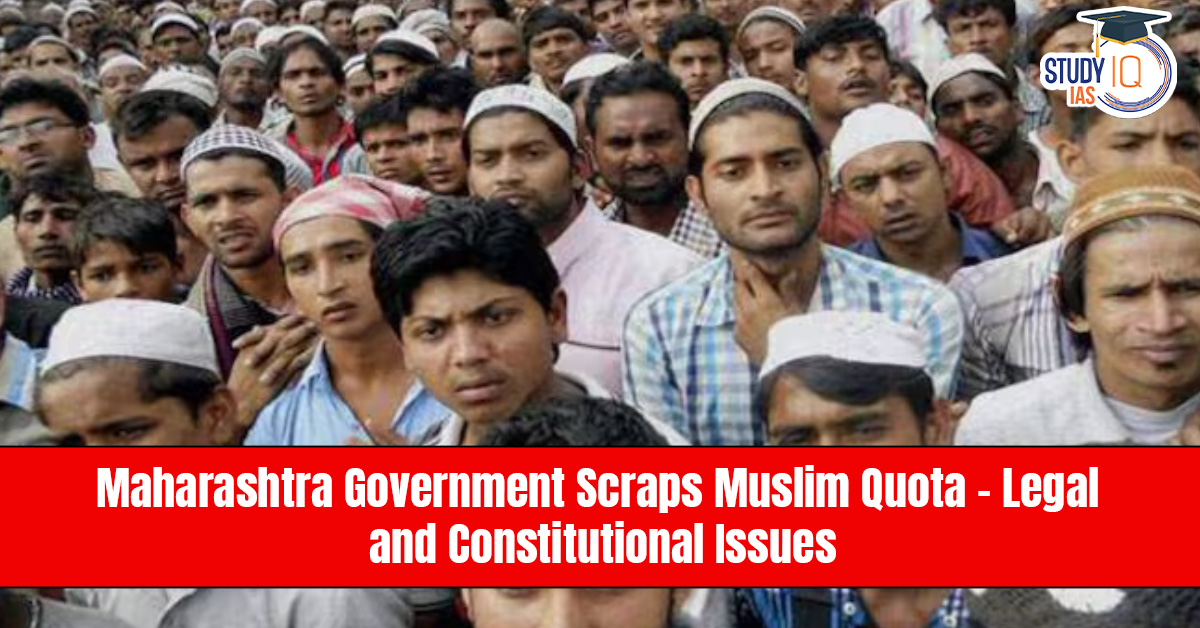
The recent withdrawal of the last administrative traces of Maharashtra’s 2014 Muslim reservation policy has revived interest in the legal journey of the measure.
| Muslims in India |
| ● Population Share: As per the 2011 Census, Muslims account for 14.2% of India’s total population.
● State-wise Distribution (2011 Census) ○ States with the largest Muslim population (absolute numbers): Uttar Pradesh ranks first, followed by West Bengal and Bihar ○ States with the highest Muslim proportion (percentage of state population): Jammu & Kashmir records the highest share, followed by Assam and West Bengal. |
Maharashtra’s 2014 Muslim Reservation Policy
|
Origin |
| ● Evidence of socio-economic disadvantage: The policy was rooted in multiple studies highlighting educational and economic deprivation among sections of the Muslim population in India and Maharashtra.
● Key committee findings: The Sachar Committee (2006) documented that Muslims lagged behind many communities on education, employment, and income indicators. ● A Maharashtra study group headed by Dr. Mehmood-ur-Rehman similarly reported low representation in public services and high dropout rates among certain Muslim occupational groups. ● State policy response (2014) ○ 16% reservation to Marathas under a new backward class category. ○ 5% reservation in education to 50 identified Muslim sub-castes under Special Backward Category A. Impact on Overall Reservation Structure ● Increase in total reservation: Before the policy, Maharashtra’s reservation stood at about 52%. ○ With the 5% Muslim quota, it rose to 57%. ○ Including the Maratha quota, the total reached 68%. ● Immediate legal scrutiny: The sharp rise triggered constitutional challenges centred on the judicially evolved 50% ceiling on reservations. |
Constitutional and Legal Framework for Reservation in India
- Article 15(4): Empowers the State to introduce special measures for the advancement of socially and educationally backward classes (SEBCs).
It serves as the constitutional foundation for reservations and affirmative action in educational institutions. - Article 16(4): Permits the State to provide reservation in public employment for backward classes that are inadequately represented in government services.
- This provision enables employment-based affirmative action to improve representation.
- Article 340: Authorises the President to appoint a commission to examine the conditions of backward classes and recommend remedial measures.
- This provision led to the creation of bodies such as the Kaka Kalelkar Commission and the Mandal Commission.
- Article 342A: Introduced through the 102nd Constitutional Amendment Act, 2018.
- It empowers the President to notify SEBCs for each State and Union Territory in consultation with the Governor, with the objective of maintaining a Central List of SEBCs while States continue to identify backward classes for their own purposes.
|
Criteria for Identification of SEBCs |
| ● Social Backwardness: Refers to communities that have historically faced limited access to education, social mobility, and social acceptance, often accompanied by stigma or discrimination.
● Educational Backwardness: Indicated by literacy rates below national or state averages, along with high dropout rates and low participation in higher education. ● Economic Backwardness: Characterised by low income levels, limited asset ownership, and concentration in low-paid or informal occupations. |
Major Committees and Reports on Muslim Backwardness
Sachar Committee Report (2006)
- Constitution of the Committee: Appointed by Prime Minister Manmohan Singh to assess the socio-economic and educational status of Muslims in India.
- Key Findings
- Education: Muslim literacy rates were below the national average, with substantial school-level dropouts. Only about 4% of Muslims were in higher education compared to roughly 7% among SCs and STs.
- Economic conditions: High poverty incidence and weak presence in formal sector employment.
- Social indicators: Limited access to healthcare and basic amenities in Muslim-concentrated localities.
- Public employment: Around 5% representation in government jobs despite forming about 14% of the population.
- Major Recommendations
- Expand schooling infrastructure in Muslim-concentrated areas and increase scholarships.
- Improve access to institutional credit and skill development.
- Strengthen infrastructure in minority-dominated regions.
Ranganath Mishra Commission Report (2007)
- Objective: To evaluate the conditions of religious and linguistic minorities and recommend measures for their advancement.
- Key Findings
- Social and educational status: Many Muslim groups were found to be comparable to or worse than SCs and STs on several indicators.
- Education: Persistently low literacy and high dropout rates, particularly among girls.
- Economy: Widespread poverty and concentration in informal, low-income occupations.
- Representation: Very limited presence in government services and professional sectors.
- Financial exclusion: Weak access to institutional credit.
- Political participation: Underrepresentation in elected bodies.
- Major Recommendations
- Provide 10% reservation for Muslims in education and public employment within the OBC framework.
- Grant an additional 6% where Muslims are already classified as OBCs.
- Extend Scheduled Caste status to Dalit Muslims.
- Establish an Equal Opportunity Commission to address discrimination.
|
Judicial Position on Muslim Reservation |
| ● Indra Sawhney v. Union of India (1992): The Supreme Court upheld 27% OBC reservation but clarified that affirmative action must be based on social and educational backwardness rather than religion alone.
● P. A. Inamdar v. State of Maharashtra (2005): The Court held that the State cannot impose religion-based reservations in private unaided institutions and reiterated the backwardness-based test. ● Calcutta High Court judgment (2023): The court invalidated the classification of certain Muslim groups as OBCs where it found that religion appeared to be the primary basis, reaffirming that reservations cannot rest solely on religious identity. |
Key Challenges in Providing Reservations to Muslims
- Constitutional constraint: The Constitution does not recognise any religious community as backward per se; backwardness must be demonstrated through objective criteria. Courts have repeatedly rejected blanket religion-based quotas.
- Internal diversity within the community: Muslims are socially heterogeneous, comprising numerous occupational and biradari groups with varying levels of disadvantage. A uniform approach risks over-inclusion or exclusion.
- Political and administrative complexities: Efforts such as sub-quotas in some States have generated legal and political debate, reflecting the difficulty of designing constitutionally robust policies.
Alternative Strategies for Upliftment
- Targeted infrastructure development: A spatial approach focusing on improving schools, roads, and health facilities in Muslim-concentrated areas can address structural deficits.
- Educational and economic support: Expansion of scholarships, skill development, and self-employment programmes for economically weaker sections within the community.
- Implementation of existing schemes: Effective delivery of Pre-Matric, Post-Matric, Merit-cum-Means scholarships, and the Maulana Azad Education Foundation fellowship programmes can improve outcomes.
- Prime Minister’s New 15-Point Programme: The Prime Minister’s New 15-Point Programme for the Welfare of Minorities seeks to expand access to education, employment, and credit for minority communities.
 World Day of Social Justice 2026: Theme,...
 NHAI to Develop India’s First Bee Corr...
 Loggerhead Turtles – Ecology, Habitat,...











 WhatsApp





