

Table of Contents
Context
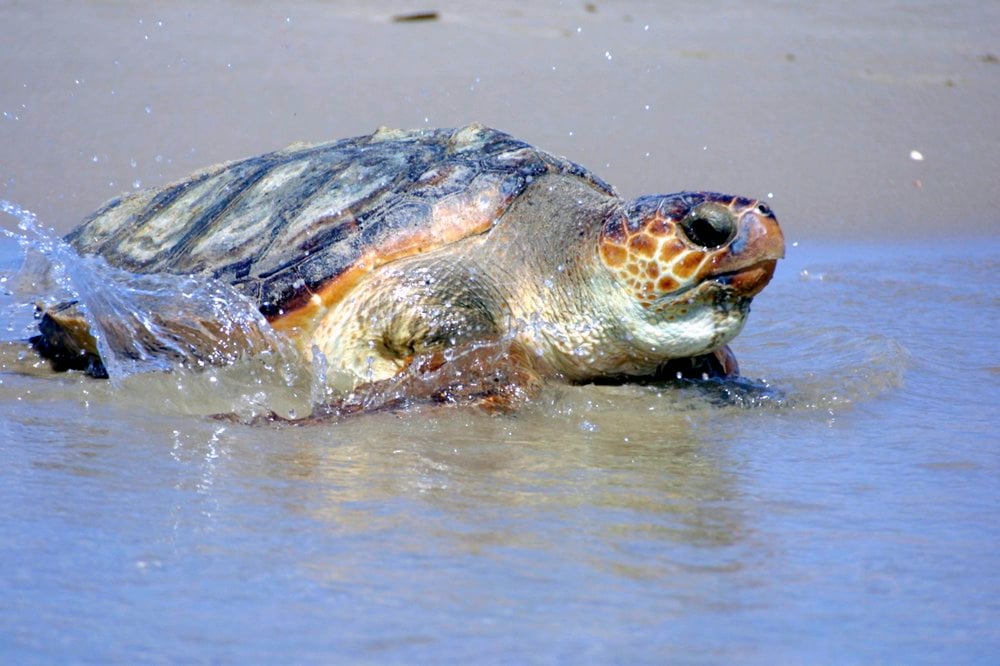
A recent study warns that Loggerhead sea turtles (Caretta caretta) are facing an unprecedented existential crisis due to the combined “four-pronged” impact of climate change.
About Loggerhead Turtles
- Distribution: Found in the Atlantic, Pacific, and Indian Oceans, as well as the Mediterranean Sea.
- Characteristics
- They are named for their relatively large heads, which support powerful jaws
- Unlike the Green Sea Turtle (which is a herbivore), Loggerheads are primarily carnivores.
- The sex of the hatchlings is not determined by genetics but by the incubation temperature of the sand. “Hotter is Femaler”, “Cooler is Maler”.
- Loggerheads use the Earth’s magnetic field to navigate during their long-distance migrations
- They are slow-growing and long-lived, often taking 20 to 35 years to reach sexual maturity.
- Threats from Climate Change
- Extreme Feminization (TSD)
- Hatchling Dehydration and Stunting
- Sea-level rise is eroding nesting beaches. When turtles encounter sea walls or urban infrastructure, they have no place to retreat, a phenomenon known as Coastal Squeeze.
- Rising sea temperatures are shifting the distribution of their primary prey (crabs, mollusks, and jellyfish). Turtles are forced to travel further for food, leading to “energetic exhaustion.”
- Conservation Status:
- IUCN Red List:Vulnerable (though some sub-populations are Endangered).
- CITES: Appendix I (Trade is prohibited).
- CMS (Bonn Convention): Appendix I and II.
- Wildlife (Protection) Act, 1972: Schedule I
|
Read More Notes |
|
| Environment Notes | Art and Culture Notes |
| Science and Tech | History Notes |
| Geography Notes | Indian Polity Notes |
| General Knowledge | International Relation |
|
Explore StudyIQ Courses |
|
 World Day of Social Justice 2026: Theme,...
 NHAI to Develop India’s First Bee Corr...
 Upgradation of Helsinki Treaty and Green...











 WhatsApp





