
Table of Contents
Context
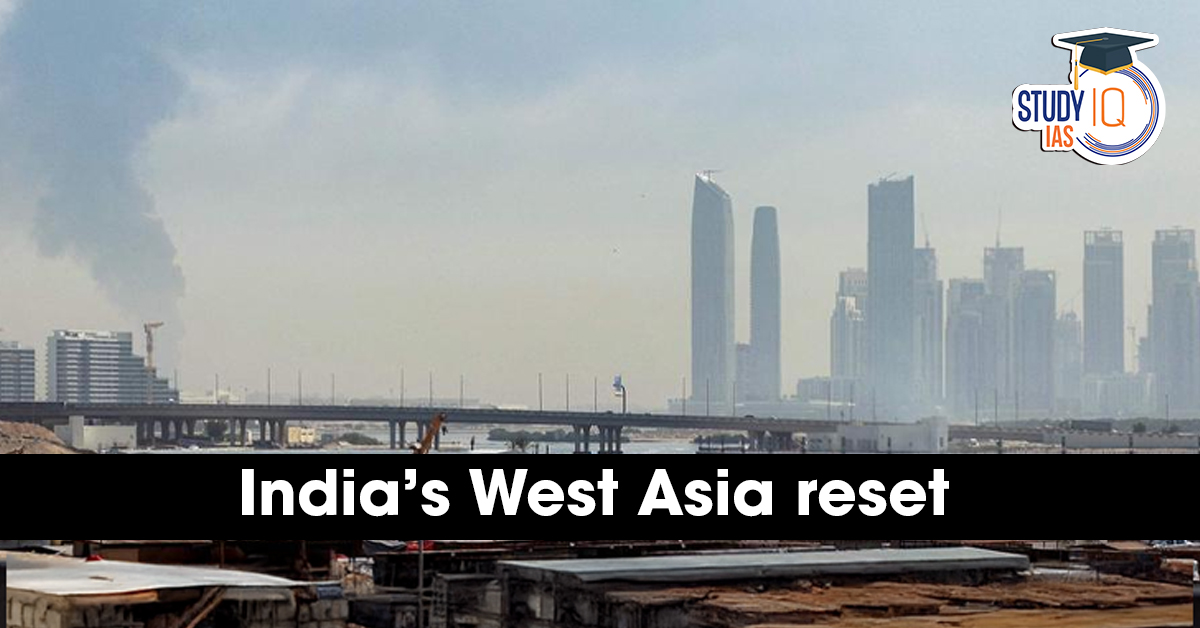
- India’s recent shift in its West Asia policy reflects a move towards pragmatic, interest-driven diplomacy. India is attempting a strategic reset to protect its energy, trade, and diaspora interests while enhancing its role as a reliable regional partner.
Key Trends Behind India’s Policy Reset
- Deepening Engagement with West Asia: Over the past decade, India has significantly increased engagement with GCC countries, Israel, Iran, and Palestine, strengthening economic and strategic ties.
- Economic and Diaspora Linkages: The region accounts for over $160 billion trade and 10 million Indian diaspora, making it India’s largest external socio-economic partner.
- Changing Regional Security Dynamics: The ongoing conflict and weakening of S.-led security architecture (Pax Americana) have pushed Gulf countries to seek alternative security partners.
Features of India’s New West Asia Doctrine
- Shift to Hard Diplomacy: India is adopting a more realist and interest-based approach, focusing on security, economic partnerships, and strategic convergence.
- Reduced Balancing Rhetoric: Unlike earlier policy, India has avoided “please-all” diplomacy, showing greater clarity and confidence in its positions.
- Direct Strategic Engagement: High-level outreach, including leadership visits and direct communication with regional leaders, signals India’s active diplomatic role.
Criticism and Concerns
- Perception of Strategic Tilt: India’s actions are seen as leaning towards S.–Israel alignment, raising concerns about loss of neutrality.
- Deviation from Traditional Policy: Reduced emphasis on Palestine and Iran is viewed as a shift from India’s historical balanced approach.
- Risk of Strategic Overreach: Increased involvement may expose India to security risks and geopolitical entanglements.
- Diplomatic Delays: Slow response to key events (e.g., leadership changes in Iran) raised concerns about lack of timely diplomatic sensitivity.
Need for Balance and Strategic Sensitivity
- Maintaining Multi-Alignment: India must continue engaging with all regional actors — Israel, Iran, GCC, and Palestine — to preserve strategic flexibility.
- Recognising Iran’s Importance: Iran remains critical for energy supply, connectivity (Chabahar Port), and regional geopolitics.
- Addressing Regional Sentiments: Sensitivity to cultural, political, and humanitarian concerns is essential to maintain trust and goodwill.
Emerging Opportunities for India
- Decline of U.S.-Centric Security Model: Gulf countries may diversify partnerships beyond the U.S., creating opportunities for India to emerge as a trusted security partner.
- Economic Diversification (GCC+1 Strategy): Instability in West Asia may push investors to look for alternatives, allowing India to position itself as a stable economic hub.
- Trade and Investment Expansion: India can leverage disruptions to attract capital, talent, and supply chains shifting from West Asia.
Way Forward
- Balanced and Agile Diplomacy: India must combine consistency with flexibility, adapting quickly to changing regional dynamics.
- Strengthening Strategic Autonomy: Avoid overdependence on any bloc and maintain independent decision-making.
- Enhancing Regional Cooperation: Promote energy security, trade connectivity, and maritime cooperation.
- Humanitarian and Economic Outreach: Provide aid and support to affected populations to strengthen soft power
|
Read More Notes |
|
| Environment Notes | Art and Culture Notes |
| Science and Tech | History Notes |
| Geography Notes | Indian Polity Notes |
| General Knowledge | International Relation |
|
Explore StudyIQ Courses |
|
 Scientific Cooperation in BRICS: Key Ini...
 Cholesterol Makes Cell Nuclei Squishy: H...






 WhatsApp





