
Table of Contents
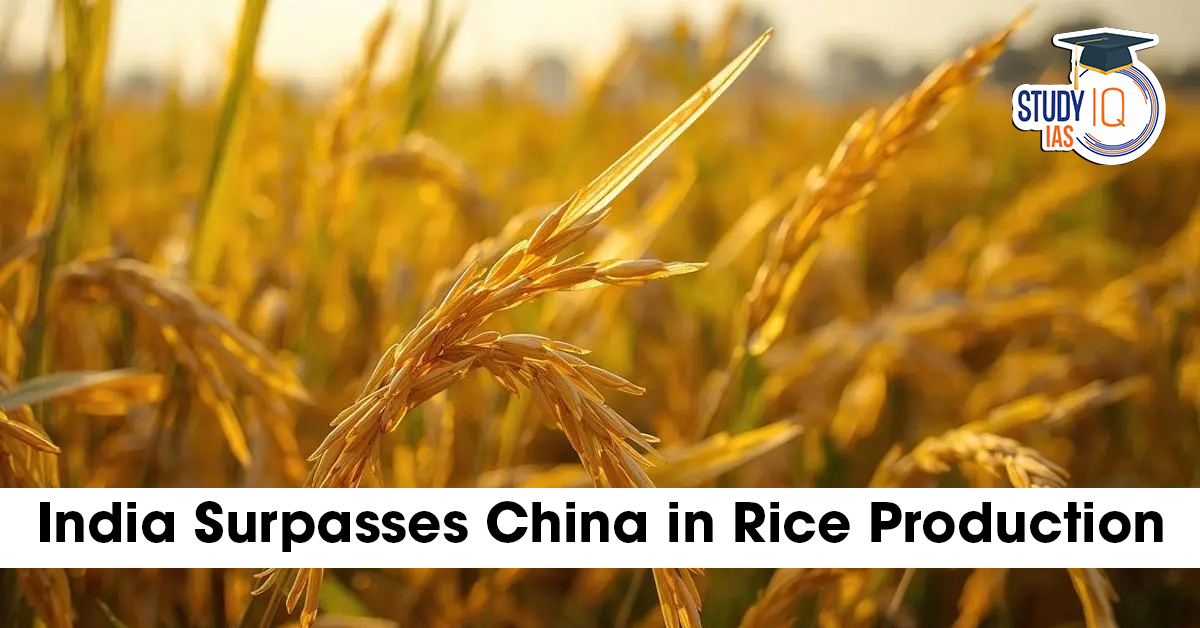
India Surpasses China in Rice Production: India has marked a historical record by surpassing China to become the largest producer of rice in the world in 2024-25. Being a production of about 150 million metric tons, India has exceeded the production of China at 145.28 million metric tons, thus marking India as a major food security pillar in the world.
This is not just symbolically significant but also has major economic, strategic, and geopolitical implications, particularly when the global value chains for food remain fragile in the wake of climate change and geopolitical turbulences around the world.
India Surpasses China in Rice Production: Key Highlights
- India’s rice production (2024–25): ~150 million metric tonnes
- China’s rice production (2024–25): 145.28 million metric tonnes
- Global rank: India – 1st, China – 2nd
This achievement reflects years of expansion in cultivated area, improved irrigation coverage, high-yield varieties, and strong government procurement support.
Read: Gene Editing of Rice Varieties, Implications and Challenges
Rice Production in India: Latest Statistics (2024–25)
Rice, also known as paddy, remains the backbone of Indian agriculture.
1. Largest Cultivated Crop in India
- Grown in 614 out of nearly 800 districts across the country
- Total area under cultivation: 514.23 lakh hectares
This wide geographic spread highlights rice as the most dominant and politically sensitive crop in India’s food economy.
2. India – The World’s Largest Rice Exporter
India continues to dominate global rice trade.
| Category | Quantity Exported | Export Earnings |
|---|---|---|
| Basmati rice | 6 million tonnes | $5.9 billion |
| Non-basmati rice | 14.13 million tonnes | $6.5 billion |
Major Basmati Importing Countries
- Saudi Arabia
- Iraq
- Iran
- Yemen
- UAE
- United States
- United Kingdom
- Kuwait
- Oman
- Qatar
- Jordan
- Israel
India’s premium basmati variety commands strong demand in Middle Eastern and Western markets, strengthening agricultural foreign exchange inflows.
Why India’s Rice Production Growth Matters
1. Global Food Security Leadership
Surpassing China has elevated India’s status as a central pillar of global food stability. Higher production reduces volatility in international markets and improves supply resilience during climate-induced shortages.
2. Strengthened Domestic Food Security
Large rice stocks in the central pool support welfare schemes under the National Food Security Act (NFSA), 2013, ensuring subsidized grain access to more than 800 million Indians.
3. Stable Income for Farmers
Rice cultivation provides:
- Assured government procurement
- Minimum Support Price (MSP) protection
- Reliable market demand
This makes paddy one of the least risky crops for farmers, particularly in Punjab, Telangana, Uttar Pradesh, and West Bengal.
4. Boost to Agricultural Exports
Rice exports contribute over $12 billion annually, improving:
- Agricultural trade balance
- Rural employment
- Foreign exchange reserves
Read: Pangenome of Asian Rice
Challenges Associated with India’s Rice Dominance
Despite impressive output, rice-centric agriculture presents several structural risks.
1. Water Stress and Resource Depletion
Paddy is a water-intensive crop. Its expansion into water-scarce regions has resulted in:
- Falling groundwater tables
- Increased electricity usage for irrigation
- Long-term ecological stress
States like Punjab and Haryana face alarming groundwater depletion.
2. Nutritional Imbalance
Excessive policy focus on rice has discouraged cultivation of:
- Pulses
- Oilseeds
- Coarse cereals and millets
This reduces dietary diversity and weakens nutritional security, particularly protein intake.
3. Geographic Concentration of Production
A few states dominate rice output:
- Telangana
- Uttar Pradesh
- West Bengal
- Punjab
Many rainfed and eastern states remain underdeveloped, creating regional inequality in agricultural income and infrastructure.
4. Export Market Vulnerability
India’s heavy dependence on a few overseas buyers creates risks. For example:
- Payment delays from Iran, one of the largest basmati importers, have disrupted exporters’ cash flows and affected domestic prices.
Trade restrictions, sanctions, or geopolitical tensions can quickly destabilize the rice export ecosystem.
5. Environmental Degradation
High production has come at a cost:
- Excessive fertilizer use
- Soil nutrient imbalance
- Methane emissions from flooded fields
- Waterlogging and soil salinity
These factors threaten long-term agricultural sustainability.
Way Forward
India must transition from quantity-focused agriculture to sustainability-driven growth.
1. Promote Crop Diversification
Government policies should actively support:
- Pulses
- Oilseeds
- Millets
- Climate-resilient crops
This will improve soil health, reduce water stress, and strengthen nutritional security.
2. Adopt Water-Efficient Farming Techniques
Encouraging modern practices such as:
- Alternate Wetting and Drying (AWD)
- Direct Seeded Rice (DSR)
- Laser land leveling
- Micro-irrigation
can reduce water use by 20–30% without compromising yield.
3. Reform MSP and Procurement Policy
Expanding assured procurement beyond rice and wheat to include:
- Pulses
- Oilseeds
- Nutri-cereals
will align farmer incentives with environmental and nutritional objectives.
4. Strengthen Infrastructure and Agricultural Markets
Investments are needed in:
- Modern storage facilities
- Cold chains
- Efficient logistics
- Digital market platforms
This will reduce post-harvest losses and stabilize farmer income from diversified crops.
5. Climate-Smart Agriculture
India must integrate:
- Low-emission farming techniques
- Carbon-smart fertilizers
- Precision agriculture tools
into mainstream rice cultivation.
Conclusion
India surpassing China in rice production marks a defining moment in global agriculture. It reflects strong institutional support, farmer resilience, and technological progress. However, long-term leadership will depend not just on producing more rice, but on producing it sustainably, profitably, and responsibly.
Balancing food security, farmer income, export growth, and environmental protection is now India’s next major agricultural challenge.
If addressed wisely, India can transform its rice dominance into a model of sustainable global food leadership.
 Shia Politics in India: History, Influen...
 Future of Chipmaking: Trends, Technologi...
 Nucleic Acid Testing (NAT): Meaning, Wor...











 WhatsApp





