Context
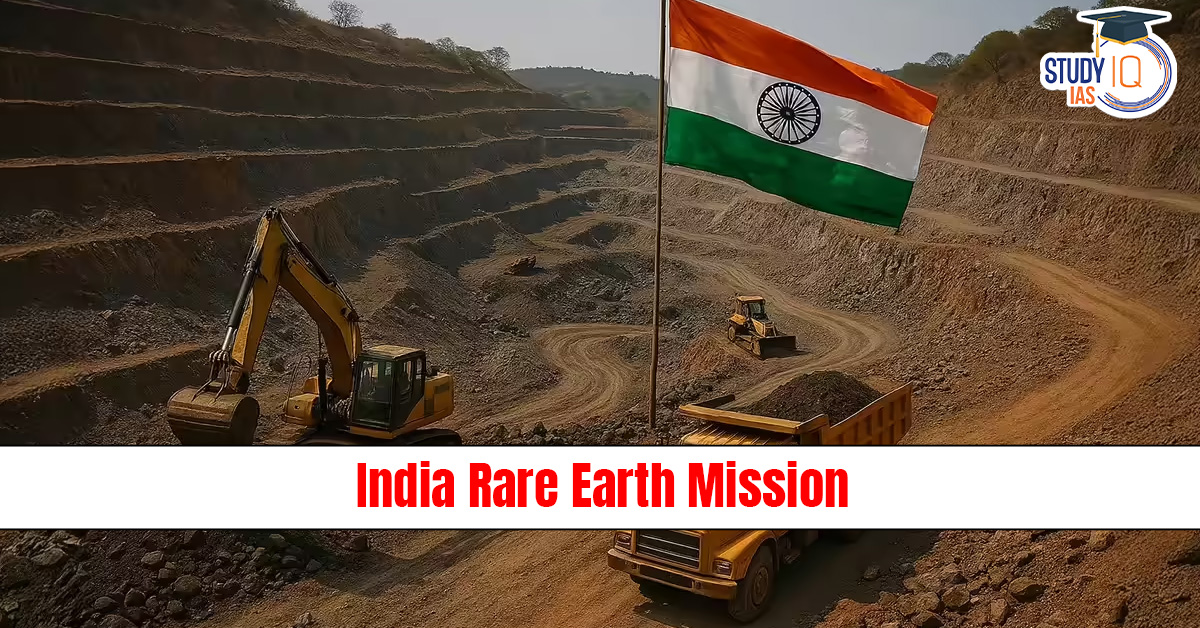
Budget 2026-27 propose to support the mineral-rich States of Odisha, Kerala, Andhra Pradesh and Tamil Nadu to establish dedicated Rare Earth Corridors to promote mining, processing, research and manufacturing
It is in line with the recently announced scheme to promote the manufacturing of Sintered Rare Earth Permanent Magnets (REPM), with a financial outlay of Rs 7,280 crore.
Key Budget Measures
- Basic Customs Duty (BCD) on monazite reduced from 2.5% to zero
- Monazite is a key mineral for high-end permanent magnets.
- BCD exemption on capital goods for critical mineral processing.
- Certain critical minerals added to Schedule XII of the Income Tax Act:
- Allows tax deduction for exploration & prospecting expenditure (Section 51).
- Earlier launched:
- ₹7,280 crore scheme for Rare Earth Permanent Magnets (Nov 2025).
|
Why Rare Earths Matter
|
- Rare earth elements are critical minerals used in:
- Rare Earth Permanent Magnets (REPMs)
- Electric Vehicles (EVs)
- Renewable energy (wind turbines)
- Electronics, aerospace, defence
- REPMs are essential for clean mobility and battery manufacturing.
What is Rare Earth Permanent Magnet (REPM)?
- REPMs are amongst the strongest types of permanent magnets and are used extensively in technologies requiring compact and high-performance magnetic components. Their high magnetic strength and stability make them integral to:
- Electric vehicle motors
- Wind turbine generators
- Consumer and industrial electronics
- Aerospace and defence systems
- Precision sensors and actuators
Global Context and India’s Opportunity (REPM & Critical Minerals)
- India currently imports 60–80% (value-wise) and 85–90% (quantity-wise) of permanent magnets, largely from China
- REPM demand is expected to double by 2030, driven by EVs, renewables and electronics
- Supply chain disruptions in rare-earth materials and permanent magnets have exposed heavy global dependence on a few suppliers, especially China.
- Strategic sectors like electric mobility, renewable energy, electronics and defence are vulnerable to these disruptions.
- This has increased the global push for secure, diversified and resilient critical mineral supply chains.
India’s Strategic Response
- Bilateral Mineral Partnerships
- India has signed agreements with Australia, Argentina, Zambia, Peru, Zimbabwe, Mozambique, Malawi and Côte d’Ivoire.
- Objective: Access to critical and strategic minerals through exploration, mining and processing cooperation.
- Multilateral Engagements: India participates in global platforms to strengthen mineral security:
- Minerals Security Partnership (MSP) – coordinated supply-chain diversification.
- Indo-Pacific Economic Framework (IPEF) – resilient and trusted supply chains.
- Initiative on Critical and Emerging Technologies (iCET) – tech-mineral linkage for strategic sectors.
|
Sharing is caring!

 Removal of the Chief Election Commission...
 Artemis II Launch 2026 LIVE: Crew Begins...
 Utkal Divas 2026: Date, History, Signifi...













 WhatsApp





