
Table of Contents
Centre’s Notice to Punjab Over Sidhu Moosewala’s Mother’s IVF Treatment
The Ministry of Health and Family Welfare has requested a report from the Punjab government regarding the in-vitro fertilization (IVF) treatment received by Charan Kaur (mother of the late Punjabi singer and rapper Sidhu Moosewala).
About In-Vitro Fertilization Treatment
- Purpose: Helps individuals or couples facing infertility challenges conceive. Among Assisted Reproductive Technologies (ART), IVF offers the highest success rate.
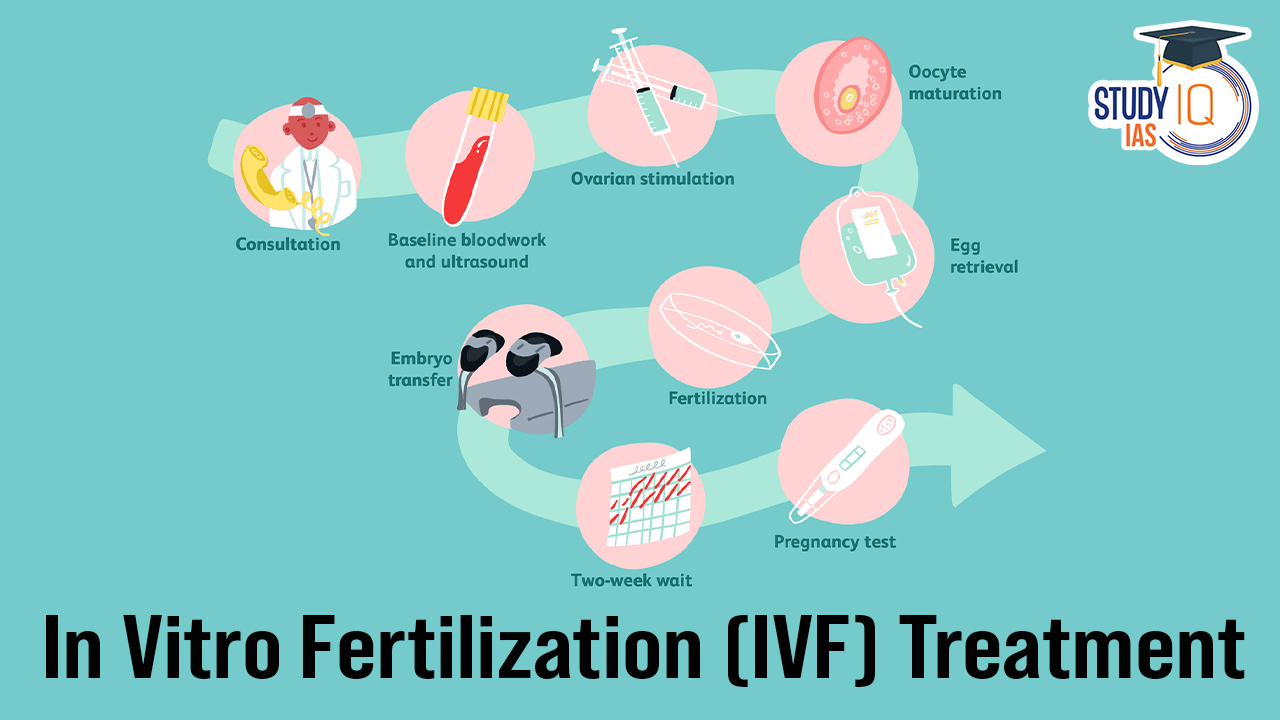
- Process:
- Egg retrieval from ovaries.
- Manual sperm fertilization of eggs in a laboratory setting.
- Transfer of fertilized egg (embryo) into the uterus for implantation.
- Options for genetic material:
- Couple’s own eggs and sperm.
- Eggs, sperm, or embryos from donors (known or anonymous).
- Factors to Consider For Successful IVF:
- Reproductive history.
- Age (particularly maternal age).
- Cause of infertility.
- Lifestyle habits.
- Applications:
- Blocked or damaged fallopian tubes.
- Male infertility (low sperm count/motility).
- Ovulation disorders, premature ovarian failure, uterine fibroids (females).
- Absence of fallopian tubes.
- Genetic disorders in intended parents.
- Unexplained infertility.
Age Limit for IVF Treatment
The age limit for IVF treatment in India is dictated by the Assisted Reproductive Technology (ART) (Regulation) Act, 2021. Here’s a breakdown:
- Women: According to the Act, women can receive IVF treatment if they are between 21 and 50 years old.
- Men: There’s a slightly higher limit for men. They can undergo IVF procedures between 21 and 55 years old.
Assisted Reproductive Technology (ART)
- The Assisted Reproductive Technology (Regulation) [ART] Act, 2021 defines ART to include all techniques that seek to obtain a pregnancy by handling the sperm or the oocyte (immature egg cell) outside the human body and transferring the gamete or the embryo into the reproductive system of a woman.
- Examples of ART services include gamete (sperm or oocyte) donation, in-vitro fertilisation (fertilizing an egg in the lab), and gestational surrogacy (the child is not biologically related to the surrogate mother).
- ART services will be provided through:
-
- ART clinics, which offer ART-related treatments and procedures, and
- ART banks, which store and supply gametes.
Key provisions of the Assisted Reproductive Technology (Regulation) [ART] Act, 2021
| Regulation of ART clinics and banks |
|
| Conditions for gamete donation and supply |
|
| Eligibility criteria for commissioning parties
{Section 21(G)} |
|
| Conditions for offering ART services |
|
| Rights of a child born through ART |
|
| National and State Boards |
|
| Offences And Penalties |
|
Challenges Related to ART
- Limited Access: Unmarried couples (heterosexual), LGBTQ+ individuals and couples are excluded.
- Reduced Options: Only applicable to infertile couples, restricting options for others.
- Unregulated Costs: No price control for ART procedures.
- Unethical Counselling: Clinic ethics committees might not provide objective advice.
- Weak Regulations: Federal and state guidelines may not be strictly enforced.
- Lack of Oversight: Independent review needed beyond clinic committees.
- Inadequate Consideration: Ethical, legal, and social concerns not fully addressed.
Way Forward
- Independent Counselling: Counseling should be provided by independent organisations rather than by the clinics’ own ethics committees.
- Government Directives: The federal and state government guidelines should be mandatory for all ART centres, in the interest of the nation, international relations, and public welfare.
- Thorough Evaluation: All constitutional, medical-legal, ethical, and regulatory concerns need to be meticulously reviewed before affecting the lives of millions.

 World Ozone Day 2026: Ozone Layer, Montr...
 Places in News: Mayun Island- Why Is Per...
 UPI MDR Charges 2026: Who Will Pay How M...









 WhatsApp





