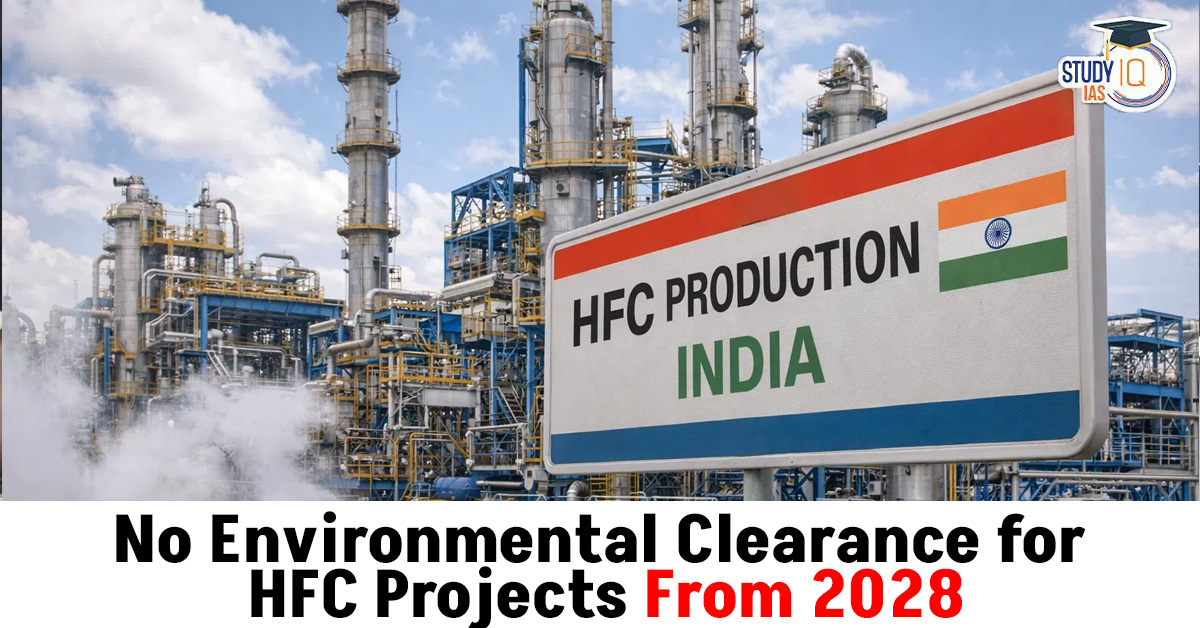
Context: Starting January 1, 2028, India will stop issuing environmental clearances (EC) for new projects or the expansion of existing facilities producing Hydrofluorocarbons (HFCs).
Key Provisions of the Notification on HFC Projects Ban 2028
- Notified under the Ozone Depleting Substances (Regulation and Control) Amendment Rules, 2024
- No new environmental clearances or “Consent to Establish” will be granted for HFC production projects after the 2027 calendar year.
- Also mandates that no person shall import any HFC without a valid license from the government, further tightening the supply chain.
- Exceptions: Clearances may still be granted for HFC production intended solely as feedstock (raw material) for the manufacture of other chemicals, provided they are not released into the atmosphere.
Ozone Depleting Substances (Regulation and Control) Amendment Rules, 2024
- International Alignment: The 2024 amendment is designed to implement the Kigali Amendment to the Montreal Protocol, which India ratified in 2021.
- Primary Objective: To regulate the production, consumption, and trade of Hydrofluorocarbons (HFCs), which were previously used to replace Ozone Depleting Substances (ODS) but are now recognised as potent greenhouse gases.
| Kigali Amendment |
- Adopted: 2016, in Kigali, Rwanda.
- Legally Binding: Unlike the Paris Agreement, which relies on voluntary pledges (NDCs), the Kigali Amendment has mandatory, specific targets for all signatory nations.
- Goal: To reduce HFC consumption by more than 80% over the next 30 years. Success could prevent up to 0.5°C of global warming by the end of the century.
- The agreement recognises that different countries have different economic capacities. It divides nations into three groups with varying timelines:
| Group |
Countries Included |
Baseline Years |
Freeze Year |
| Group 1 |
Developed countries (USA, EU, etc.) |
2011–2013 |
2019 |
| Group 2 |
Most developing countries (China, Brazil, etc.) |
2020–2022 |
2024 |
| Group 3 |
Hot-climate developing countries (India, Pakistan, Gulf states) |
2024–2026 |
2028 |
Hydrofluorocarbons (HFCs)
- These are synthetic organic compounds composed of hydrogen, fluorine, and carbon.
- Synthetic Origin: HFCs do not exist naturally; they are entirely man-made.
- Stability: They are generally non-flammable, chemically stable, and non-reactive, making them safe for use in pressurised systems like air conditioners.
- Ozone Depletion Potential (ODP): HFCs have an ODP of zero. Because they lack chlorine (unlike CFCs), they do not break down ozone molecules in the stratosphere.
- Global Warming Potential (GWP): While they don’t harm the ozone layer, they are incredibly efficient at trapping heat. Their GWP can be hundreds to thousands of times higher than that of carbon dioxide
- Atmospheric Lifetime: HFCs are considered “short-lived climate pollutants.” They stay in the atmosphere for an average of 15 to 29 years
|
Sharing is caring!


 Regulatory Issues in India’s Nuclear P...
 Deep-Space Distance Measurement: New Tec...
 Elephanta Island Excavations: New Discov...













 WhatsApp





