
Table of Contents
Context
During the ongoing conflict with Iran, the United States Department of Defense announced a shift from long-range stand-off missiles to the deployment of precision gravity bombs. This decision follows reports that Iranian air defence systems have been significantly degraded, allowing U.S. aircraft to operate closer to targets.
|
What Are Gravity Bombs? |
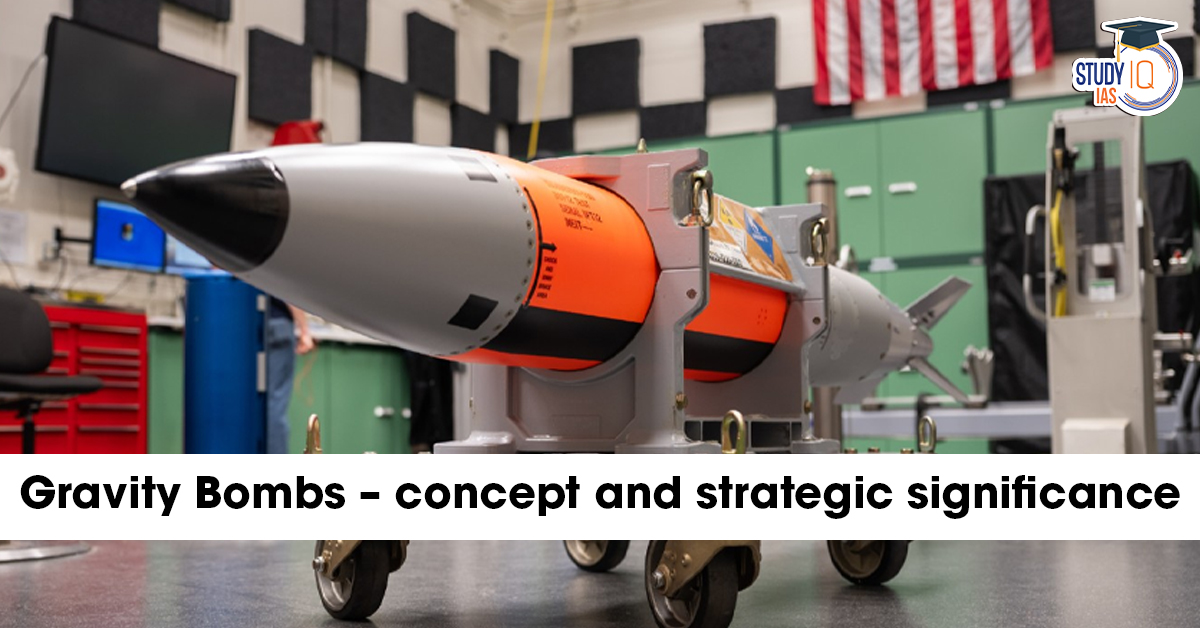
| ● A gravity bomb is an unguided or guided munition dropped from aircraft that relies primarily on gravity to reach its target.
● Free-Fall Weapon System: Historically called free-fall bombs, these weapons descend directly toward targets after release.They do not have engines or independent propulsion. ● Modern Precision Variants: Modern gravity bombs are often equipped with guidance kits such as the Joint Direct Attack Munition (JDAM), which adds GPS navigation and movable fins. This converts traditional bombs into precision-guided munitions (PGMs) capable of striking targets with high accuracy. Types of Gravity Bombs Used by the U.S. ● Mk-82 (500-pound bomb): Part of the Mark 80 series bomb, the Mk-82 is typically used against lightly protected targets such as vehicles, troop formations, and radar systems. ● Mk-83 (1,000-pound bomb): A medium-weight bomb designed to destroy fortified structures, command centres, and infrastructure such as bridges. ● Mk-84 (2,000-pound bomb): The largest bomb in the series, capable of penetrating bunkers or destroying heavily reinforced structures, creating large blast craters. Conventional vs Nuclear Gravity Bombs ● Conventional Gravity Bombs: Conventional variants carry chemical explosives and are widely used in modern warfare. They are relatively inexpensive and commonly deployed by tactical aircraft. ● Nuclear Gravity Bombs: The U.S. arsenal also includes nuclear gravity bombs such as the B61 nuclear bomb, which deliver nuclear payloads measured in kilotons. Their deployment requires direct authorisation from the U.S. President. |
Why the U.S. Shifted to Gravity Bombs
- Cost Efficiency: Stand-off missiles cost millions of dollars per unit. Gravity bombs with guidance kits cost roughly $25,000–$30,000, making them far more economical for sustained operations.
- Air Superiority Advantage: Gravity bombs require aircraft to fly close to targets. This is feasible as S. believes it has achieved air superiority over Iranian airspace.
- Higher Volume Bombardment: Because of their lower cost and ease of deployment, gravity bombs allow militaries to conduct large-scale bombing campaigns more efficiently.
|
Read More Notes |
|
| Environment Notes | Art and Culture Notes |
| Science and Tech | History Notes |
| Geography Notes | Indian Polity Notes |
| General Knowledge | International Relation |
|
Explore StudyIQ Courses |
|
 Mascots for Census 2027 in India: Theme,...
 The Legality of The U.S.-Israel Strikes ...
 India vs New Zealand: India Clinch T20 W...











 WhatsApp





