
Table of Contents
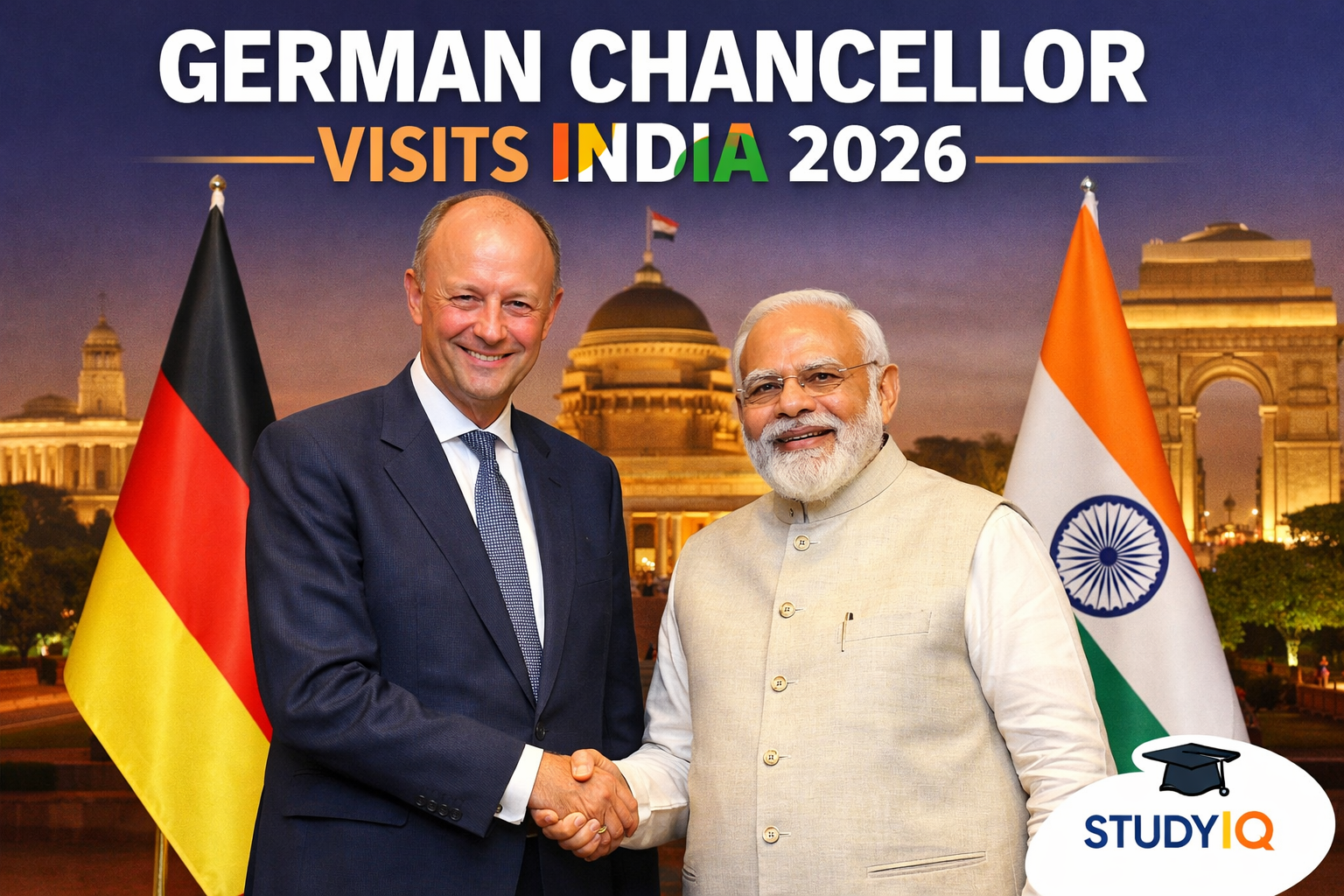
German Chancellor Friedrich Merz’s first visit to India and Asia in January 2026 marked:
- 25 years of India–Germany Strategic Partnership
- 75 years of diplomatic relations
- A shift from mainly economic cooperation to strategic, technological and geopolitical convergence
The visit was outcome-driven with the signing of 19 agreements/MoUs, showing a mature and forward-looking partnership.
German Chancellor’s Visit to India in 2026 Highlights
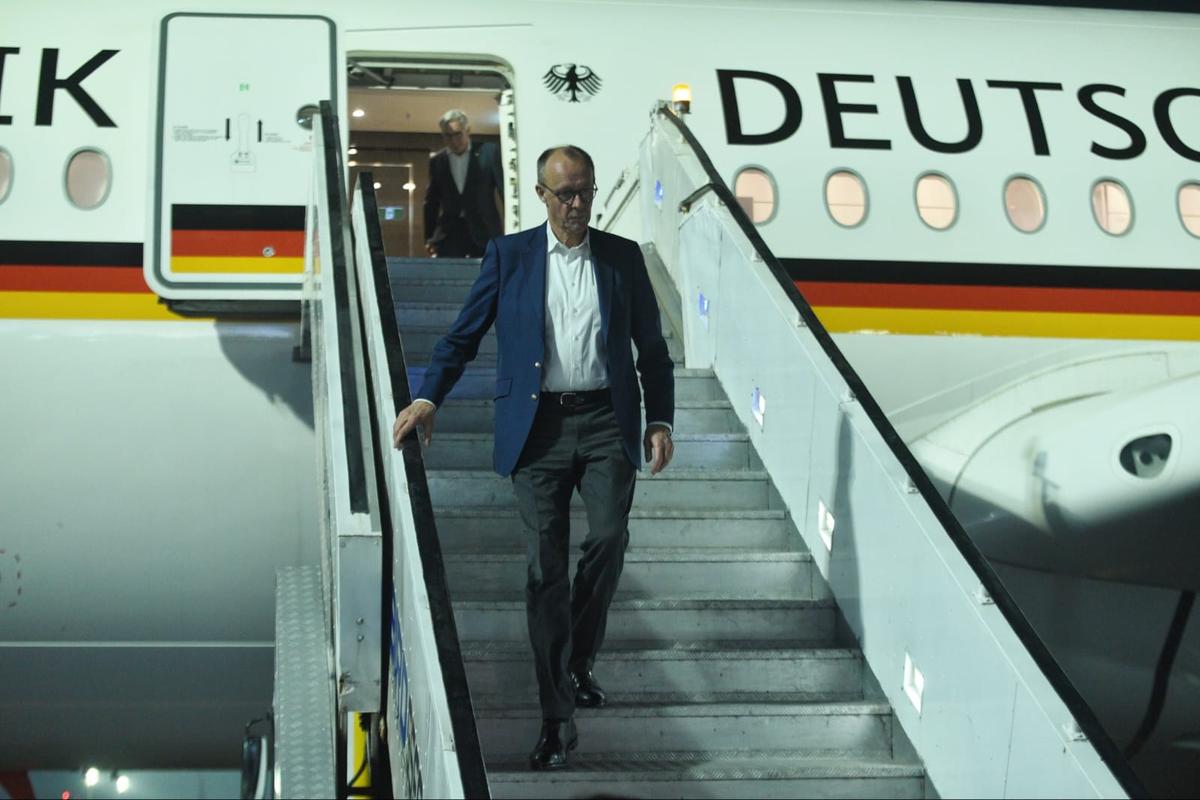
German Chancellor Friedrich Merz’s visit to India in January 2026 marked a historic milestone in bilateral relations, coinciding with 25 years of the India–Germany Strategic Partnership and 75 years of diplomatic ties. The visit elevated cooperation across defence, Indo-Pacific strategy, climate action, technology, trade, education and skilled mobility.
| Area | Key Highlights |
|---|---|
| Significance | First visit of Chancellor Merz to India & Asia; 25 years of Strategic Partnership; 75 years of diplomatic relations |
| Agreements | 19 MoUs/Agreements signed |
| Defence | JDoI on Defence Industrial Cooperation Roadmap; focus on co-development & co-production |
| Defence Projects | Submarines, C-UAS, helicopter systems, joint exercises |
| Indo-Pacific | New Bilateral Indo-Pacific Consultation Mechanism; commitment to Free & Open Indo-Pacific |
| Trade & Economy | Bilateral trade $50 bn (2024); German–Indian CEO Forum |
| FTA | Strong push for India–EU Free Trade Agreement |
| Semiconductors | Semiconductor Ecosystem Partnership |
| Critical Minerals | Cooperation on exploration, processing & supply chains |
| Climate & Energy | India–Germany Centre of Excellence in Renewable Energy; Green Hydrogen cooperation |
| Climate Finance | €10 bn commitment under GSDP till 2030 |
| Education | Roadmap on Higher Education; German universities invited to India |
| Skilled Migration | Global Skills Partnership (healthcare focus) |
| People-to-People | Visa-free transit for Indians via Germany |
| Multilateral Issues | Support for UNSC reforms under G4 |
| Overall Impact | India–Germany ties enter a new strategic phase |
Important Decisions Taken During the Visit of Chancellor Merz to India
Defence & Security Cooperation
- Defence Exercises: Germany has shown interest in participating in India’s defence exercises such as MILAN Naval Exercise, 9th Indian Ocean Naval Symposium (IONS) Conclave of Chiefs, TARANG SHAKTI Air Combat Exercise and deploying a Liaison Officer to Information Fusion Centre – Indian Ocean Region (IFC-IOR).
- Cooperation on Defence Systems: DRDO (India) & OCCAR are collaborating on the Eurodrone MALE UAV Program. There is ongoing collaboration for the development of submarines, obstacle avoidance systems for helicopters & counter-unmanned aerial systems (C-UAS).
- Announcements:
- Establishment of a new Track 1.5 Foreign Policy and Security Dialogue between India & Germany.
- Signing of JDoI to develop a Defence Industrial Cooperation Roadmap for long-term collaboration of defence industries, technology partnerships, co-development & co-production of defence platforms and equipment.
- MoU on Peacekeeping training between the two countries.
Cooperation on Global Issues
- Cooperation on Indo-Pacific: Both countries are committed to a free and open Indo-Pacific and respect for international law, including UNCLOS.
- Germany has been increasing its engagement in the Indo-Pacific region, including by participating under the Capacity Building & Resource Sharing Pillar of the Indo-Pacific Oceans Initiative, co-led by India & Germany.
- Announcements: New Bilateral Indo-Pacific consultation mechanism.
- Cooperation on India-Middle East – Europe Economic Corridor (IMEC): Both countries realise the transformational potential of IMEC in shaping global trade, economy and connectivity.
- Announcements: India & Germany look forward to the first IMEC ministerial meeting to advance the initiative.
- Reforms of UN Security Council: India & Germany agree on comprehensive reforms of the UN Security Council, through the expansion of both permanent & non-permanent categories of membership, for the UN to reflect the contemporary world order and enhanced effectiveness. Both countries are part of the G4 group, which includes Brazil & Japan.
- India & Germany call for text-based negotiations and early conclusion of the IGN process for UN Reforms.
- Israel-Palestine Issue: Both countries support the Gaza Peace Plan and UNSC Resolution 2803 as a step forward towards peace for Gaza conflict.
- They called for unhindered and at-scale delivery of humanitarian aid to Gaza and unimpeded access for humanitarian organisations.
- Both support a just, lasting and comprehensive resolution of the conflict in the Middle East in the form of a negotiated Two State Solution.
- Global Climate Talks: Both countries called for urgent & accelerated global action on climate change under the UNFCCC process. The countries are strong supporters of the Paris Agreement & support mechanisms such as the Just Transition Mechanism and the Technology Implementation Program, and look forward to the Global Stocktake.
- They called for:
- Significantly enhanced climate action.
- Increasing efforts in climate finance & technology transfer to support developing countries in a just transition
- Well-designed climate action for economic development & poverty reduction.
- Scaling up climate finance by all actors for accelerating the transition along national and cross-border value chains.
- They called for:
Trade & Economic Relations
- Sustained growth in bilateral trade & investment between India & Germany, with bilateral trade reaching a record high of $50 billion in 2024, amounting to over 25% of India’s trade with the EU.
- Announcements:
- Conclusion of India–EU Free Trade Agreement as a key outcome of the upcoming EU-India Summit, which will facilitate trade flows and inject further momentum into German-Indian economic relations.
- Establishment of the German-Indian CEO Forum for promoting industry collaboration, supported by the long-standing presence of German businesses in India and Indian businesses in Germany.
Cooperation in Science, Innovation & R&D
- Cooperation on Semiconductors: Both countries are committed to enhanced institutional research and industrial collaboration between their semiconductor ecosystems.
- Germany’s semiconductor company, Infineon, has opened its Global Capability Centre in GIFT City.
- Announcements: Establishment of an institutional dialogue across the semiconductor value chain through the establishment of the Semiconductor Ecosystem Partnership.
- Cooperation on Critical Minerals: They aim to boost their collaboration in critical minerals in areas of exploration, R&D, value addition through processing and recycling and acquisition and development of critical mineral assets in both as well as third countries.
- Collaboration on Mega-Science Projects: India is participating in major science projects of Germany, such as Facility for Antiproton & Ion Research (FAIR) & Deutsches Elektronen Synchrotron (DESY), and PETRA-III.
Cooperation on Sustainable Development/Green & Renewable Energy
- Green & Sustainable Development Partnership (GSDP): India and Germany entered the GSDP in 2022 to cooperate on shared global climate and sustainability goals. Under the GSDP, Germany committed €10 billion till 2030, largely as concessional finance, to support implementation of the SDGs and the Paris Agreement.
- India has already accessed €5 billion under GSDP, which has supported key initiatives such as PM e-Bus Sewa, Solar Rooftop Programme, National Green Hydrogen Mission, metro rail projects in Ahmedabad, Surat and Bengaluru, Water Vision 2047, battery storage in West Bengal, agro-photovoltaic technologies, and financing public financial institutions to scale up renewable energy.
- Green Technologies: Cooperation in green technology, standards, regulation and supply chain resilience for renewable energy such as solar, wind and battery manufacturing.
- Announcements: Establish the India – Germany Centre of Excellence. It will serve as a shared platform for knowledge, technology, and innovation.
- Cooperation on Green Hydrogen: Aim towards deeper technological, commercial, regulatory and business collaboration in the Green Hydrogen Sector.
- Germany’s Uniper Global Commodities has signed one of the largest Offtake Agreements for the supply of Green Ammonia from AM Green.
- Announcements: For advancing cooperation on developing hydrogen regulations & standards in India, an MoU was signed between PNGRB and its German Counterpart.
- Triangular Development Cooperation Projects: Both sides undertake joint projects in Africa and Latin America by mobilising complementary strengths for the sustainable development of third countries. Presently, such projects are being scaled up in Ghana, Cameroon & Malawi.
Promotion of People-to-People Ties
- There is a growing exchange of students, researchers, skilled professionals, artists and tourists between India & Germany. The Indian community has emerged as a valuable contributor to Germany’s economy, innovation & cultural life.
- Announcements:
- Visa-free transit facility for Indian passport holders for transiting through Germany – facilitate ease of travel of Indians and intensify people-to-people ties.
- Further strengthening of legal mobility and cooperation on the return of persons required to leave the country and fight against irregular migration, human trafficking, document & visa fraud by fully implementing the Migration & Mobility Partnership Agreement (MMPA).
Cooperation on Skilled Migration
- India & Germany have a strong institutional cooperation on skilled migration under the Migration & Mobility Partnership Agreement.
- They aim to facilitate mobility of skilled workers in a manner that benefits all parties while safeguarding against exploitation and ensuring compliance with international labour standards.
- Announcements:
- JDI on Global Skills Partnership focussing on an ethical & sustainable framework for skilled mobility, particularly for addressing Germany’s growing demand for healthcare professionals.
- JDI to establish an Indo-German Centre of Excellence for Skilling in Renewable Energy for cooperation in curriculum development, Industry and training of trainers in the renewable energy sector.
- Commitment to expanding the teaching of the German language in India in secondary schools, universities & vocational education centres.
Cooperation in Education
- Germany has emerged as a popular destination for higher education among Indian students, along with a growing network of joint and dual degree programs, collaborative research and institutional partnerships in higher education.
- Increasingly, Germany has adopted policies to support Indian students and their integration in the German job market.
- Institutional Collaboration: IITs & Technical Universities in Germany.
- Announcements:
- Indo-German Comprehensive Roadmap on Higher Education for deepening institutional linkages.
- PM Modi invited German Universities to open campuses in India.
Cultural Cooperation
- MoU between German Maritime Museum – Leibniz Institute for Maritime History (DSM), Bremerhaven and National Maritime Heritage Complex at Lothal for deepening cooperation on maritime heritage.
Way Forward
- Operationalise the defence industrial roadmap through flagship co-production projects.
- Fast-track the India–EU Free Trade Agreement.
- Institutionalise semiconductor and critical minerals cooperation with time-bound targets.
- Deepen Indo-Pacific security coordination and joint maritime initiatives.
- Expand German universities and skill centres in India under NEP 2020.
- Scale up green hydrogen and renewable energy collaboration.
- Strengthen ethical and mutually beneficial skilled mobility frameworks.
Conclusion
The 2026 visit marks a qualitative upgrade in India–Germany relations, transforming them into a strategic partnership rooted in defence cooperation, technological trust, climate leadership and shared geopolitical values. In a rapidly changing global order, India and Germany emerge as natural partners committed to a rules-based international system and sustainable development, making this partnership a cornerstone of India’s Europe and Indo-Pacific strategy.
 US–Israel Attack on Iran 2026: Khamene...
 Agentic AI vs AI Agents: Meaning, Differ...
 Prahaar Missile System: Range, Features ...










 WhatsApp





