
Table of Contents
Context
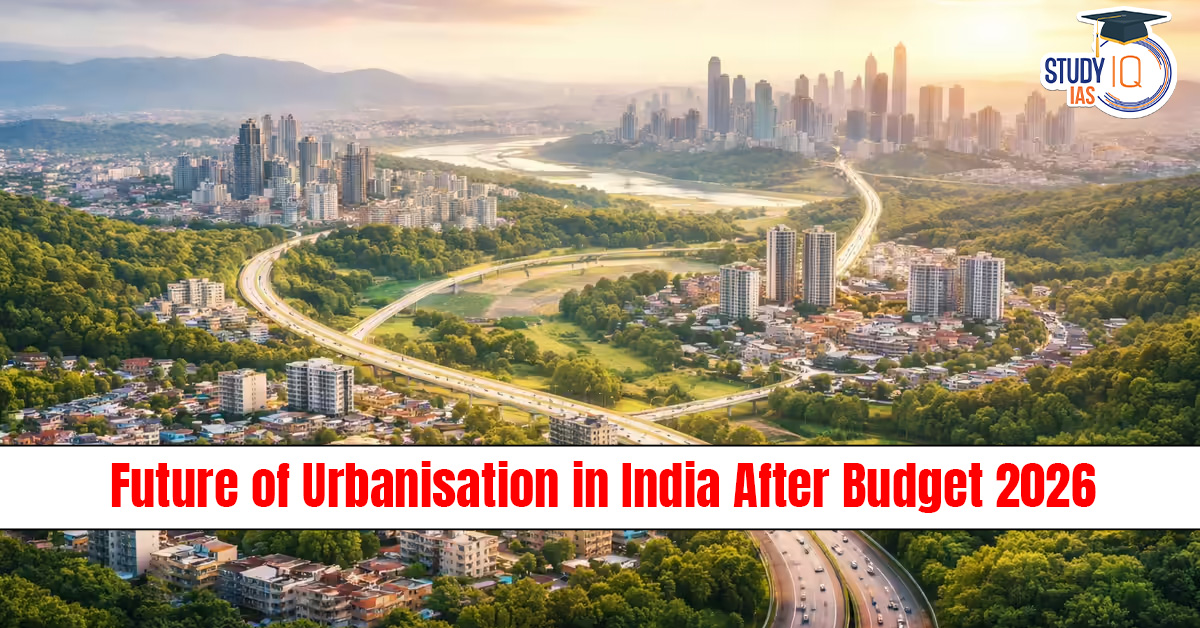
- The Union Budget 2026 signals a tightening of public spending on India’s cities, raising concerns about the long-term sustainability of the country’s urbanisation strategy.
- Central allocations for urban development have been reduced by 11.6%, from ₹96,777 crore to ₹85,522 crore, at a time when cities are absorbing large-scale migration, confronting climate stress, and managing ageing infrastructure systems.
Role of Cities in India’s Growth Story
- Urban regions play a pivotal role in India’s economic and social transformation.
- Cities contribute close to two-thirds of the national GDP and serve as centres for employment generation, innovation, and delivery of essential services.
- However, rapid urban expansion has placed significant pressure on housing, transport systems, sanitation, water supply, and urban governance frameworks.
- Managing this shift requires consistent public investment, especially since urban local bodies (ULBs) remain financially weak and heavily reliant on transfers from the Centre and States.
- The 74th Constitutional Amendment envisioned empowered municipalities with operational and financial autonomy.
- In practice, limited devolution of funds, functions, and functionaries has constrained their effectiveness.
- To bridge these gaps, central initiatives such as PMAY-Urban, AMRUT, Swachh Bharat Mission-Urban, and investments in mass transit systems were introduced to ensure a basic standard of urban services across cities.
Institutional Framework and Constitutional Context
- The 74th Constitutional Amendment envisaged empowered municipalities with meaningful autonomy.
- In practice, limited devolution of funds, functions, and functionaries has restricted their capacity to plan, finance, and deliver urban services effectively.
- Central initiatives such as PMAY (Urban), AMRUT, Swachh Bharat Mission (Urban), and mass transit programmes were introduced to bridge institutional gaps and create a baseline of urban infrastructure across Indian cities.
Framework for Financing Urban Development
- Urban development funding in India comes from a combination of central government allocations, state budgets, municipal revenues, and borrowings.
- Centrally Sponsored Schemes (CSS) play a major role, particularly in sectors like housing, sanitation, water supply, and urban mobility.
- While large-scale projects such as metro rail networks have received steady backing, routine urban services—including solid waste management, public buses, pedestrian infrastructure, drainage, and informal housing—depend on reliable and long-term funding.
- In recent years, climate-related challenges such as extreme heat, flooding, and water shortages have increased the demand for climate-resilient urban infrastructure.
- As a result, prioritising urban investment is no longer merely a welfare concern but a broader macroeconomic necessity.
Imbalance in Spending Priorities
- Despite the overall reduction, a large share of urban funding continues to be directed toward metro rail projects.
In 2026–27, allocations for metro and mass rapid transit systems amounted to ₹28,740 crore, accounting for nearly one-third of total urban expenditure. - While metro systems are essential for major metropolitan areas, they are highly capital-intensive, geographically limited, and primarily serve formal-sector commuters.
- In contrast, bus services, non-motorised transport, and last-mile connectivity—used by a much larger segment of the urban population—receive comparatively limited support.
- This pattern reflects a preference for high-visibility infrastructure projects over more inclusive and widely accessible mobility solutions.
Reduction in Key Urban Welfare Schemes
Several flagship urban programmes have faced budget cuts:
- Pradhan Mantri Awas Yojana–Urban (PMAY-U) has seen a reduction of nearly 6%, despite persistent shortages in affordable housing and the expansion of informal settlements.
- Swachh Bharat Mission–Urban (SBM-U) allocations have been reduced by half, raising concerns about maintaining progress in sanitation coverage and waste management systems.
- AMRUT, which focuses on water supply and sewerage infrastructure, has experienced a 20% cut, even as cities grapple with severe water stress and deteriorating networks.
These reductions directly affect urban living standards and risk undermining the gains achieved in essential services.
Broader Implications for Governance and Growth
- The Budget does not offset lower central funding with greater fiscal autonomy or enhanced revenue-generating powers for municipal bodies.
- As a result, ULBs continue to face limitations in long-term planning and addressing local development needs.
- From a broader perspective, weakening investment in cities could hinder India’s long-term growth ambitions.
International experience shows that sustainable development is closely linked to well-resourced, inclusive, and productive urban centres. - Viewing urban development primarily as an expenditure burden rather than a growth catalyst may lead to adverse economic and social outcomes over time.
|
Read More Notes |
|
| Environment Notes | Art and Culture Notes |
| Science and Tech | History Notes |
| Geography Notes | Indian Polity Notes |
| General Knowledge | International Relation |
|
Explore StudyIQ Courses |
|
 Removal of the Chief Election Commission...
 Artemis II Launch 2026 LIVE: Crew Begins...
 Utkal Divas 2026: Date, History, Signifi...












 WhatsApp





