
Table of Contents
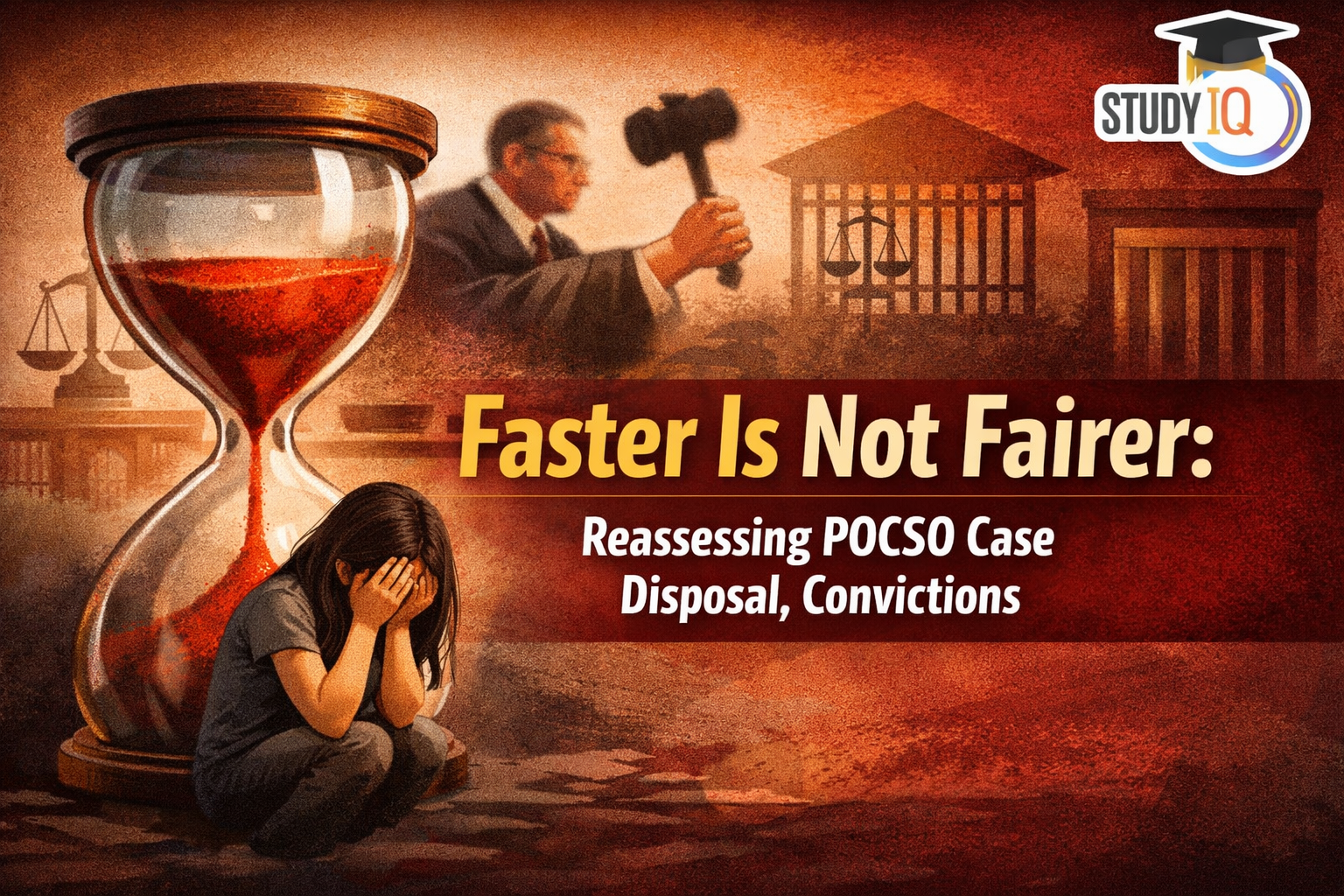
Under the Protection of Children from Sexual Offences (POCSO) Act, 2012, India achieved a widely reported milestone in the administration of justice in 2025. During the year, Fast Track Special Courts (FTSCs) closed 87,754 cases out of 80,320 newly registered cases, reporting a disposal rate of 109%. This statistical accomplishment was generally praised as a breakthrough in addressing the chronic backlog of cases involving child sexual offences. However, a more alarming reality emerges when conviction rates, trial quality, institutional support networks, and the lived experiences of child survivors are examined more closely. Stronger convictions, more equitable results, or child-centred justice have not resulted from quicker case clearance. Rather, it runs the risk of ignoring fundamental flaws and reducing justice to numerical efficiency.
The Origins and Objectives of the POCSO Act, 2012
To rectify the shortcomings of the Indian Penal Code and other criminal legislation about sexual offences against children, the POCSO Act was passed in 2012. Before POCSO, rape, molestation, and outraging modesty were covered under broad laws that did not acknowledge children’s increased vulnerability or provide child-sensitive procedures. By establishing gender-neutral definitions of sexual offences, acknowledging various types of abuse, and putting the child’s best interests at the core of the legal process, POCSO aimed to address this.
The Act promised a revolutionary framework, including mandatory in-camera hearings, time-bound investigations, child-friendly reporting and trial procedures, the presence of support personnel, and special courts to ensure speedy and sensitive justice. Its philosophy was to stop children from becoming secondary victims of the legal system in addition to punishing offenders.
The Rise of Fast Track Special Courts
In October 2019, Fast Track Special Courts were established with ₹1,952 crore from the Nirbhaya Fund, as directed by the Supreme Court of India. As of 2025, India operates 773 FTSCs, of which approximately 400 are dedicated exclusively to POCSO cases. These courts were established to ensure speedy adjudication and address systemic delays.
According to data, FTSCs handle 9.51 cases on average each month, whereas ordinary courts only handle 3.26 cases. These courts had resolved 3,50,685 cases by September 2025. This appears to indicate a notable improvement in judicial efficiency. But when it comes to assessing justice in situations involving child survivors, quickness by itself is insufficient.
Declining Conviction Rates and Fragile Justice
Conviction outcomes reveal a quite different picture, even though disposal rates are higher. By 2023, the national POCSO conviction rate had dropped from roughly 35% in 2019 to 29%. Conviction rates should have climbed proportionately if disposals had increased without sacrificing quality, possibly reaching about 45% at a 90% disposal threshold. Instead, there is a 36% shortage in convictions, which is 16 percentage points less than anticipated.
Conviction rates in fast-track courts in particular average a startling 19%, with numerous states reporting more acquittals than convictions. The idea that quicker trials inevitably result in greater justice is called into question by this trend. In reality, hasty hearings frequently undermine evidence standards, weaken investigations, and shorten witness examinations.
Structural Failures in Investigation and Prosecution
Investigative shortcomings are a major contributing reason to convictions that fall short. Particularly in high-burden states like Uttar Pradesh and Maharashtra, field reports show incomplete charge sheets, delayed forensic results and insufficient paperwork. Delays are made worse by overcrowded courts and understaffed forensic labs, which makes it more difficult for the prosecution to prove guilt beyond a reasonable doubt.
Forensic and medical evidence are often used in POCSO cases, although laboratory analysis delays weaken cases and increase the likelihood of acquittals. Speed-driven disposal runs the risk of giving finality precedence over thoroughness, which could lead to verdicts that fail survivors.
The Missing Child Support Ecosystem
Under POCSO, justice goes beyond the effectiveness of the courtroom. Throughout the trial, child survivors need welfare interventions, ongoing psychosocial assistance, and legal counsel. Support persons must be appointed to help children throughout investigations and trials, according to Section 39 of the POCSO Act. In 2021, the Supreme Court reiterated this duty, and in 2024, the National Commission for Protection of Child Rights released comprehensive instructions.
Implementation is still wildly inconsistent, though. Cases have collapsed even before trial in a number of states due to the failure to empanel support individuals. Unaccompanied children frequently navigate police stations and courts, which increases trauma and causes them to withdraw from proceedings.
Para-Legal Volunteers: A Missing First Line of Defence
The Supreme Court ordered the appointment of para-legal volunteers (PLVs) to support POCSO cases at every police station in December 2025. However, compliance has been appalling. Only 42 of Andhra Pradesh’s 919 police stations have PLVs, whilst Tamil Nadu’s 1,577 stations have none. Families experience intimidation, delayed FIRs, and procedural negligence in the absence of PLVs.
Well-known incidents highlight these shortcomings. Police threatened the survivor’s family and postponed filing the FIR in the Unnao rape case. A 13-year-old survivor was beaten once more at a police station in Lalitpur in 2022, and it wasn’t until an NGO intervened that the FIR was filed. PLVs may have guaranteed prompt registration, protected evidence, and shielded families from coercion.
Judicial Responses and Troubling Trends
Inconsistencies still exist even though the judiciary has been crucial in bolstering the POCSO framework. Even in situations involving convictions under Section 6 of the Act, courts have occasionally cleared accused individuals who pledged to marry survivors after they reached adulthood. Such decisions run the risk of legitimising coercion and suffering that lasts a lifetime, undermining the statutory aim of POCSO.
At any point during the legal process, courts have the authority to award interim compensation, particularly when health or education is at risk. However, a lot of courts wait for final verdicts, which are frequently rendered years later, before awarding compensation. By then, the harm to family finances, education, and mental health is irrevocable. Studies have shown that compensation loses its rehabilitative aim when it is disbursed, and High Courts have frequently chastised legal aid providers for delays.
The Economic and Social Costs of Speed Without Support
The legal system itself becomes a cause of suffering for underprivileged families. Families borrow money for travel and legal costs; moms quit their jobs to support their children; and daily wage earners lose money attending hearings. These expenses are frequently not fully covered by state assistance. Survivors and their families are left emotionally and financially exhausted by hasty disposal without sufficient aid.
Learning from Comparative International Frameworks
Child justice systems around the world place a strong focus on striking a balance between promptness and child care. Strict forensic timetables, mandated victim support programs, and dedicated child advocacy centres are all integrated in countries like the UK, Canada, and Australia. Conviction quality is seen as a fundamental measure of the administration of justice, not just disposal rates.
Authoritarian systems, on the other hand, frequently claim high disposal rates but low public trust because they prioritise quick closure over procedural safeguards. If corrective action is not taken, India’s experience is becoming more and more similar to the latter.
The Way Forward: From Numerical Success to Substantive Justice
There are workable solutions. Accountability can be enhanced by RTI-based monitoring of support person appointments, stringent forensic timelines, grouping of older cases, and periodic conviction audits. Madhya Pradesh provides encouraging instances of how sensitive witness handling and efficient forensic procedures have enhanced conviction rates.
More importantly, the legal system needs to reiterate POCSO’s central tenet that child safety cannot be reduced to statistical efficiency. Fairness must be served by speed, not replaced by it.
Conclusion
The fact that India has resolved more POCSO cases than it has registered is not a sign of justice in and of itself. Efficiency is undermined when convictions decline, investigations become weaker, and children leave the system more traumatised than safeguarded. The real litmus test for POCSO is not disposal rates but rather whether the court system pays attention to children, helps them deal with trauma, and produces results that rebuild trust and dignity. Faster is not more equitable unless the child is still at the centre of justice.
 Trial by Social Media: Public Shaming, D...
 Governors’ Address to State Legislatur...
 Mandating Prior Approval for Corruption ...








 WhatsApp





