
Table of Contents
Context: India’s nuclear programme has reached a significant milestone with the commencement of core loading at the country’s first indigenous Fast Breeder Reactor (FBR) in Kalpakkam, Tamil Nadu.
Fast Breeder Reactor: Historical Context and Development
- Fast Breeder Reactor Program: Initiated two decades ago, the FBR program aims to extend India’s capabilities across the nuclear fuel cycle, contributing to electricity production from uranium.
- BHAVINI Establishment: In 2003, under Prime Minister Atal Bihari Vajpayee, Bharatiya Nabhikiya Vidyut Nigam Ltd (BHAVINI) was formed to construct and operate the Prototype Fast Breeder Reactor (PFBR).
- Project Delays: Originally targeted for completion by September 2010, the PFBR faced delays due to technological challenges, with the last set of approvals moving the completion to October 2022.
- Global Context: Upon commissioning, India will join Russia as the second country to have a commercial FBR in operation. China has a smaller fast breeder program, while Japan, France, and the United States have ceased theirs due to safety concerns.
Check here: India’s Nuclear Breakthrough Prototype Fast Breeder Reactor (PFBR) at Kalpakkam
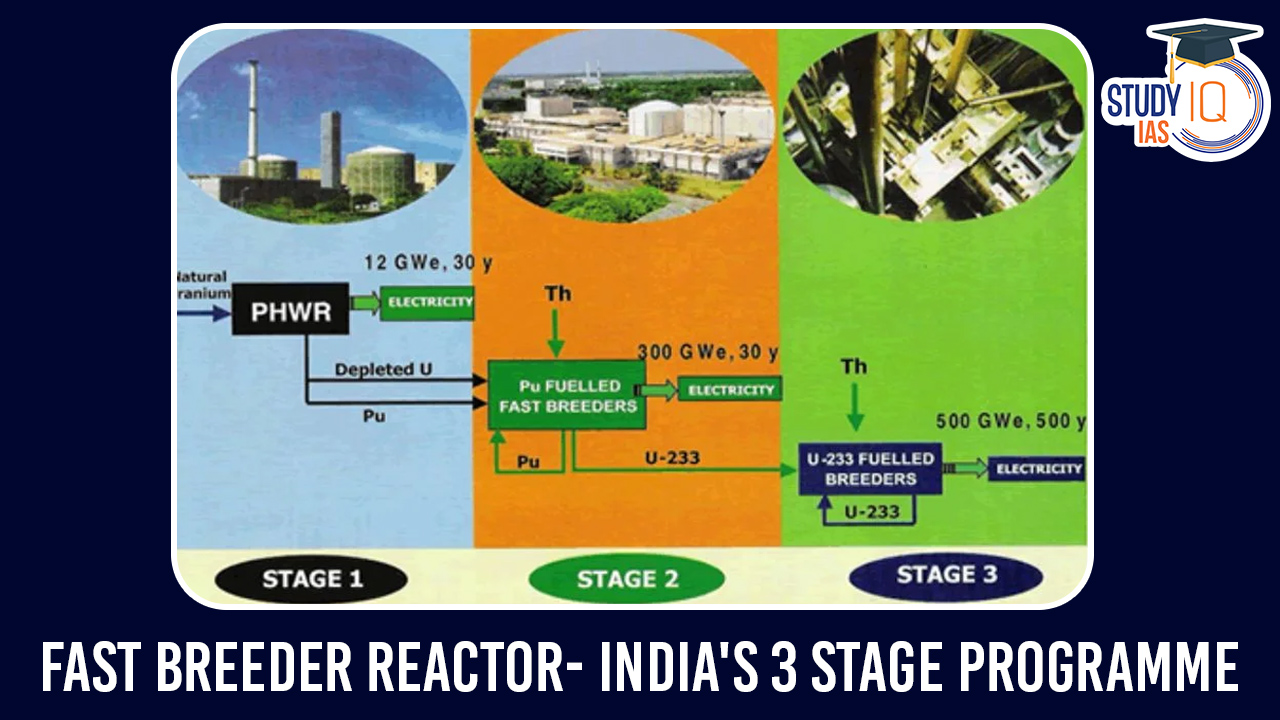
Three-Stage Nuclear Power Programme
- Stage One: Involves Pressurised Heavy Water Reactors (PHWRs) using natural uranium as fuel, with 22 operational reactors having an installed capacity of 6,780 MWe.
- Stage Two: Focuses on FBRs to multiply fissile material inventory, critical for utilising thorium in the future.
- Stage Three: Envisions using thorium in an Advanced Heavy Water Reactor (AHWR) to produce electricity through the ThU233 cycle.
Thorium Utilisation and Energy Security
- Thorium Reserves: India’s strategy includes leveraging its abundant thorium reserves in coastal and inland sands across various states to ensure long-term energy security.
- Closed Fuel Cycle Approach: Involves reprocessing spent fuel to separate useful isotopes, facilitating the transition towards thorium usage.
Progress and Future Directions
- Initial Fuel Use: The FBR will initially use Uranium-Plutonium Mixed Oxide (MOX) fuel, with plans to incorporate thorium (Th232) as a blanket for producing fissile U233 in later stages.
- Energy Production and Costs: Despite advanced technology, the projected capital and electricity costs of the FBR are comparable to those of other nuclear and conventional power sources.
- Nuclear Power Expansion: With the India-US civil nuclear deal enabling uranium imports, India aims to significantly increase its nuclear power output to 22,400 MWe by 2032.

 Artificial Intelligence in Diplomacy: Ap...
 Google AI Data Centre in Visakhapatnam: ...
 Drone Warfare: Strategic Shift in Modern...













 WhatsApp





