
Table of Contents
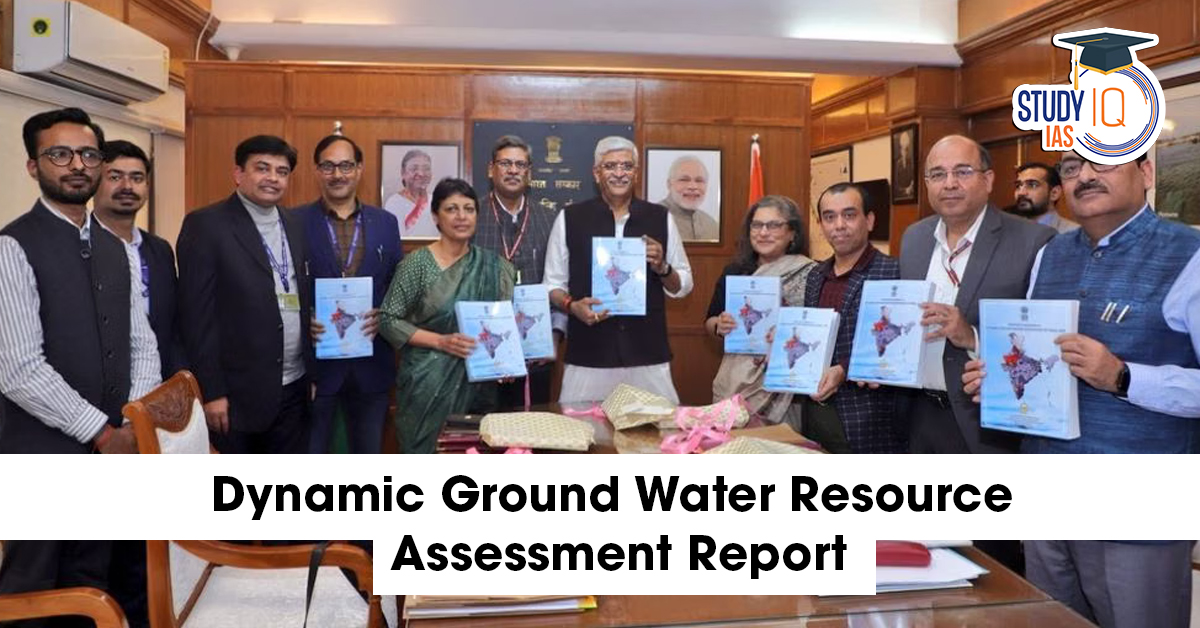
The Dynamic Groundwater Resource Assessment Report, 2024, released by the Government of India, presents a cautiously optimistic picture of India’s groundwater situation. The report highlights improved recharge, reduced long-term extraction, and a rise in ‘Safe’ groundwater units, while also flagging persistent regional stress, climate risks, and governance challenges.
Published through the Press Information Bureau (PIB) under the Ministry of Jal Shakti, the report is crucial for UPSC aspirants, policymakers, researchers, and water resource planners.
What is the Dynamic Ground Water Resource Assessment Report?
The Dynamic Ground Water Resource Assessment (DGWRA) is an annual scientific assessment of groundwater availability, recharge, and extraction across India. Conducted by the Central Ground Water Board (CGWB) in collaboration with States, it evaluates groundwater conditions at the assessment unit level (blocks/talukas/mandals).
Since 2022, the assessment has shifted to an annual cycle, enabling real-time, data-driven groundwater governance.
Key Highlights of the Dynamic Ground Water Resource Assessment Report 2024
1. Increase in Groundwater Recharge
-
Total annual groundwater recharge: 446.90 Billion Cubic Metres (BCM)
-
Reflects a long-term upward trend, supported by:
-
Rainwater harvesting
-
Tanks, ponds and check dams
-
Water conservation structures
-
This improvement underscores the impact of national water conservation campaigns.
2. Moderate and Sustainable Extraction Levels
-
Annual groundwater extraction: 245.64 BCM
-
Stage of groundwater extraction: 60.47%
At the national level, India remains within the sustainable extraction threshold, though local-level stress persists.
3. Expansion of ‘Safe’ Groundwater Units
-
73.4% of assessment units are now categorised as Safe
-
Up from 62.6% in 2017
This marks a significant improvement in groundwater management practices across several regions.
4. Decline in Over-Exploited Units
-
Over-exploited units reduced from 17.24% (2017) to 11.13% (2024)
The decline indicates a partial reversal of groundwater stress, especially in areas benefiting from recharge interventions.
5. Role of Water Conservation Structures
-
Recharge from tanks, ponds, and water conservation structures: 25.34 BCM
-
Nearly double the contribution recorded in 2017
This highlights the success of artificial recharge and community-level water conservation efforts.
6. Rainfall Remains the Dominant Recharge Source
-
~61% of groundwater recharge comes from rainfall
-
Makes groundwater availability highly sensitive to monsoon variability and climate change
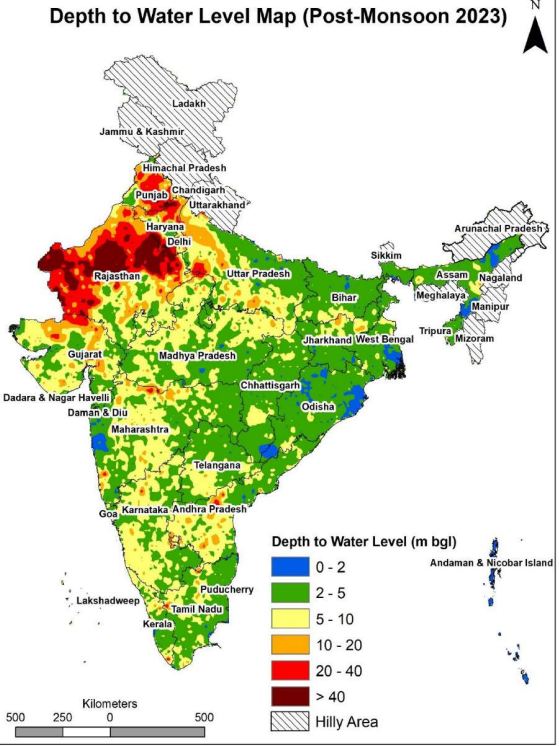
7. Persistent Regional Imbalances
Despite overall improvement, Critical and Over-exploited units remain concentrated in:
-
Punjab, Haryana, Delhi
-
Rajasthan, Gujarat
-
Tamil Nadu, Karnataka, Telangana
These regions face a combination of water-intensive agriculture, energy subsidies, and hydro-geological constraints.
Reasons for Groundwater Depletion in India
Agriculture-Driven Over-Extraction
-
Groundwater supports ~62% of India’s irrigation
-
Dominance of water-intensive crops like rice and sugarcane
-
Major driver of stress in north-western and peninsular India
Seasonal Rainfall Pattern
-
Nearly 75% of annual rainfall occurs between June–September
-
Results in temporal mismatch between recharge and year-round withdrawal
Hydro-Geological Constraints
-
About two-thirds of India lies in hard rock terrain
-
Limited groundwater storage confined to fractured zones
Energy Subsidy Distortions
-
Free or cheap electricity encourages indiscriminate pumping
-
Especially visible in Punjab, Haryana, Rajasthan and Tamil Nadu
Urban and Industrial Pressure
-
Rapid urbanisation and industrial growth increase non-agricultural extraction
-
Reflected in the 245.64 BCM annual groundwater draft (2024)
Government Initiatives to Address Groundwater Stress
-
National Aquifer Mapping Programme (NAQUIM & NAQUIM 2.0)
Scientific aquifer mapping and aquifer-level management plans -
Atal Bhujal Yojana (ATAL JAL)
Community-led, demand-side groundwater management in stressed blocks -
Master Plan for Artificial Recharge (2020)
Proposes ~1.42 crore recharge structures to harness 185 BCM of monsoon runoff -
Jal Shakti Abhiyan – Catch the Rain
Nationwide campaign promoting rainwater harvesting -
PM Krishi Sinchayee Yojana (PMKSY – Groundwater Component)
Focus on micro-irrigation and efficient water use
Challenges Highlighted in the Report
Water Security Risks
-
Groundwater supplies 85% of rural and ~50% of urban drinking water
-
Depletion directly threatens human security and livelihoods
Regional Inequality
-
Concentration of stress in specific regions leads to uneven development
Groundwater Quality Concerns
-
127 assessment units (1.88%) affected by salinity
-
Arsenic and fluoride contamination overlaps with quantity stress
Climate Change Vulnerability
-
Erratic rainfall caused a slight fall in recharge
-
449.08 BCM (2023) → 446.90 BCM (2024)
-
Governance Fragmentation
-
Groundwater is a State subject
-
Leads to weak regulation, poor pricing signals, and uneven policy adoption
Way Forward: Policy and Governance Priorities
-
Aquifer-Based Management:
Scale up NAQUIM 2.0 with village-level aquifer management plans -
Demand-Side Reforms:
Crop diversification, rationalised power subsidies, and micro-irrigation -
Artificial Recharge Acceleration:
Fast-track the Master Plan for Artificial Recharge -
Community Stewardship:
Expand ATAL JAL to more water-stressed Gram Panchayats -
Data-Driven Governance:
Institutionalise annual assessments using the IN-GRES GIS platform
Conclusion
The Dynamic Ground Water Resource Assessment Report 2024 reflects measurable progress in groundwater recharge and management, offering cautious optimism for India’s water future. However, regional stress, climate uncertainty, quality degradation, and governance gaps remain significant threats.
Achieving long-term groundwater sustainability will require aquifer-based planning, behavioural change, community participation, and climate-resilient water governance—moving from extraction-driven use to sustainable stewardship of groundwater resources.
 Illegal Sand Mining in National Chambal ...
 16th Finance Commission: Key Facts, Func...
 Species in News for UPSC Prelims 2026: C...









 WhatsApp





