
Table of Contents
Denial of Maternity Benefits to Adoptive Mothers: A Constitutional Analysis of the Supreme Court’s 2026 Judgment
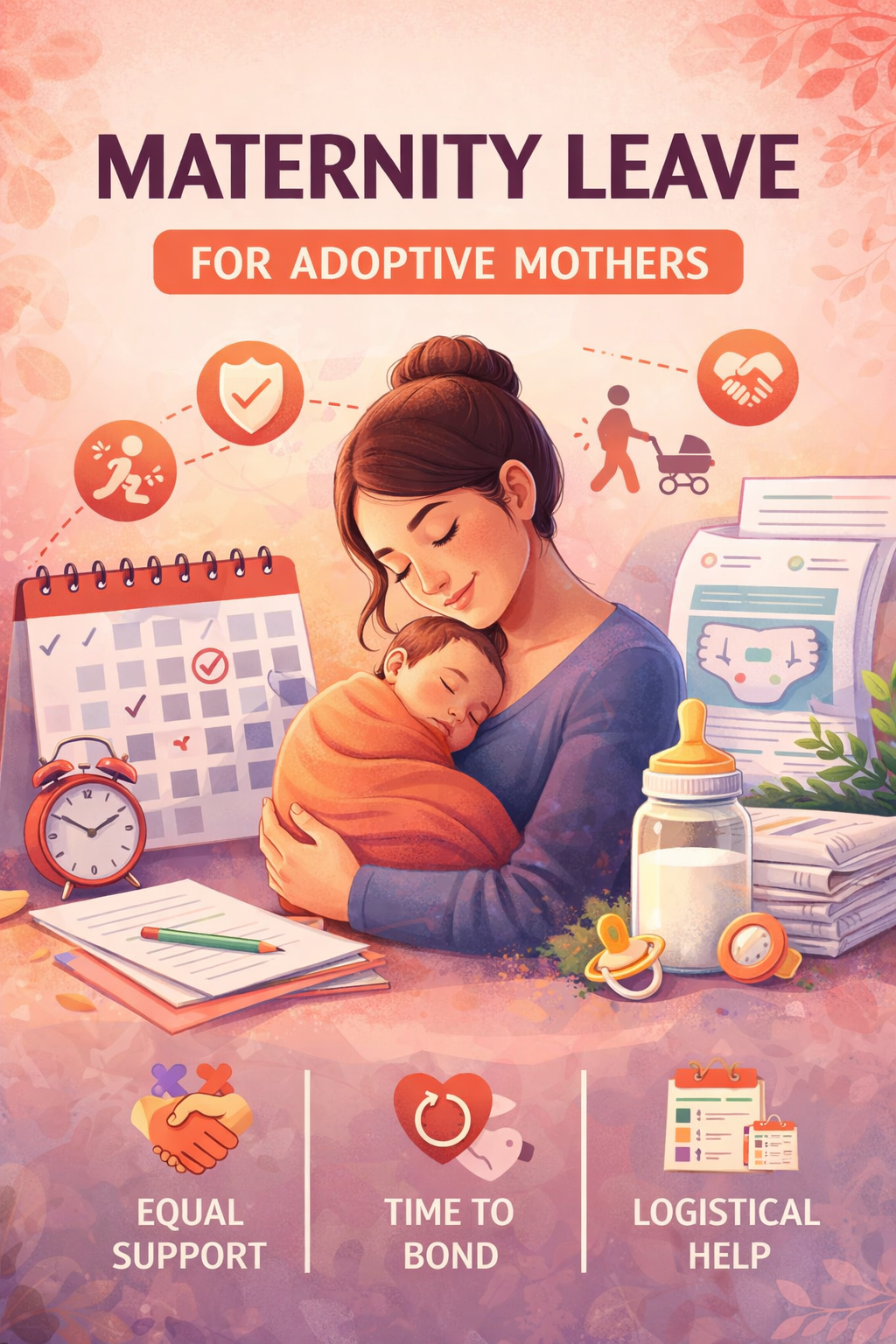
Context: The recognition of maternity benefits as a fundamental aspect of social justice and gender equality has markedly progressed in Indian constitutional jurisprudence. On March 17, 2026, the Supreme Court of India issued a pivotal decision that struck down a restrictive provision in the Social Security Code, 2020, which confined maternity benefits for adoptive mothers to instances when the adopted child was below three months old. The decision represents a significant advancement in the extension of maternity rights, especially for adoptive and commissioning mothers. It upholds the principles of equality, dignity, and welfare enshrined in the Constitution.
The case, Hamsaanandini Nanduri v. Union of India (W.P.(C) No. 960/2021; 2026 LiveLaw (SC) 250), examines the legality of Section 60(4) of the Social Security Code, 2020. The Supreme Court, via a bench of Justice Pardiwala and Justice R. Mahadevan, determined that the refusal of maternity benefits to adoptive mothers due to the age of the adopted child is unconstitutional and contravenes Articles 14 and 21 of the Constitution.
Factual Background and Procedural Timeline
The suit commenced in 2021 as a Public Interest Litigation against Section 5(4) of the Maternity Benefit Act, 1961, as revised in 2017. The policy allocated 12 weeks of maternity leave exclusively to adopting mothers, contingent upon the adopted child being under three months of age.
The petitioner, an adoptive mother of two children since 2017, contended that the provision was capricious and discriminatory. On November 12, 2024, the Supreme Court notified the Union Government. Following the implementation of the Social Security Code, 2020, which repealed the Maternity Benefit Act, attention turned to Section 60(4) of the new Code, which maintained the same age limitation.
The petitioner emphasised the procedural aspects of adoption as delineated in the Juvenile Justice (Care and Protection of Children) Act, 2015. In instances of abandoned or orphaned children, the Child Welfare Committee may require two to four months to officially declare the child legally free for adoption. A statutory reconsideration time of 60 days is allotted to biological parents in instances of abandoned children. The procedural timelines render it very unfeasible for several adoptive mothers to adopt children under three months of age.
On January 29, 2025, following the presentation of comprehensive arguments, the Court reserved its decision.
Judicial Matters Under Review
The principal legal questions presented before the Court were:
- Whether Section 60(4) of the Social Security Code, 2020, infringes on Article 14 by establishing an arbitrary classification predicated on the age of the adopted child.
- Whether the provision violates Article 21 by depriving adoptive mothers of dignity and substantive motherhood.
- Whether the limitation is capricious and devoid of a rational nexus to the objective of maternity benefits.
- Whether such a regulation implicitly contravenes Article 19(1)(g) by imposing obstacles on women’s professional and personal decisions.
The Decision of the Supreme Court
The Supreme Court determined that the age-based limitation established by Section 60(4) is unconstitutional. The Court interpreted the law to extend maternity benefits to all adoptive mothers, regardless of the adopted child’s age.
The modified interpretation asserts:
“A woman who legally adopts a child, or a commissioning mother, shall be entitled to maternity benefit for a period of 12 weeks from the date the child is handed over.”
This interpretation effectively eliminates the previous restriction that limited benefits solely to women adopting children under three months old.
Judicial Rationale
Lack of Rational Nexus
The Court determined that the classification based on the adopted child’s age did not have a reasonable nexus to the objective of maternity benefits. Maternity leave aims to support caregiving, foster emotional attachment, and promote the well-being of both mother and child.
The Court noted that:
- The necessity for maternal care remains constant regardless of the child’s age.
- Adoptive mothers of older children encounter comparable, if not heightened, obligations in facilitating the child’s adaptation and welfare.
- Consequently, the classification was deemed arbitrary and in violation of Article 14.
Infringement of Article 21
The Court additionally determined that the provision violated Article 21, which ensures the right to life and personal liberty, encompassing dignity and the right to a meaningful family life.
The exclusion of maternity benefits for adoptive mothers of children over three months significantly hampers their capacity to deliver sufficient care and foster emotional connections with the kid.
Justice Pardiwala stated:
The age limit makes the provision impractical and ineffective.

Practical Impossibility and Capricious Exclusion
The Court acknowledged the adoption protocols established by the Juvenile Justice Act and the regulations of the Central Adoption Resource Authority (CARA). Due to mandatory waiting periods and legal procedures, the majority of children qualify for adoption only after surpassing the three-month mark.
This culminated in a scenario wherein:
- The statutory benefit was theoretically established but infrequently accessible in practice.
- A significant group of adoptive mothers was effectively marginalised.
- The Court determined that such a provision does not meet the criteria of reasonableness and fairness.
Insights on Paternal Leave
The Court has recommended that the Union Government consider enacting provisions for paternal leave within the social security framework.
The Court underscored that caregiving duties should not be perceived as solely maternal and that contemporary family dynamics necessitate shared parenting obligations. The length and framework of paternal leave must accommodate the requirements of both parents and the child.
Maternity Benefits in India: Legal Structure
The Maternity Benefit Act of 1961
The Maternity Benefit Act of 1961 is the principal legislation regulating maternity leave in India. It was established to govern employment conditions for women and guarantee paid maternity leave.
Principal characteristics encompass:
- Paid maternity leave
- Safeguards against termination during maternity leave
- Allocation of nursing breaks
- Healthcare incentives
The Act underwent substantial amendments in 2017, increasing maternity leave for biological moms from 12 weeks to 26 weeks.
Types of Maternity Leave
Maternity benefits in India encompass various categories:
- Biological Mothers
Biological mothers are entitled to a maximum of 26 weeks of compensated maternity leave as per the revised Act. This acknowledges the necessity for physical rehabilitation and childcare.
- Adoptive Mothers
Before the Supreme Court’s 2026 decision, adopting mothers were granted 12 weeks of leave only if their child was under three months old. This restriction has now been lifted.
- Commissioning Mothers
A commissioning mother in surrogacy is eligible for maternity benefits. The law acknowledges the necessity of connecting and caregiving regardless of biological ties.
- Paternal Leave (Novel Concept)
Paternal leave, while not yet extensively codified in Indian law, is becoming acknowledged as a significant component of gender equality and shared parenting.
Implementation of the Social Security Code, 2020
The Social Security Code of 2020 amalgamated several labour statutes, notably the Maternity Benefit Act. Section 60 of the Code pertains to maternity benefits.
The continuance of the age restriction for adoptive mothers under Section 60(4) underwent constitutional examination, resulting in its invalidation by the Supreme Court.
The Judiciary’s Role in Advancing Maternity Rights
The judiciary has significantly contributed to the enhancement of maternity benefits in India. Judicial bodies have consistently construed maternity rights as integral to overarching constitutional protections.
Municipal Corporation of Delhi v. Female Workers (2000)
The Supreme Court expanded maternity benefits to daily wage workers, holding that these benefits are an essential component of social justice and cannot be denied due to employment status.
Neera Mathur v. Life Insurance Corporation (1992)
The Court denounced invasive employment conditions mandating the disclosure of pregnancy information, underscoring the dignity and privacy of female employees.
B.Shah v. Labour Court (1978)
The Court embraced a broad interpretation of maternity benefits, asserting that the rules should be understood in a way that promotes the welfare of women.
Societal Implications of Augmenting Maternity Benefits
The decision of the Supreme Court to grant maternity benefits to adoptive mothers regardless of the child’s age has significant cultural ramifications. Historically, maternity benefits in India have been predominantly linked to biological motherhood, frequently neglecting the circumstances of adoptive and non-traditional family configurations. The Court has acknowledged the dynamic essence of motherhood and caregiving by eliminating the arbitrary age restriction.
This judgment significantly promotes adoption as a legitimate and socially endorsed method of parenthood. The earlier legal system unintentionally discouraged adoption, especially of older children, by withholding crucial maternity benefits. The Court’s decision removes this deterrent and harmonises legislative rules with the overarching goal of child welfare.
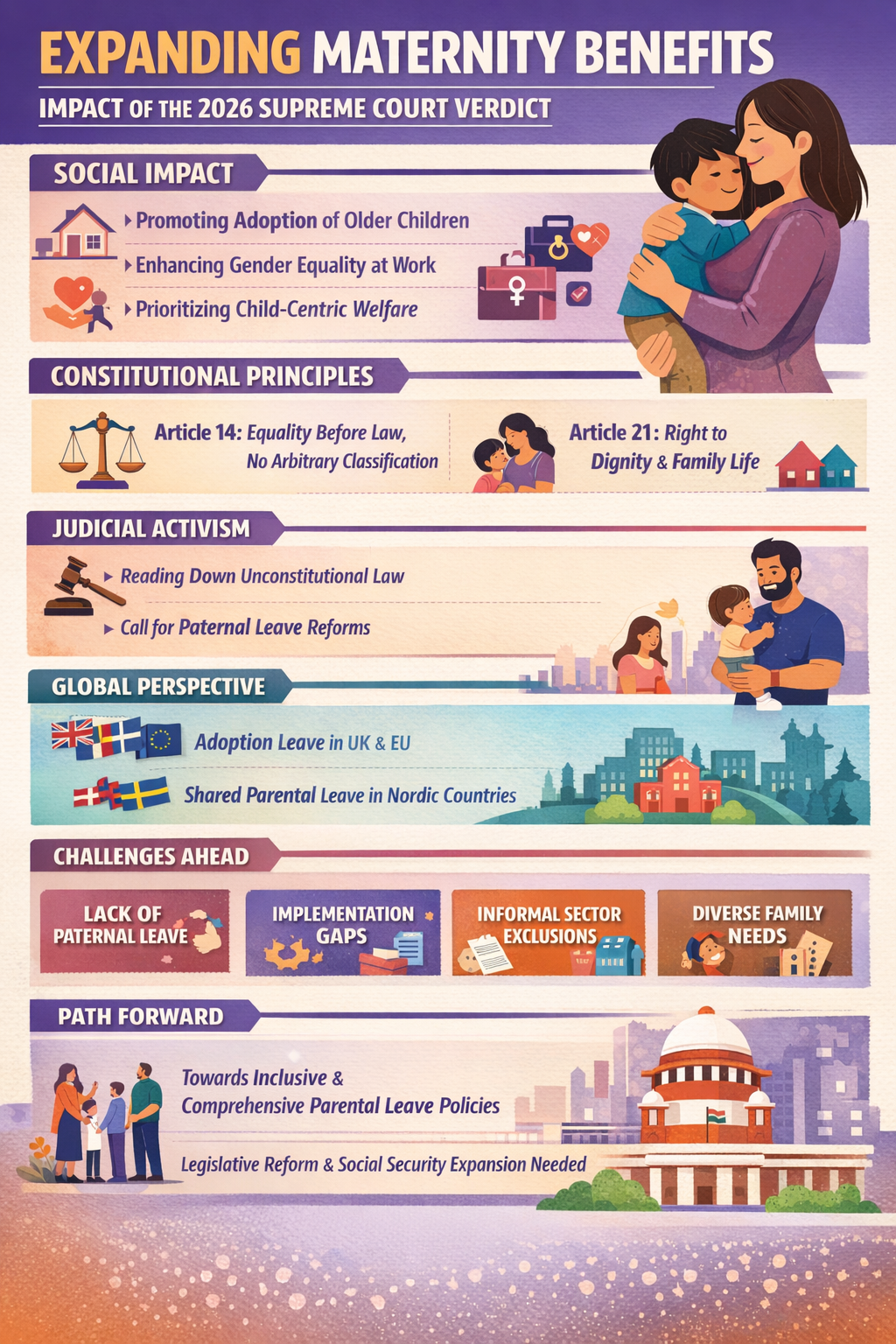
Moreover, the decision promotes gender equality in the workplace. Women who opt for adoption may encounter further difficulties in reconciling career obligations with caregiving responsibilities. The decision guarantees maternity leave for adopted mothers, promoting their ongoing workforce engagement and mitigating systemic prejudice.
The verdict further reinforces the notion of child-centric welfare. The Court recognised that the necessity for mother care, emotional attachment, and adaptation extends beyond newborns under three months old. Older adopted children may necessitate enhanced emotional care and assimilation into the familial setting. Consequently, the decision emphasises the paramount interests of the child in conjunction with the rights of the mother.
Philosophy of the Constitution and Jurisprudence of Equality
The ruling is strongly grounded in constitutional principles, including Articles 14 and 21. The idea of reasonable categorisation under Article 14 mandates that any classification must be founded on intelligible differentia and must possess a rational nexus to the objective intended to be accomplished.
In the present matter, the Court determined that:
- The classification based on the age of the adopted child lacks clear distinctions.
- Even if such a distinction were present, it bore no reasonable nexus to the objective of maternity benefits.
- This rationale exemplifies the Court’s unwavering method in invalidating capricious classifications that sustain injustice.
Article 21 broadened the interpretation of the right to life to encompass dignity, familial ties, and the right to cultivate connections. The refusal of maternity benefits was perceived as an infringement on these essential facets of human existence.
The verdict implicitly addresses substantive equality, which transcends formal equality to tackle systemic disadvantages. The Court has acknowledged the distinct obstacles encountered by adopting moms, progressing towards a more inclusive and equitable legal framework.
Convergence of Labour Law and Social Security
Maternity benefits constitute an essential aspect of labour welfare and social security. The shift from the Maternity Benefit Act of 1961 to the Social Security Code of 2020 signifies the State’s endeavour to streamline and modernise labour legislation.
The retention of obsolete restrictions, such as the age limits for adoptive mothers, underscores the constraints of legislative reform. The Supreme Court’s intervention illustrates the judiciary’s function in maintaining the alignment of social welfare legislation with constitutional principles.
The decision emphasises the necessity of universalising social security benefits. The Court has strengthened the notion of comprehensive social security by expanding maternity benefits to a wider range of women.

Comparative Analyses of Parental Leave
Many countries worldwide have implemented inclusive parental leave policies that extend beyond biological motherhood.
In nations like Sweden and Norway, parental leave is distributed between both parents, fostering gender equality.
In the United Kingdom, adoptive parents are granted adoption leave akin to maternity leave.
In the United States, while federal law offers restricted unpaid leave under the Family and Medical Leave Act (FMLA), numerous states have implemented paid family leave laws.
India’s legal system has traditionally fallen short in acknowledging adoptive and non-biological parenting. The Supreme Court’s 2026 decision aligns Indian law with international standards by recognising the equivalent significance of caregiving, regardless of biological ties.
Obstacles and Prospective Pathways
Notwithstanding the progressive character of the decision, numerous obstacles persist:
Absence of an Inclusive Parental Leave Policy
India currently lacks a comprehensive structure for parental leave that encompasses both mothers and fathers. The lack of legal mechanisms for paternity leave reinforces gendered caregiving responsibilities.
Discrepancies in Implementation
Despite the legal recognition of maternity benefits, their implementation is inconsistent, especially within the informal sector. A significant number of female workers are deprived of legislative safeguards owing to insufficient awareness or enforcement measures.
Requirement for Legislative Reform
The Court has interpreted Section 60(4), but a thorough legislative reform is essential to formalise the principle and remove ambiguity. Parliament must undertake proactive measures to ensure the Social Security Code conforms to constitutional requirements.
Incorporation of Diverse Family Arrangements
Further reforms must take into account:
- Single parents
- LGBTQ+ families
- Surrogacy arrangements
- Foster care systems
Broadening the parameters of parental benefits to encompass these categories would establish a more inclusive and equal framework.
The Judiciary’s Role in Promoting Social Welfare
The judiciary has consistently served as a protector of social welfare rights in India. By fulfilling its interpretative function, it has broadened the parameters of labour rights, gender equality, and social security.
Regarding maternity benefits, the Court has:
- Maternity leave is acknowledged as an essential component of dignity and equality.
- Expanded benefits for non-conventional types of mothers.
- Guaranteed that legislative measures do not serve as instruments of exclusion.
The current judgment perpetuates this legacy by resolving a significant deficiency in the law and reinforcing the judiciary’s dedication to social justice.
Conclusion
The decision of the Supreme Court in Hamsaanandini Nanduri v. Union of India signifies a significant advancement in the development of maternity rights in India. The Court has reaffirmed the principles of equality, respect, and inclusion by declaring the age-based restriction on adopting mothers unlawful.
The ruling rectifies a legislative inconsistency and demonstrates a profound constitutional dedication to acknowledging all types of fatherhood. It harmonises legal standards with societal realities and fortifies the structure of social security.
The decision paves the way for future reforms, notably the acknowledgement of paternal leave and the broadening of parental benefits to include diverse family arrangements. As India progresses as a constitutional democracy, such decisions are vital in maintaining the law’s responsiveness, humanity, and justice.

 Trial by Social Media: Public Shaming, D...
 Governors’ Address to State Legislatur...










 WhatsApp





