
Table of Contents
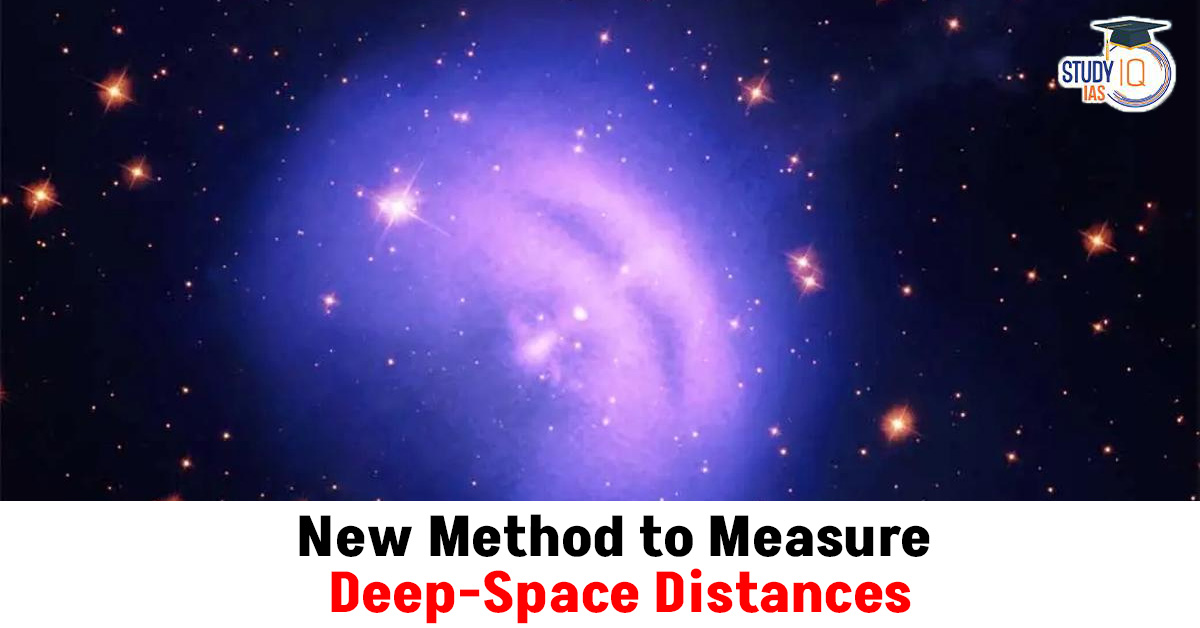
Context: Indian astronomers have proposed a new technique to estimate distances in deep space using pulsars, combining dispersion and scattering effects in radio signals, improving accuracy in regions with complex interstellar plasma
Earlier Method: Dispersion Measure (DM)
- Concept: Distance estimated from Dispersion Measure (DM) — delay between arrival of low-frequency and high-frequency radio waves caused by free electrons in the interstellar medium.
- Working Principle: More distant pulsars pass through more ionised plasma, increasing electron count along the line of sight, thus it has larger signal delay.
- Limitation: DM depends on models of electron distribution in the Milky Way, which are often uncertain in complex plasma regions (e.g., Gum Nebula).
New Method: Combined Dispersion and Scattering
- The new method combines Dispersion Measure (DM) with scatter broadening of pulsar signals.
- Scattering Effect: Irregular plasma turbulence causes radio waves to travel through multiple paths, producing signal smearing and brightness variation (scintillation).
- Joint Modelling: Scientists iteratively adjusted models until both dispersion delay and scatter broadening matched observations, giving a more accurate pulsar distance.
- Observational Study: Applied to 10 pulsars near the Gum Nebula, revealing that the Vela pulsar lies behind the nebula’s front shell.
Applications
- Improved Distance Measurements: Provides more accurate distance estimates in plasma-rich regions of the Milky Way.
- Mapping Interstellar Medium: Helps identify turbulent plasma layers and electron density distribution in the galaxy.
- No strict distance limit: Unlike parallax techniques, the method has no strict distance limit, potentially enabling measurements for objects beyond the Milky Way (e.g., fast radio bursts).
- Pulsar Timing Experiments: Improves precision in pulsar timing arrays used for gravitational wave detection.
| About Pulsars |
About the k-Factor
|

 Regulatory Issues in India’s Nuclear P...
 Elephanta Island Excavations: New Discov...
 Trade Receivables Discounting System (TR...













 WhatsApp





