
Table of Contents
The Dark Eagle Hypersonic Missile System, officially known as the Long-Range Hypersonic Weapon (LRHW), represents a major leap in modern military technology. Developed by the United States Army with integrated testing alongside the US Navy, Dark Eagle is designed to deliver rapid, precise, and hard-to-intercept conventional strikes against high-value targets. As global competition in hypersonic weapons intensifies, Dark Eagle has emerged as a cornerstone of America’s conventional prompt strike capability.
This article explains the Dark Eagle hypersonic missile system, its features, speed, range, flight profile, and its broader implications for global security.
What is the Dark Eagle Hypersonic Missile System?
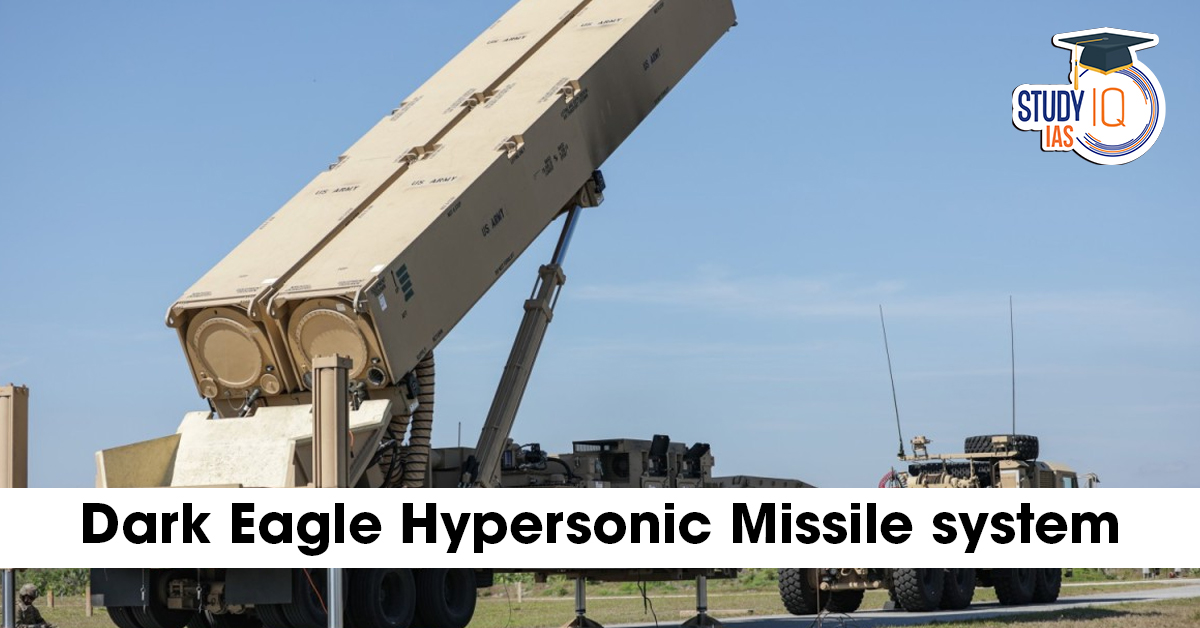
Dark Eagle is a ground-launched hypersonic missile system developed for the US Army. Unlike nuclear ballistic missiles, it is a non-nuclear, conventional weapon intended to strike strategic and time-sensitive targets at extreme speed.
The system combines a powerful rocket booster with a highly manoeuvrable hypersonic glide vehicle, enabling it to evade most existing air and missile defence systems. Recent integrated testing by the US Army and US Navy has brought the system closer to operational deployment.
Why Dark Eagle is Important in Modern Warfare
Hypersonic weapons travel at speeds greater than Mach 5 and can manoeuvre unpredictably during flight. This makes them extremely difficult to track and intercept using traditional missile defence architectures.
The United States accelerated the Dark Eagle programme to:
- Maintain strategic deterrence against peer competitors
- Counter Anti-Access/Area-Denial (A2/AD) strategies
- Enable rapid, precision conventional strikes without nuclear escalation
- Match hypersonic advances made by China and Russia
Dark Eagle fills a critical capability gap by offering speed, accuracy, and survivability in contested environments.
Key Features of the Dark Eagle Hypersonic Missile System
1. Long-Range Strike Capability
The Dark Eagle LRHW has a maximum range of up to 2,735 km, allowing it to conduct deep-strike operations far beyond conventional missile systems. This extended range enables the US to hold adversary assets at risk from stand-off distances.
2. Common Hypersonic Glide Body (C-HGB)
At the heart of the Dark Eagle system is the Common Hypersonic Glide Body (C-HGB).
- It is an unpowered glide vehicle
- Capable of travelling at speeds of up to Mach 17
- Highly manoeuvrable with an unpredictable flight path
Once released from the booster, the glide body skims through the upper atmosphere, making interception extremely difficult for existing air defence systems.
3. Advanced Flight Profile
Dark Eagle uses a solid-fuel, two-stage rocket booster to launch the hypersonic glide vehicle.
The flight sequence includes:
- Launch and boost phase to near-space altitudes
- Separation of the glide body
- Atmospheric re-entry
- Sustained hypersonic glide and manoeuvre toward the target
This trajectory keeps the missile outside the engagement envelope of most current missile defence systems, including advanced surface-to-air missiles.
4. Mobile Ground-Based Deployment
Dark Eagle is deployed through mobile ground-based batteries, enhancing survivability and flexibility.
Each battery includes:
- Transporter Erector Launchers (TELs)
- Command and control vehicles
- Support and logistics vehicles
Mobility allows rapid deployment, dispersal, and concealment, reducing vulnerability to enemy pre-emptive strikes.
Who is Developing the Dark Eagle Missile?
The missile and associated technologies are being developed by Lockheed Martin and Northrop Grumman, two of the United States’ leading defence contractors. The programme benefits from joint Army–Navy collaboration, ensuring interoperability across services.
Strategic Significance of Dark Eagle Hypersonic Missile
Penetrating A2/AD Defences
Dark Eagle is specifically designed to neutralise heavily defended zones protected by integrated air defence systems, electronic warfare, and long-range missiles. Its speed and manoeuvrability allow it to bypass layered defences.
Strengthening Conventional Deterrence
By offering a non-nuclear yet strategic-level strike option, Dark Eagle strengthens deterrence while lowering the threshold for nuclear escalation. It provides decision-makers with credible conventional alternatives in crises.
Joint Force Integration
Recent integrated testing by the US Army and Navy highlights a shift toward joint operational concepts, enabling coordinated strikes across land, sea, and potentially space-based domains.
Dark Eagle vs Other Hypersonic Weapons
Globally, hypersonic weapons are becoming central to military planning:
- Russia fields systems such as Avangard, Kinzhal, and Zircon
- China has operationalised the DF-17 hypersonic missile
- United States is advancing Dark Eagle as its primary land-based hypersonic strike system
While exact performance comparisons remain classified, Dark Eagle is optimised for precision, survivability, and interoperability, rather than sheer speed alone.
Implications for Global Security
The deployment of the Dark Eagle hypersonic missile system has far-reaching consequences:
- Shortened decision-making timelines in conflict scenarios
- Increased risk of miscalculation and escalation
- Reduced effectiveness of traditional missile defence systems
- Acceleration of a global hypersonic arms race
- Challenges to existing arms control and strategic stability frameworks
These developments are pushing major powers to invest in space-based sensors, advanced radar systems, and next-generation missile defences.
Dark Eagle Hypersonic Missile and the Future of Warfare
The Dark Eagle LRHW symbolises the shift toward speed-dominated warfare, where reaction time becomes as important as firepower. As hypersonic weapons mature, they are likely to reshape doctrines related to deterrence, defence, and escalation management.
For the United States, Dark Eagle provides a crucial capability to operate in contested environments, reassure allies, and deter adversaries without immediate reliance on nuclear weapons.
Conclusion
The Dark Eagle Hypersonic Missile System is a transformative addition to the US military’s arsenal. With its extreme speed, long range, manoeuvrability, and conventional precision strike capability, it represents a new class of weapons designed for 21st-century great power competition.
As hypersonic technology continues to evolve, Dark Eagle will play a defining role in shaping future conflict dynamics, strategic deterrence, and global security architecture.
 Electric Cooking Solutions in India: Wor...
 CAPF Bill 2026: Formalising IPS Deputati...
 Chhattisgarh Freedom of Religion Bill 20...











 WhatsApp





