
Table of Contents
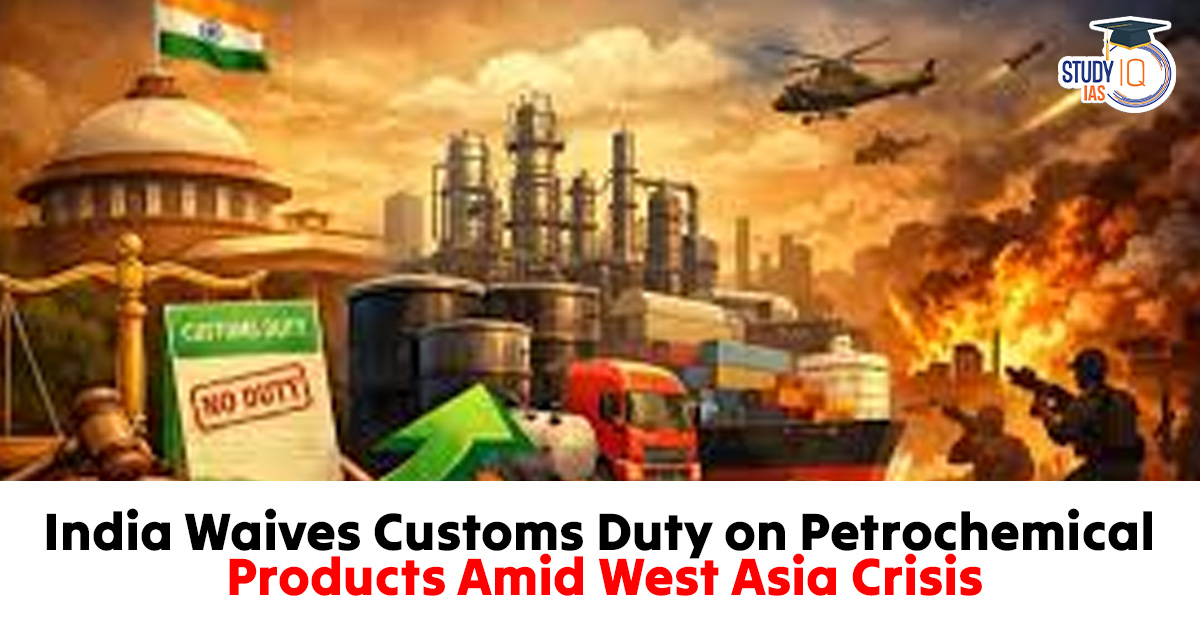
Context: Faced with supply disruptions, rising crude prices, and industrial stress across textiles, pharma, and automobiles, New Delhi has announced a sweeping three-month customs duty exemption — a targeted but temporary lifeline for India’s import-dependent chemical ecosystem.
| Important Facts | |
| ~40 | Petrochemical products exempted from customs duty |
| ₹1,800 Cr | Estimated government revenue foregone |
| June 2026 | Deadline for the exemption window |
What Are Petrochemicals and Why Do They Matter?
Petrochemicals are chemical compounds derived from crude oil and natural gas. Far from being niche industrial inputs, they are embedded in the fabric of everyday life, from the PET bottles that carry drinking water to synthetic fibres in clothing, to packaging materials, paints, adhesives, and pharmaceutical intermediates.
In India, the petrochemical industry sits at the intersection of energy policy, industrial strategy, and trade. It feeds directly into sectors such as textiles, automobiles, pharmaceuticals, agriculture (fertilisers), packaging, and consumer goods. A disruption in petrochemical availability does not stay contained — it cascades rapidly across downstream industries, raising costs and constricting output.
Key Products in Scope
Major product categories covered by India’s petrochemical sector include polymers (polyethene, polypropylene), synthetic fibres, chemical intermediates (styrene, toluene), and industrial chemicals like methanol and ammonia.
Also Check: India’s Vulnerability to Oil Price Shocks
The Announcement: What the Government Has Done
The Union government has granted a full customs duty exemption on approximately 40 critical petrochemical products. The measure is explicitly framed as temporary, running until June 30, 2026, and targeted, applying to specific inputs that have faced acute supply stress rather than a blanket sectoral relief.
The list of exempted products includes:
Methanol, Acetic Acid, Toluene, Styrene, Polypropylene, Polyvinyl Chloride (PVC), Polycarbonates, PTA (Purified Terephthalic Acid), MEG (Mono Ethylene Glycol)
In parallel, the government has increased the allocation of commercial LPG to industries, addressing the feedstock crunch that has been a structural trigger of the current supply stress.
Also Check: Global Tensions and India’s Economy
The Crisis Behind the Policy: Geopolitics Meets Supply Chain Fragility
India imports a significant share of its petrochemical requirements, with West Asia — particularly Iran and Gulf states — serving as a dominant sourcing hub due to geographic proximity and long-standing trade relationships. The ongoing geopolitical tensions in the region, including conflicts involving Iran, have hit India on two fronts simultaneously.
First, rising crude oil prices have directly elevated the cost of petrochemical feedstock. Second, disruptions to shipping routes in and around the Red Sea and Strait of Hormuz have created delivery delays and logistics bottlenecks, further inflating landed costs of imports.
Sectoral Impact: Who Stands to Benefit?
The duty exemption is expected to provide tangible near-term relief across several industrial sectors:
- Textiles: Lower input costs for PTA and MEG will ease pressure on synthetic fibre producers and garment exporters facing global competition.
- Automobiles: Improved availability of paints, coatings, and chemical inputs will help reduce production delays and input cost inflation in vehicle manufacturing.
- Pharmaceuticals: Stabilisation of supply for chemical intermediates used in API manufacturing will reduce import dependency risks for the drug industry.
- Packaging & Plastics: Reduced polymer costs will benefit FMCG packaging, food processing, and consumer goods sectors with downstream price moderation.
The government has indicated that the relief is expected to moderate end-consumer prices, not merely benefit industrial producers. In a high-inflation environment, this consumer dimension adds political weight to the decision.
The Road Ahead: Building a Resilient Petrochemical Sector
- Duty relief is a useful short-run stabiliser, but India’s petrochemical sector requires a longer-term strategic framework to reduce structural vulnerabilities. Analysts and industry bodies have broadly converged on several priorities.
- Expand domestic production capacity — India needs to scale up domestic crackers, aromatics complexes, and downstream polymer units to reduce dependence on imports for commodity chemicals.
Diversify import sourcing — Over-reliance on West Asia creates geopolitical concentration risk. Sourcing agreements with North America, Southeast Asia, and Russia can provide supply chain redundancy.
| Related Articles |
| Key Takeaways from the Expanding Conflict in West Asia |
| Historical Background of West Asia Conflict |
| Neighbourhood Diplomacy and West Asia Challenge |

 Rebate of State and Central Taxes and Le...
 Remission Power of the Governor, Article...
 UNIFIL (United Nations Interim Force in ...













 WhatsApp





