
Table of Contents
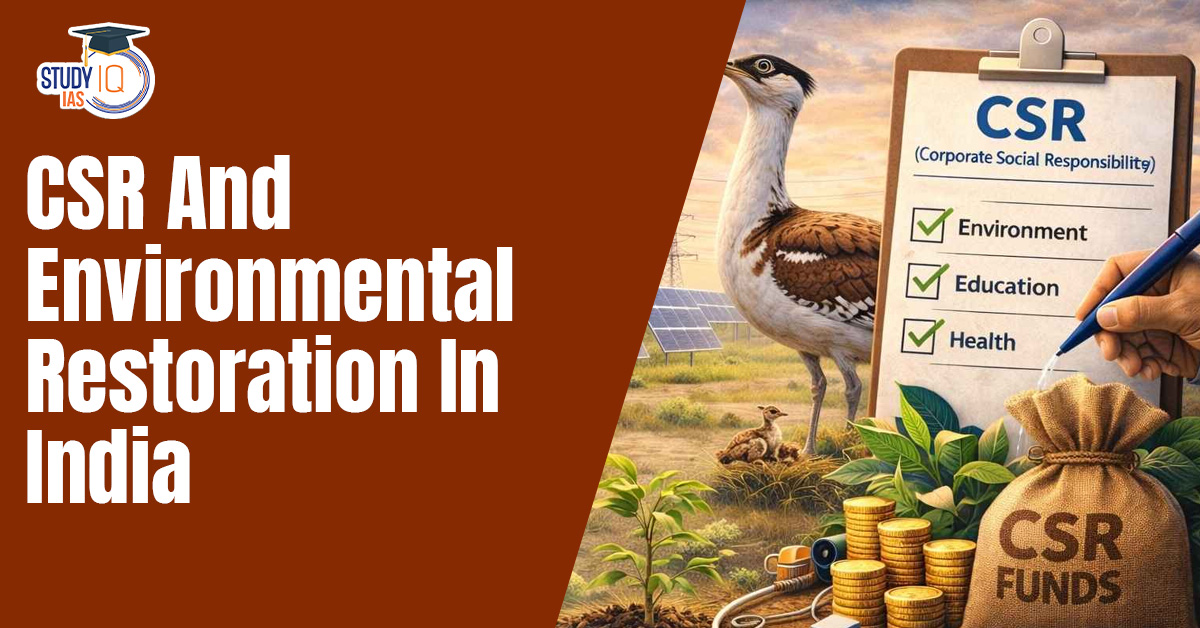
Context: While India was a global pioneer in mandating Corporate Social Responsibility (CSR) through the Companies Act, 2013, environmental funding remains a neglected ledger.
Issues and Challenges with CSR in Environmental Sector
Structural Gaps in CSR Allocation
- Human-Centric Bias in CSR Allocation: A significant majority of CSR funds in India are directed toward social sectors, with education receiving approximately 38% and healthcare around 22% of total spend. In contrast, the environment receives only 7–9% of the funding.
- Visibility vs. Ecological Impact: Corporate entities often prioritise “optics-driven CSR,” such as high-profile awareness campaigns or renewable energy projects that offer immediate branding value.
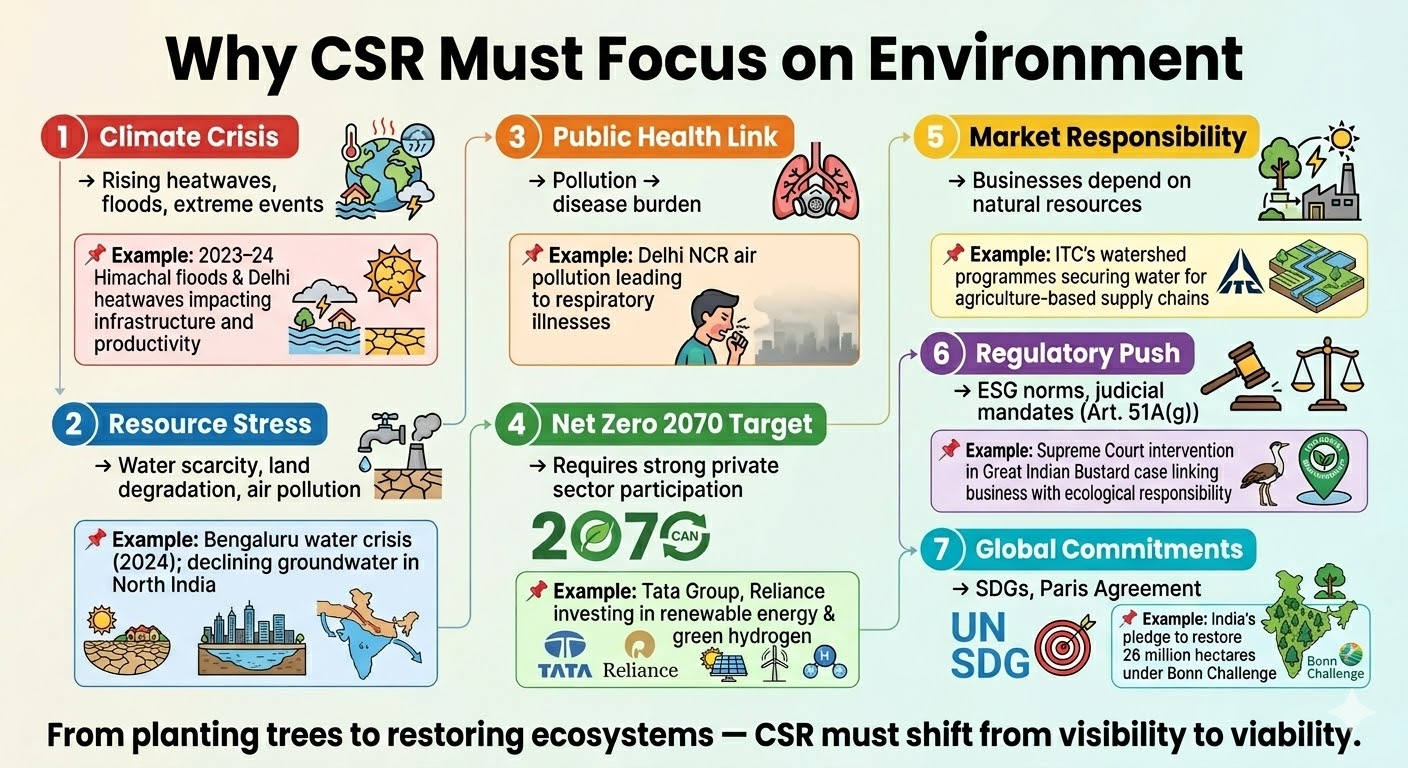
- Low Private Sector Contribution: Under the global Bonn Challenge, India has committed to restoring 26 million hectares of degraded land by 2030; however, of the approximately 9.8 million hectares restored so far, the private sector’s contribution stands at a negligible 2%.
Technical and Execution Constraints
- Technical and Institutional Capacity: Most CSR implementing agencies currently lack the scientific and technical capacity to execute specialised environmental interventions effectively.
- Miyawaki pitfall: The Miyawaki method’s emphasis on rapid growth and corporate visibility often overlooks native biodiversity, resulting in superficial greening that disrupts local ecosystems rather than achieving functional forest restoration.
- Urban Bias in Project Selection: There is a pronounced geographical imbalance in CSR activity, with initiatives heavily concentrated near corporate offices and urban or peri-urban areas.
Judicial Oversight: From Charity to Constitutional Obligation
- Judicial intervention has transformed environmental protection from a voluntary act of “charity” into a binding constitutional obligation.
- This shift strengthens the principles of sustainable development and intergenerational equity, ensuring that present-day corporate activities do not compromise the needs of future generations.
Examples
- The GIB Case: In a landmark move, the Supreme Court of India highlighted the severe ecological damage caused by infrastructure and energy projects in the habitats of the Great Indian Bustard (GIB).
- Invocation of Article 51A(g): The judiciary reinforced the Fundamental Duty to protect the environment by invoking Article 51A(g) of the Constitution.
- The Court established that the right to do business is inherently linked with ecological responsibility, making the restoration of nature a core part of the corporate mandate.
Way Forward: Towards Ecosystem-Centric CSR
- Redefining Success Metrics: Success must shift from the number of saplings planted to measurable ecological outcomes such as soil carbon sequestration, groundwater recharge, and biodiversity recovery to ensure genuine ecosystem resilience.
- Strengthening Institutional Collaboration: A multi-stakeholder alliance involving Forest Departments, universities, NGOs, and local committees is essential to ensure that restoration projects are both scientifically rigorous and community-supported.
- Long-Term Financial Mechanisms: Establishing Restoration Trusts or Escrow Funds can provide the sustained, multi-year financing necessary for landscape-scale ecological recovery that exceeds standard annual CSR cycles.
- Shift to Ecosystem-Centric Governance: Corporate strategy must transition from a shareholder-centric model to an ecosystem-centric approach by integrating Natural Capital accounting and Nature-Based Solutions into core business values.
| Corporate Social Responsibility (CSR) |
|
|
Read More Notes |
|
| Environment Notes | Art and Culture Notes |
| Science and Tech | History Notes |
| Geography Notes | Indian Polity Notes |
| General Knowledge | International Relation |
|
Explore StudyIQ Courses |
|

 Great Atlantic Sargassum Belt (GASB): Gr...
 China’s Global Ocean Mapping Initiativ...
 Ancient Marine Snail Discoveries in Guja...













 WhatsApp





